
With 345 US gallons of fresh water Britannia has a larger than average tankage for a sailboat, but she does have two fresh water flush heads in the bathrooms each with a washbasin and shower,there is a full galley with a dishwasher and a pressure pump with a delivery as powerful as a house. However, there was only an 11-gallon hot water tank, and hot water would run out quite quickly especially if both showers were in use at the same time.
This problem was exposed recently when we had four guests staying aboard who were unfamiliar with boats. I had to explain - tactfully of course, as is my wont - that they were not in a house and the hot water wasn't endless. I suggested that only one-morning shower should be taken at a time to allow the water to heat up again otherwise there would be a good chance of someone finishing with a cold rinse. This was embarrassing for me to have to admit because even though my 50-foot schooner has just about every mod-con that a house has - like a dishwasher, deep freeze, fridge, air conditioning, full size bathtub, 120v plugs in all rooms, etcetera, - it was woefully lacking in hot water capacity. I therefore started to look into rectifying this and I also had an ulterior more personal reason to increase the capacity – but more on that below.
Britannia’s hot water tank is the popular square Kuuma model 11841 sold by just about everyone in the marine supply business including Amazon, where I bought mine. Eleven gallons might sound a lot to boats that have the smaller 6-gallon model, but neither delivers its full capacity of hot water to a shower or sink faucet. This is because as the hot is pumped out it is replaced with cold and by the time about half the hot water is used up the remainder starts to become lukewarm. It helps to leave the electric emersion element on of course and even run the engine to compensate for this, but in a marina that is not practical every time.
 Water was heated in two conventional ways; from a 120v 1500w immersion heater element inside the tank, and by pumping very hot water from the engine through a coil inside the tank. Both methods can be used at the same time and when away from a dock Britannia’s 6.5 Kw generator was used to produce the 120 volts for the immersion heater. The engine operating temperature is 180F which is much too scoldingly hot to be used for washing or showering and must be cooled with cold water.
 All temperatures used here are in Fahrenheit.
The private motive I had to increase the hot water capacity was more complicated. Not only does Britannia have the many facilities of a house it also has a full-size bathtub in the owner’s aft cabin en-suite bathroom. Many boats of Britannia's size have bathtubs but mine is not just any old tub, it has eleven power jets all around the tub making it a hot-tub spa. The idea is to fill the bath with lovely hot water and have a long soak, but 11-gallons of even scalding hot water was never enough to fill a nice 55 gallon hot bath. Solving this problem was more important to me than the shower issue because we hardly ever had guests staying over compared to me enjoying a British pint in a massaging hot-tub after a hard day's work on my boat. For this I needed to generate 55-gallons of water at about 104F and if that could be achieved the shower problems would solve themselves.
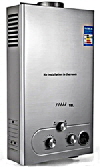 Backtracking a little: I had bought a conventional domestic tub to which I had the makers fit eleven jets and a pump to shoot hot water through them. I have had hot-tubs in houses but never on a boat, so I relied on the makers to supply the correct electric heater. However, they supplied a heater that was intended to keep the water warm only after it had been already heated from a house hot water tank and the heater they sold me was not powerful enough to heat the water from cold to 104F. Worse: I then learned this could only be achieved with a 240v heater of considerable wattage. I then looked at propane gas heaters - also called tankless water heaters, but those that are capable of supplying continuous hot water in volume at 104F are quite big and need to vent their hot exhaust to the atmosphere. Also, the boat only has one propane tank that would quickly be used up so they were no good and I was now back at the drawing board…
THE SOLUTION.
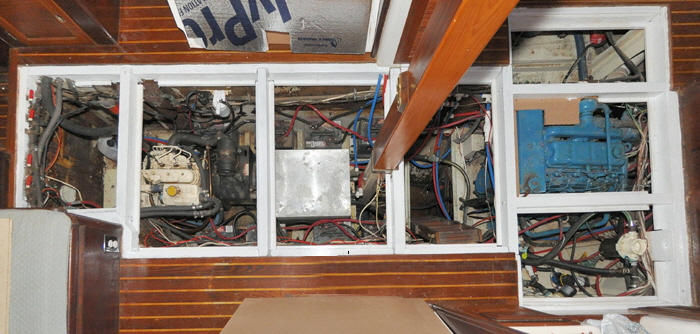 Britannia has a long keel full-volume hull with an amazing 5-foot deep equipment-bay bilge stretching 27-feet from the stern gland to the foreword cabin and housing all the machinery including the water heater. To easily solve the shower capacity issue I decided to install a second 11-gallon water heater and I hoped that with two heating elements and double the volume it might also be enough to heat enough water for the bathtub.
I lifted the empty existing tank by using a tackle strapped to the ceiling handrail supports then I built a new platform and positioned a new heater on top of the old one and piped them together in series. It was a welcome change to be able to work on the two tanks while they were sitting on the saloon floor, instead of having to hang upside down in the equipment bay like a blind bat in a cave.
The engine hot water pipe was connected to 'hot water in,' in the lower tank, then to the top heater and back into the engine, thus forming a continuous hot water loop from the engine with a stop-valve on the pipe to close off the circuit to allow the engine to come to operating temperature more quickly. This done both tanks were then lowered back into position.
 The next question was how to increase the temperature inside the two tanks, so that the water would be hot enough for a bath preferably without running the noisy engine when in a marina. Britannia has two shore-power receptacles supplying two separate 120 volt distribution panels. This splits the load of some of the higher electrical draws like the twin AC units and the dishwasher. I wired each tank emersion heater separately through a 15am breaker on each panel. The advantage in wiring the two elements separately is that if one fails - as they often will after years of use - water could at least be heated in the other tank. Another advantage was to be able to disconnect the bottom tank heater by simply switching its breaker off when we didn’t need the full 22 gallons of hot water. To heat enough water for a 55 gallon bath, both tanks needed to be heated to much higher temperature than the 140F thermostat restriction on each tank – but how much higher? The
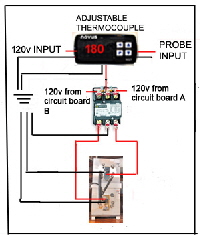
  answer I found in an adjustable thermocoupler temperature controller that I bought from IOThrifty Inc, (service@iothrifty.com), This neat little device can control whatever temperature I wanted in both tanks through a double pole-double throw relay, so I removed the Kuuma thermostats completely to allow the thermocouple to take over. I installed the thermostatic probe in place of the top tank drain tap that gives an accurate reading for the top tank outlet temperature but not the bottom one. In this bottom tank I fitted an automobile temperature gauge with a capillary wire probe which reads that tank’s temperature. Flexibility is the name of the game on a boat with so much electrical demand.

 Note: Twin tanks don't have to be placed on top of each other like mine, they can be located anywhere but they should be close enough to minimize heat loss through the connecting water pipes that should be lagged (insulated) using split foam tubing.
I used the existing wiring from each electrical panel to the immersion heater on each tank. This enabled me to switch one tank off if I only wanted to heat enough water in one tank. The complete wiring diagram shows my setup and can be modified according to each boat’s configuration.
THE DAY OF RECKONING. It was finally time to test my amateur hydro-electrical engineering theories. Firstly using only the emersion heaters I dialed the thermocouple to peak at 180F. This would give me 22 gallons of scalding hot water, that I would then cool down with cold to get my 104F bath temperature. This was pure guesswork but I now had the ability to modify the hot temperature if necessary. The distribution panel meters showed a total discharge of 23 amps for both heaters and it took an hour and a half to heat the water to 180F in both tanks. I then opened both the hot and cold bathtub faucet and watched as scalding hot water crept slowly up the sides of the bath and as the tub became nearly half full my “rubber duck” floating spa temperature gauge showed 175F which is still much, much too hot to even test by hand. Slowly the temperature of the water coming into the bath began to drop as it filled the bath but I still needed to run some colder water in until the temperature was reduced to 104F.
I climbed into a bath full of luxuriously warm water and pressed the button to switch the pump on to activate all the jets, then I celebrated with a pint of Boddington’s Pub Ale from a glass holder I had fitted on the wall. The bath pipes and jets had been insulated with foam when it was built, so I was very pleased to find the temperature did not drop much for a nice half hour relaxing soak.
A few days later I decided to see how long it would take for the engine to warm the water on its own enough for a hot bath. It took half an hour for the engine to reach operating temperature of 180F whereupon I opened the valve to allow hot engine water to be pumped through both tank coils - and I had to remind myself the engine was now having to heat 22-gallons. The whole process took three hours by which time I had 22-gallons of water at 178F reading on my new temperature gauges and after running it all into the bath it was cooled the same as with the emersion heaters.
This engine heating method was far too slow to use in a marina but when we have been out on the water and motor back to our berth the water is usually piping hot solely through the engine’s calorific heat transfer with enough hot water for a bath or virtually endless showers. When we stay on the boat for a weekend in the marina and we don’t plan on running a bath I adjust the controller to stop at just 100F on one tank only, which automatically maintains constant hot water for showers and dishwashing.
 A secondary issue also had to be addressed – how to drain 55-gallons of bath water that would have taken ages using the shower drain? I drained the tub by simply placing my portable deck-wash in the bath and the discharge end hose passing through the portlight and over the side, that emptied the bath in only 8-minutes Sometimes the simplest method is the best.
It has been suggested - by my non-boating friends - that it would have been a lot easier to have just bought a hot-tub for my house which is only a few minutes from the boat. The easy bit is definitely true, but that would not have solved the boat’s shower problem, and how would I then have a nice soak when visiting other places on a cruise?
It has also been mentioned that a 50-foot schooner is not the average size of most peoples sailboats, so how can anyone install a full size bath in a 30-footer? For this, ingenuity is the name of the game. Most boats of nearly any size have full length bunks and if there is room beneath for the depth of a bath there is room for a tub and when not in use the bath can be used as a storage tub. Carpe Diem!
