
There can be few instruments on a boat more important than that which shows the amount of fresh water in the tanks. If there is one thing you need to know on a cruising boat especially if it doesn't have a water-maker it is an accurate indication of how much drinking water you have.
Britannia has two stainless steel water tanks amidships one each side. The shape follows the curve of the hull and is therefore somewhat triangular in cross section tapering to a point at the base. This makes accurate calibration difficult by any type of measuring system because when the water is half way down the vertical side of the tank the actual capacity is much less than half full, in fact it is only about 1/3rd full in my tanks. This physical fact would even apply to the simplest and probably the oldest method of measuring water capacity, with a transparent sighting tube up the outside of the tank. I considered fitting this method but since my tanks are enclosed by bulkheads all round I couldn't easily drill a hole in the bottom of the tanks to install plumbing fittings and a clear plastic tube. Even if I had managed to fit a sighting tube in each tank I still would have had to physically calibrate and mark the tube at various capacity levels, and to read a sighting glass would mean lifting the floorboards on each side every time.
 The system that was fitted when I bought the boat was pneumatic (air) operated, that was supposed to read the air pressure differential as the water level in the tanks varied. Basically it is a simple concept having only two components and no electrics - just the job for a cruising boat you might think. A rigid plastic pipe mounts vertically inside the tanks from the top to the bottom and is connected to a gage by a thin flexible nylon tube. As the water level varies in the tank the pressure changes in the pipe and the tube and registeres on a gage.
However, the system never worked properly from the day I bought the boat. The gage would frequently drop to zero sometimes immediately after a tank was filled to the top or sometimes slowly over a few days. The whole thing was erratic and unreliable and since there are no electronics involved I reasoned that there had to be an air leak somewhere, probably in the connections between the tank pipe and the gage or even in the gage itself. I therefore sealed the connections with epoxy but still the gages still failed. I then took the back off the gages and examined the delicate clock-like mechanism in minute detail. I tightened up the tiny diaphragm mounts and inspected the moving parts—all to no avail. I also conducted numerous water tests by immersing everything in a bathtub looking for air bubbles to identify a leak. Finally I even submerged the gage itself but no air leaks were visible. To make a diagnosis even more difficult the original manufacturers had gone out of business and nowhere to be found on the Internet. The chances of finding any information, help or spare parts was therefore slim. I decided to look for a reliable alternative
The shape of the tanks meant that a simple electrical swing-arm float mechanism would not register accurately because when the arm is half way on its ark and the gage registers half full it will not be correct. There was also a baffle in my tank that would obstruct a swing arm system.
I found a product called The Tank Tende, that works on the same pneumatic principal as my original equipment. To overcome tank shape problems their gage is calibrated in inches of water and it is for the buyer to determine how many inches corresponds to any particular capacity. The manufacturers told me that most owners mark their gages with an ink marker at the quarter, half and three quarters point. This would be accurate, but from my experience I was concerned about pressure leaks in any air system. I would also have to buy two gages one for each tank at a cost of $570.

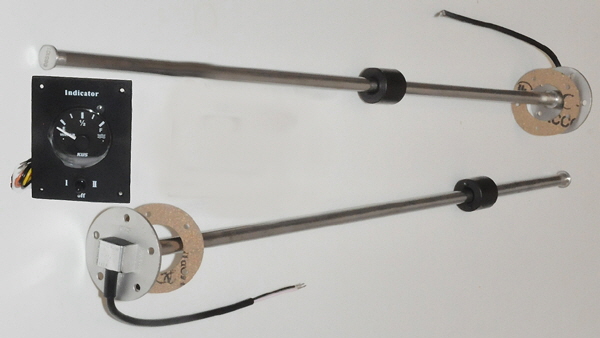
 I then found an electrically operated device made by Wema/Kus USA. Fort Lauderdale, Florida. www.wemausa.com/sensors/level-FuelWater. This also uses a vertical tube in the tanks but instead of working on air pressure it has a float which travels up and down the tube activating electrical sensors inside the stainless steel tube that are then read by a gage. The tube's top flange fitting also matched the standard SAE (Society of American Engineers) five hole pattern in the top of my tanks so I would not have to drill and tap any new mounting holes. The Kus technical department were extremely helpful and told me they could actually custom calibrate the tank tube senders to my exact tank shape. All they needed was a drawing showing where the various levels were in the tank. This would ensure the gage would read the correct capacity of water in the tank throughout the whole range. Info@kus-usa.com. Kus also has a gage mounted on a panel with a switch to read either port or starboard tank. In the middle the switch is off and no electric current is being used. However, for this gage to register accurately for twin tanks both sides have to be the same shape which Britannia’s are. The gage also lights up when reading a tank and there is a choice between red and yellow illumination
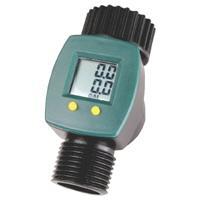 The first test I needed to do was to find out exactly how much water the tanks actually held. I drained both sides by running all the water out through the galley and bathroom faucets, then I re-filled them using a flow meter fitted to the water hose that I bought from Amazon.com for $14.96 (part # P3-P0550 ). The actual capacity turned out to be 168 US gallons each side, eight more than the makers specification.
 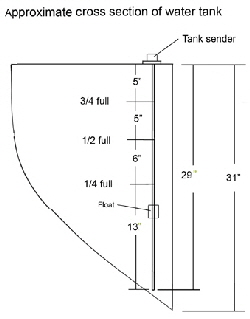 This gave a total capacity of 336 US gallons, which is 268 Imperial gallons or 1272 liters. To find out exactly how long the new tank sender pipes needed to be I measured the depth with a length of 1/4-inch diameter wooden dowel. This read 31-nches to the bottom of the tanks. The sender tube would not fit to the bottom of the tank because of the curvature so I settled for 29-inches. This was when I realized the original 21-inch long tubes could never have registered accurately anyway even when they worked properly because they were 8-inches too short and never reached anywhere near the bottom of the tank. I calculated this produced an error of about 25 gallons on each side.
Having determined the capacity I again drained the tanks and took the opportunity to flush them with two gallons of swimming pool chlorination liquid from a local pool supply shop. I then ran 42 gallons into the tanks, this being one quarter of the total capacity then physically measured the water level with my wooden dipstick. Then I added another 42 gallons and measured where half full actually was, then another 42 to bring the capacity to three quarters. I put these dimensions on my drawing that I e-mailed to the Kus engineer. I received my kit in two weeks.
 I drained the tanks once more and lowered the starboard tank sender tube through the hole in the top of the tank. This was when I discovered that the standard SAE five hole plate does not have symmetrical holes round the top of the plate, even though it looks like they are equally spaced. There is in fact only one position the plate can be fitted and to find this you have to rotate the plate and gasket until the holes all line up with the screw holes in the tank. I kept losing the location of the gasket and plate until I actually glued the gasket to the top of the tank then rotated the plate to mate with the holes. After I installed the starboard side another problem arose with the port side. As I lowered the tube into the hole in the top of the tank it rubbed against the tapered side of the tank and the top plate would not sit flat. I did some measuring and found the hole in the top of this tank had been cut 2-inches further outboard than on the starboard tank which was why the tube caught against the side of the tank. This would prevent the float sinking to the bottom as the tank emptied and give a false reading. There was nothing for it but to cut a new mounting hole in the same place as the starboard hole.
I first made a cover plate for the old hole from some 1/8-hick stainless steel and sealed that hole. Drilling the holes in the new location was tricky, because I wanted to ensure the minimum amount of swarf dropped into the water tank. As I drilled I positioned my vacuum near the bit that sucked up most of the filings. I then used a new 1¼-inch diameter hole cuter to make the center hole for the float to pass through. I lowered the sender into the tank then used the top as a guide to drill a hole through one of the five bolt holes. I tapped this hole with a 5/64-inch thread and screwed the plate tightly in place. This ensured the plate would not move while I drilled the other four holes that I then drilled and tapped these and secured the unit.
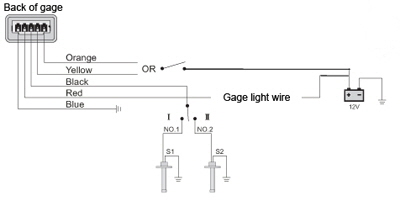 The gage was much easier to fi, but needed more than the regular round hole to mount it. It is more like a square hole which I achieved by making a template out of paper and sticking it in place with Scotch tape, then I drilled the corners and cut between them with a keyhole saw. The wiring is easy and I wired the power through a spare contract breaker on the master panel. Wiring. It was then just a matter of refilling the tanks in one quarter increments using my flow meter and checking the gage registered correctly, which is did right through to completely full.
It is now very reassuring to know that I have a reliable gage for the water capacity in each tank. This enables us to maximize and enjoy the usage according to whatever length of passage we are making