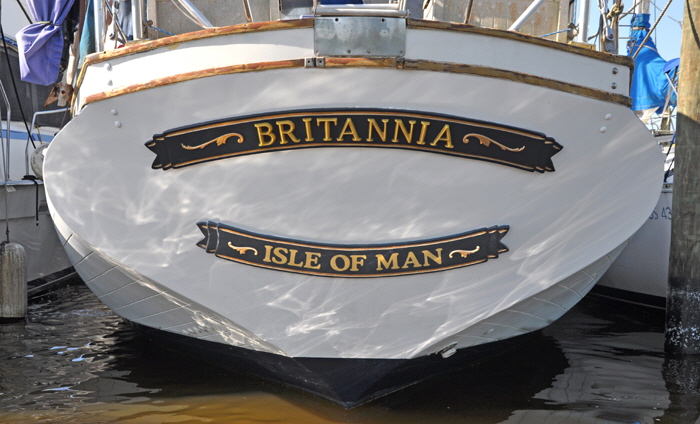
There is often more than one nautical term for the exact same thing on a boat. This includes the boards showing a boat’s name and its port of registration. The board carrying the name can rightly be called the name plate, or the stern board, or the aft board, or the transom board, because they are usually mounted on the stern, the transom, or aft section of the boat – or any combination thereof. These boards are not to be confused with quarter boards that have the ship’s name on either stern quarter, not actually on the stern. A boat will normally also have a board showing its port of registration, also known as the port-of-call, or registration board, (but not it’s actual home port, which is different), and which can also be mounted on….. well you get the drift.
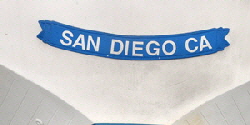 When I bought the boat it had a differnt name and was registered as an American vessel in San Diego, CA. In due course I un-documented her and re-christened her Britannia, one of the oldest name of any British ship going back to Roman times. Registration is now in the Isle-of-Man, a picturesque island in the middle of the Irish Sea between England and Ireland and part of the UK. Both boards therefore needed new letters and restoration. They are heavy solid mouldings in glassfibre resin fastened to the transom with stainless screws and lashings of adhesive caulk. It was very difficult to lever them of the back even using 3-foot long pry-bars and it left a big mess that I then had to clean up and polish the whole transom
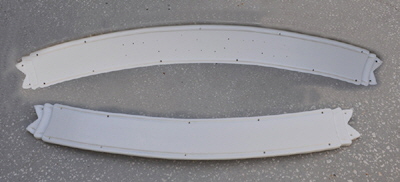 The original name was with white vinyl letters stuck on the blue painted boards. I sanded the boards with my belt sander that made short work of all the letters and smoothed out the globules of paint and varnish that had been applied over the top of each other over the years. I then undercoated both boards with two coats of two-part epoxy primer from Jamestown Distributors Total Boat range, (www.Jamestowndistributors.com), rubbing down between coats with 120 grit sandpaper. I then rolled three coats of Total Boat Flag Blue on each board—again rubbing down between coats and finishing with 250 grit, that produced a glass like hard finish.
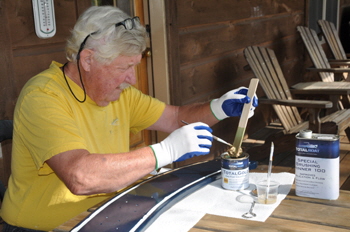
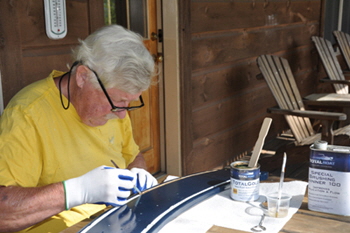 Both boards had a ½-inch wide cove stripe inlay along the top and bottom that I carefully painted with Total Boat metallic gold paint.This actually contains copper dust to give it it’s gold color and the heavier metal sinks to the bottom of the tin so it needs constant vigorous stirring as you paint. It still took four coats to produce the simulated gold leaf effect I wanted that was very striking against the dark blue background. Finally I painted two coats of Total Boat clear varnish over the whole board that further increased the shine of the gold
I didn’t think I was capable or routing Britannia’s name and port-of-call on these solid resin boards as I had routed the new trailboards I have made for the bow. So I bought nine gold colored 4-inches high moulded acrylic letters from www.buysignletters.com. At $12.00 each they were not cheap but the gold color is impregnated into the acrylic moulding and I was assured they will never tarnish. I ordered my letters to be fitted with threaded nylon bushes in the back of each letter to enable them to be fastened through the boards with 3/16-inch stainless steel set screws. The company offers other methods of fixing the letters to any type of board. There is stud mounting, wire mounting, flange mounting and outside brackets.
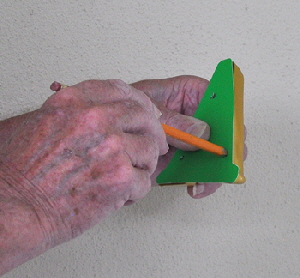 When the letters arrived I first made a template of each letter by tracing the outline on art board and cutting them out then I pressed through the template with a pencil to mark the position of the studs. Then I placed them evenly on the curved board and marked the center of the stud holes then drilled through the board with a ¼-inch drill and countersunk the back of the holes. The letters were then easy to screw to the board from the rear.
For the port-of-call board I had nine 3-inch letters cut from self-adhesive gold vinyl by a local sign shop. These were only $35.10 for the whole lot and the same typeface as the name board letters. The sign-shop also stuck them down accurately on the curved board, which I was doubtful I could do with the same precession.
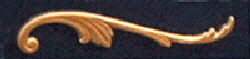 As an added adornment I bought a set of four ornamental appliqués for $16.65 from The Home Depot’s website. The two larger scrolls were for the name board and the smaller scrolls for the port-of-call board. They are made from ¼-inch thick plywood so they had to be thoroughly waterproof sealed first with epoxy undercoat then gold painted, before being glued to the boards with epoxy adhesive.
The boards were now ready to fasten back on the transom. I coated the backs with a liberal covering of Total Boat SEAL caul, that also sealed the screws—this is half the price of 3M caulking. When both boards were screwed tightly back where they came from there remained a total of 29 screw heads to be filled in and smoothed into the cove stripes then painted over with gold.
The teak trim that stretches all the way across the transom was stripped of all the eroded varnish down to the bear teak, then painted with two coats of primer and three coats of gold paint. I am a great believer in “Not spoiling the ship for two pennyworth of tar.”
