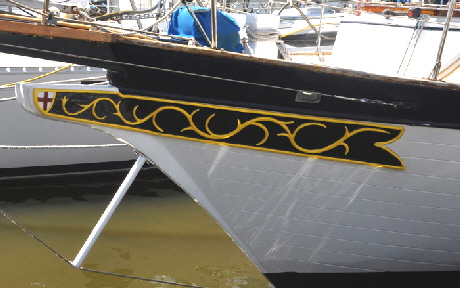

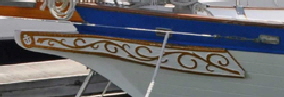
 The Down East range of American made boats had traditional clipper bows and bowsprits. They also had ornamental trailboards either side of the bow—except the boat I bought! I never could find out why she didn’t have trailboards like all the others because they certainly enhance the bow of any boat. The hull showed no signs they had ever been fitted either, so perhaps the original buyer just didn’t like them. I had searched for ages to find a pair on the web and sailing forums and even writing to other owners, but they didn’t know how they were made either. So I decided to try to make a pair myself and from photographs of other boats I estimated they were about seven feet long and a foot wide at the rear tapering forward to the beak-head under the bowsprit.
I did find out that the originals were probably made of solid glassfibre resin and very heavy then screwed to the side of the hull. They were probably cast from port and starboard moulds but making moulds would be a very time consuming method for just two trailboards. I resolved to try and carve them like the carpenters of old, but first I had to decide what material to carve them from. It had to be something which would not only be carveable and also bend to the shape of the hull and the sharper curve where the hull met the beak-head, called the bow rabbet line, (that’s not a typo). The material also needed to be impervious to seawater because a sailboats bow is constantly sprayed with seawater and occasionally completely submerged.
 Wood was the obvious material and I did have a few special tools, like routing bits and chisels to perhaps be able to carve the intricate scroll-work in a solid plank of timber. But a hardwood plank, like teak, of the size I needed would be horrendously expensive and I also felt that a couple of wooden boards either side of the bow would rapidly become just another high maintenance area. I asked numerous “pro service desk” people in do-it-yourself stores if they had any suggestions. The replies varied from, “Look down our boating equipment aisle,” to “Try West Marine down the road.” Searching the web was not much help either because all the trailboards I found were carved in wood by experts and at a price...
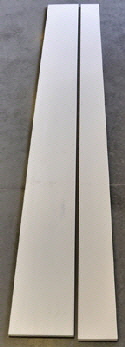
I finally found what I was looking for in solid plastic Poly Vinyl Chloride, (PVC) boards, called trimboard, made by Royal Mouldings Limited. (www.royalbuildingproducts.com). I guess the reason they were never suggested was because they were for use in “houses”, not boats – such is the limited perception of some “pro desk” advisers. They are available in various widths and lengths, all 3/4-inch thick and in white pigmentation. These planks are actually easier to work then wood because there is no grain and the material is fairly soft to cut. It is also impervious to seawater and will not rot or delaminate like wood and also easy to paint. A major advantage for my project is that PVC can also be bent when heated, to fit the shape of the hull and beak-head. The boards are smooth on one side and have a wood grain on the other and I used the smooth side outwards for my trailboards.
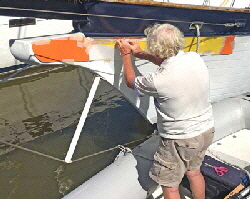 Having discovered a suitable material, (I hoped), I bought some sheets of art-board to make a template of the shape I needed. Standing in my dinghy I taped the art board to the side of the hull and beak-head then trimmed it until I had a shape similar to the original trailboards. When the template was removed and laid flat it was nothing like what I expected the shape to be and it turned out that I need a board 14-inches wide and 89-inches long.
 I then bought a 10-inch wide plank and one 5½-inches wide, both 8-feet long to try and fabricate a single trailboard. They were not exactly cheap at $61.20 for both, so I only bought planks for one in case my experiment didn’t work. I glued and clamped them together edge to edge using regular PVC cement and primer. This is the same adhesive used for gluing PVC pipes for lawn sprinkler systems, etc. I left the glue to set overnight then traced the template shape on the board then rough-cut it with my circular bench saw and rounded the edges with a belt sander with 80 grit.
At this point I would caution anyone intending to use this material to wear complete cover-alls, including a hat gloves and a mask. The dust from cutting PVC is finer than wood shavings and gets absolutely everywhere!
Having cut my shape I transcribed the scroll on to the board and wondered how best to cut the pattern. There are two ways to carve a shape or name on a board, whether it be for a house, business or boat. The shape can be cut into the board, called incised, usually in a “V” profile; or alternatively the surrounding background material can be removed leaving the shape raised up, called relief. The original trailboards were made in the relief format so I decided to copy this even though it is the much more difficult and time consuming method but I think the finished effect is more striking. For this I used my trusty hand-held router fitted with a ¾-inch wide plunge cutting bit, to remove the larger areas between the scrolls. I set the cutter depth to ½-inch that would leave ¼-inch of material in the base of the board. I also used a ¼-inch plunge bit to remove material between the narrower areas between the scrolls.
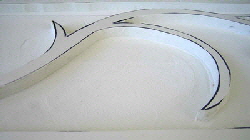 Before I started to use the router I taped my shop vac’ nozzle near the bit, to suck all the cuttings into the vac’. Not only did this minimize the dust going all over me and my garage but it allowed me to see where I was cutting. I first began routering out the larger sections between the scroll shapes and also the raised border all the way round the outer edges.
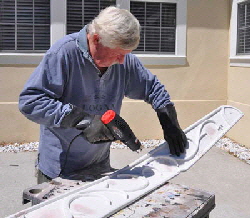 It took a complete day to route out the background material, leaving the scroll as a raised relief, and I looked like a snowman! Then I changed the cutter for a ¼-inch half round to form a rounded edge on all the scrolls. Next came the hard work, hand sanding all the relief with 120 grit paper to prepare for painting. Removing more than half the thickness of the board made it much more flexible and lighter. With all this done I drilled a row of 3/16-inch holes at 12-inch centers all round the edges to take the stainless self tapping screws I would use to fasten the boards to the hull. These holes were than counter-bored with a 3/8-inch drill to sink the screw heads enough to be able to plug the holes.
I marked the board where the rabbet bend was and decided to try and pre-bend it to make it easier to fit. I had previously practiced on some off-cuts to soften the plastic using a heat gun, so I had a rough idea how much heat was needed to make the board pliable. It was just a matter of keeping the gun moving over the a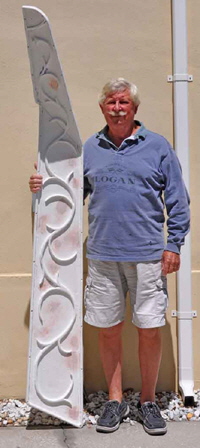 rea—wearing heavy gardening gloves I should add—and slowly the PVC softened enough to allow me to bend it. . It certainly looked an odd shape.
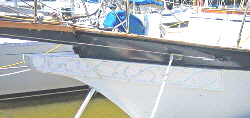 Eventually the piece was ready to trial-fit to the bow and I again used my dinghy as a work platform. This time my wife Kati joined me to hold the board in place while I fastened it. It was now pliable enough to conform to the gentle shape of the bow but I had not bent it enough to the rabbet curve. I applied more heat and was able to push it into the curve and the exact shape of the beak-head and held it with clamps while securing it with screws and
 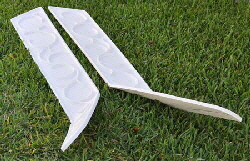 suddenly I had quite a fancy looking trailboard. PVC is really amazing material because when I removed the boards they stayed in the exact shape of the hull and beak-head.
I was so pleased with the result that I bought two more planks and fabricated the other trailboard exactly the same. Making a second board went smoother because by then my wife and I were experienced trailboard fabricators, weren’t we?
PAINTING THE BOARDS
The next job was to paint the boards. I wanted the background color to be the same as the topside stripe called Mauritius Blue, from the Interlux’ Perfection range. These paints are two-pot mixes and very hard finishes. I had used Perfection on the masts and spars years ago and they are as good now as they were then. However, since I was now painting PVC not aluminum I decided to seek advice from the manufacturers themselves. Matthew Anzardo, the Interlux marketing manager for North America was very helpful and suggested I again use their Perfection and Brightside range of paints.
Matthew first reco mmended cleaning the PVC surface with Fibreglass Surface Prep (YMA601V), then two coats of Epoxy Primekote undercoat, (404) also a two part paint. Then I could apply the Perfection background and polyurethane scroll color. The paints were bought from Jamestown Distributors. www.Jamestowndistributors.com . Included with every tin was a mixing bowl, wooden stirrer, gloves and a filter and shipping was free
Traditionally trailboard scroll-work is highlighted with gold leaf but gilding with real gold leaf is a very specialized and expensive business, well outside my skill level and budget. Fortunately, Jamestown distributors have a gold paint within their Total Boat range so I ecided to see how realistic it looked on the scrollwork of my trailboards. Gold paint is usually pigmented with microscopic granules of copper or brass, definitely not gold. Consequently the heavier metal particles will fall to the bottom of the tin and it should be shaken vigorously and then stirred before use, and stirred periodically during application. I painted three coats on the scrolls allowing two hours for each to dry and the finished result is better than I expected. I then applied the Mauritious Blue background while the boards were flat on my bench. That way, I didn’t need to mask all round the scrolls because I was able to “float” the blue up to the edges in a neat line using a flat ½-inch wide soft artists brush.
I learned something new when using the Perfection paint that I’ve been using for six years on and off. When mixing only small measures of the 2:1 mixture the curing agent always runs into the tin lid chine, where it sets so hard it’s sometimes difficult to re-open the lid next time it is used. I discovered you don’t need to even open the tin at all—ever. If you remove the round silver foil in the tin lid it reveals an orange lid with two handles. Pull this upwards and it brings a spout out from the inside. Unscrew the orange lid and pull the spout seal off, then you can easily pour as much of the curing agent as you need. Then just replace the screwed lid ready for next time. Amazingly, I could find nothing about this on the tin or in any instructions! This snippet would have been useful to know on many occasions that I have used this excellent paint. When the whole board had thoroughly dried I brushed on two coats of clear gloss varnish that further emphasized the gold and the result is stunning.
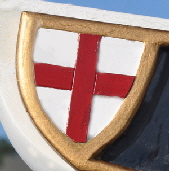
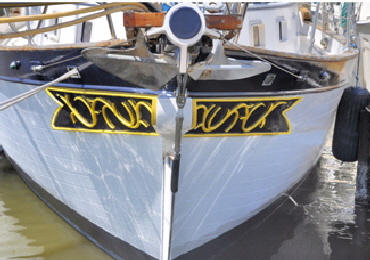 Since Britannia is British registered - like its owner, I thought I would add some heraldic symbolism to my handiwork. The red cross at the tip of the beak-heads is the Cross of St. George, patron saint of England that forms part of the Union Jack. My wife thought we should hang the boards in our house as a sort-of psychedelic artwork instead of on the boat. It did seem a pity to subject all my hard work to the sea and weather. Perhaps I’ll remove them if we eventually sell the boat.
Before attaching the boards permanently to the bow I gave the underside a liberal coat of 3M 5200 adhesive caulk also from Jamestown Distributors. It took three tubes, that helped glue the boards to the hull. I then trimmed the excess caulk and this long job was finished.
Finally I would advise not to start this job unless you have infinite patience. Making them was tedious in the extreme, first making the templates, one for each side, then routing the scrolls and painting them with three coats. then wo on the background all round the scroll. The result though is spectacular and to me well worth the cost and effort.