
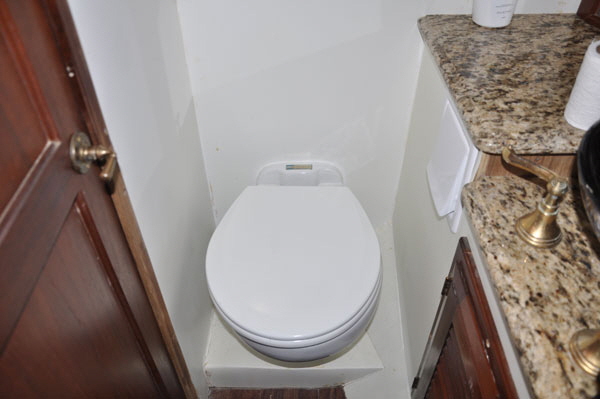
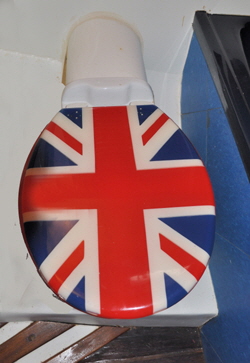
 Both of Britannia’s two heads are Raritan “Elegance” electric models that have full size seats and when installed with hidden pipework look exactly as their name suggests – elegant – which is more than can be said for most marine toilets especially the manual variety. I installed them in 2014 and they have continued to perform flawlessly thus far and a principal reason is for about 90% percent of the time they are flushed with clean fresh water. I even found a very British toilet seat that causes amusement when guests as first shown how to use these marine heads that can be an embarrassment to landlubers who have not seen one before.
The corrosiveness of sea water is well known to sailors, and the filthy brackish water in the Intracoastal Waterway that Britannia has lived in for years does not help either. Even “clear to the bottom” seawater conditions do not prevent calcification of the pipes and valves or the frequent offensive odor that comes from using sea water flushes. this is because it isn’t so much human waste which causes the foul stink commonly emitted from marine heads, but sea water born micro-organisms that die in the pipes and are then pumped into the bowl - usually on the first flushes after a period of none use. Fresh water flushing also prevents that nasty brown stains in the bowl and eliminates all of these problems. Most manufacturers recommend their seawater toilets should be flushed with fresh water occasionally, especially when leaving the boat unattended for any length of time.
My toilets were originally raw (sea) water models, but when I installed the electric heads I devised a modification that allows them to be easily interchangeable between fresh water and seawater flush. Raritan also offers a kit that converts their Elegance raw water flush toilet into fresh water flush at the press of a button. My system operates in a similar way but with an extra one way check-valve and shut-off valve that positively ensures that there is no transference of seawater into the boats fresh water system. Raritan’s kit costs $190.00 and my equipment cost was $80.00. The factory system is also specific to the Elegance head, whereas my method will work with any marine head electric or manually operated because it is fitted on the incoming pipework not in the actual body of the toilet like Raritan’s installation. My objective in devising this system was to be able to flush the toilets with fresh water from either a marina shore-water supply or the boat’s water tanks. But when converting back from one to the other to ensure the fresh water system is totally protected against any incursion of seawater, both automatically and manually. I achieved this by using a 12 volt stainless steel water solenoid valve that is normally closed and watertight by default, and only opens when current is applied to it. Not wishing to rely entirely on this mechanical/electrical device to prevent back flushing I also incorporated a manually operated ball shut-off valve and a one-way check-valve as a third protection. All this is in addition to closing the seawater seacock when using fresh water flush.
Like most boats of her size Britannia has an on-demand electric pump drawing from her fresh water tanks and pressurizing the boat’s complete water system. I interconnected this supply to each of my two heads so that when the solenoid valve is activated the toilet flushes with fresh water. My method can also be used to flush manually operated heads with fresh water even if the boat does not have a pressurized system.
When in a marina I usually connect to the pressurized dock water supply with a water hose to a pressure reducing regulator into the boat. I can then switch the electric pressure pump off and have constant silent water pressure throughout the boat, including the heads. I have also incorporated an automatic solenoid shut off to this water inlet in case of an internal pipe failure. Even when under way I normally leave both heads on fresh water flush especially in the ICW and short passages elsewhere. But then Britannia has a very large fresh water capacity of 325 US gallons. It will depend on the capacity of your fresh water tanks and the number of people using the heads as to whether you change over to seawater when on a passage. A urine flush uses about a quarter of a gallon of water in Britannia’s heads and a full flush uses about three quarters of a gallon.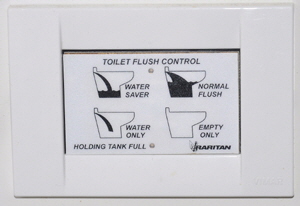 FRESHWATER FLUSH:Pressing a button on the control panel in the bathrooms activates a dedicated diaphragm pump that pumps fresh water into the bowl - or it comes in pressurized through the shore water, In the case of a manual head fresh water is sucked into the bowl with the manually operated pump
SEAWATER OPERATION; After physically changing over the valve and pump connections the flushing operation is the same for seawater flush, except the dedicated pump draws seawater through a filter inot the bowl. Manual toilets are the same except sea water is sucked in by operating the toilet’s hand pump.
 INSTALLATION.
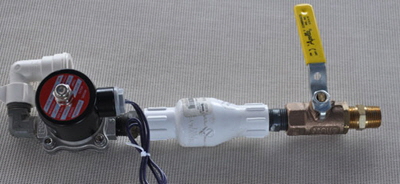
This system is easier to actually install than it is to describe. It may sound complicated but it really isn’t. There are only three components:
A plastic one-way check valve and a regular ball shut-off valve can be bought from most hardware stores. I bought the 12 volt solenoid from Amazon.com. who also have a 24 volt version.
I First tested the one-way check valve by connecting it to a dock water hose. In its flow direction water flowed without restriction but when connected to the opposite end of the check-valve absolutely no water came out and that’s how it should be. I then connected the parts together into an in-line assembly consisting of the solenoid, the shut-off valve and the one-way check valve. Then I connected them using tee connectors between the boat’s cold water system and the sea water inlet pipe which feeds each toilet. The picture shows that the manual ball valve is connected next to the toilet pipe, then comes the one way valve, then the solenoid. This arrangement ensures that when in raw water flush mode no seawater can ever get to the solenoid and never percolate back into the boats fresh water system. The installation is under an easy to reach floor-board. Interconnecting the pipes  would be just the same for a manually operated toilet.
A 12 volt wire comes from the toilet’s control boxes and when operated this normally activates the seawater inlet pumps. I fitted this wire with quick-change connectors on the pump and solenoid wires. When on seawater flush mode the wire is connected to the seawater inlet pump, but when using fresh water it is changed over to the solenoid. The two negatives, (returns), from the pump and solenoid go to ground. I considered making this wiring connection using a double pole, double throw switch, like Raritan uses and mounted somewhere near the toilets. But since my system has the added safety of the manual ball shut-off valve it is necessary to physically open and close this valve to change the flushing method. I therefore decided it was just as easy to switch the pump and solenoid power over at the same time which means one less switch to go wrong, but it’s not as though we change the flushing method frequently.
In the case of manually operated toilets that have no pumps it is only necessary to connect the solenoid to a straightforward 12 volt supply through a switch near the toilet which can be permanently connected to the solenoid. When the valves are turned to fresh water and the switch is activated the solenoid opens and permits fresh water to be drawn into the bowl using the hand pump on the toilet. When switched off the solenoid closes again.
OPERATION:
To change from seawater to a fresh water flush on an electric head the seawater inlet seacock is closed, then the wire from the seawater pressure pump in changed over to the solenoid and the fresh water supply ball valve is opened. On a manually operated toilet the switch to the solenoid can be permanently connected.
When the control panel button is operated, (or the switch in the case of a manual head), the solenoid instantly opens and the water pump, (or shore water pressure), pumps fresh water into the bowl exactly the same as if a washbasin faucet has been opened. It takes only a few seconds to fill the bowl and when the button is released the solenoid closes and the water stops. A manual toilet would be pumped by hand and after flushing the switch would be returned to ‘off’ and the solenoid closes. To switch back to sea water flush the process is reversed. First the fresh water ball valve shut-off is closed, then the electrical wire from the solenoid is changed over to the sea water pump and the sea water seacock opened.
Fresh water flushing has a great secondary advantage, but which will only be appreciated when it comes time to dismantle the head to install new parts or replace pipes - you will no longer wish you had an oxygen mask to do the job!
I consider fresh water flushing to be a major improvement to a very necessary but often neglected, (until a problem occurs), piece of my boat’s equipment.