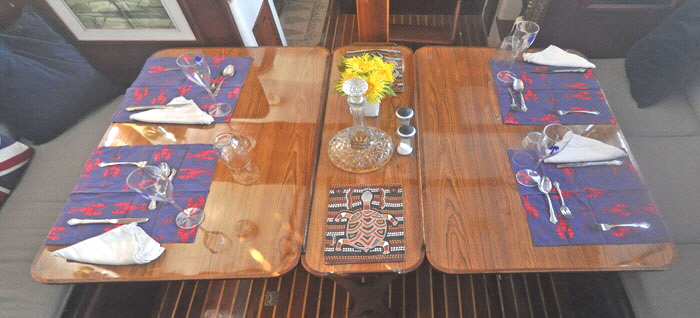

The original saloon table was a single heavy sheet of 3/4-inch laminated plywood, 27-inches wide by 57-inches long supported on two substantial aluminum pedestals that locked into large round collars screwed to the floor. 
There were two annoying problems with this structure. It was permanently mounted on the port side of the saloon so people sitting on the starboard settee couldn’t reach the table at all and it was also difficult to squeeze in and out of one end because the chart table bulkhead was in the way. It was a very substantial but also a very impractical table designed like that to be able to convert it into a bed if necessary. I decided to built myself a more versatile table that could seat more than just three people. My new design would have a narrow fixed center section with hinged leaves either side that could swing up to reach either or both of the settees. This is hardly a unique concept so why didn’t the original builders do it this way, because the times the table is used as a table far outway the odd times it might be needed at a bed.
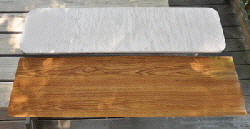 The ideal table height for the settees was 27-inches, that meant the drop-down leaves could not be more than 27-inches or they would catch on the floor when they were down. With both leaves open in a normal position of eating at both settees the middle fixed section would need to be 13-inches wide. The table would be 43-inches long to allow access all round.
 I began by buying a 4-foot by 8-foot sheet of ¾-inch thick oak plywood from my local hardware store for $53.71. They cut this large heavy sheet to my three panel sizes on their circular saw that saved me a lot of time and enabled the pieces to fit in my vehicle. I wanted rounded corners on all three sections, so I drew round a tin lid with a pencil to give me a radius, then I rounded the corners with my jig saw fitted with a fine scrolling blade.
 I decided to laminate the table tops with a melamine laminate that is both very hard material and scratch resistant. I found exactly what I was looking for on the Wilsonart website, (www.willsonart.com). It is a very realistic looking teak grained laminate called Nepal Teak in a high gloss finish that looks just like real varnished teak. I ordered a 4-foot by 8-foot sheet for $93.69. It is 3/64-inch thick but very that I had to cut to the approximate size of each table section using metal cutting shears and leaving about ½-inch overhang all round. Then I glued them on the plywood using original formula Weldwood contact cement. This is more liquid than the Gel type I have used for other applications and poured it out of the tin then spread it on the plywood and laminate surfaces with a 6-roller then waited for the glue to get tacky.
Joining large surfaces of laminate with contact glue is a once-off process because like its name suggests, contact cement bonds on contact and for large areas like I was working with there is no ‘wiggle room. It is also important to ensure there are no air pockets in the glue that might cause blistering after the glue sets.
I placed a glued plywood section on the floor, glue side upwards then laid a thin wooden batten each end and one in the middle and carefully placed the laminate on top with the glue side downwards. The wood strips kept the two pieces apart and enabled me to locate the laminate accurately above the plywood. I then slid the center batten out and pressed the laminate down to contact the plywood. I then carefully pressed the laminate along the wood each way and finally removed the end battens. I then walked all over it in my deck shoes that applied much more then the 75Lbs pressure called for in the gluing instructions and which firmly pressed the pieces together. NOTE: When positioning a flimsy laminate to a heavy plywood board it is easy to (a) get it a little bit out of square and even completely miss the board at one end, and (b) get air bubbles in the laminate that will be very difficult to remove once the whole sheet is in contact with the plywood. The method I adopted prevents both these mishaps.
After leaving the three boards overnight for the glue to harden I carefully trimmed the laminate flush with the edges of the boards using a router with a plunge cutting bit and roller bearing guide. This produced a sharp straight edge to which I intended to fit teak trim all round.
 I had some ½-inch thick teak slats left over from my rebuild of the forward cabin that were just right to make the straight edge trim for the panels. these pieces were much too thick to bend round the corners, so I used my jig saw to cut quarter-rounded trim from bits of solid teak I had saved from previous projects. All the trim had to be drilled and counter bored then screwed and glued to the edges of the three boards. Then all 75 holes had to be plugged and sanded.
I decided to make fixed fiddles on the center section because things invariably get placed there which are liable to slide off when the boat rocks, even in a marina. I beveled and rounded the edging strips then shaped both ends in a graceful swan’s neck curve to join the corner trim. I left the corners open to enable the table to be wiped and also add a bit of decorative accent. I rounded the underside of the trim but left the top square.
An unusual consequence that I didn’t anticipate was actually keeping track of all the pieces of trim that had been shaped and matched individually to the edges and corners. I made twelve corner pieces, four edging strips for fiddles and eight other edging trims. I marked them as I made them as they were all slightly different because this table was nothing if not ‘hand-crafted’.
 I hinged the leaves using six stainless steel sliding pull-apart hinges, three on each leaf, from ATGstores.com for only $29.98 total. These enable the leaves to be easily detached from the center section when necessary when I needed access to the floorboards.
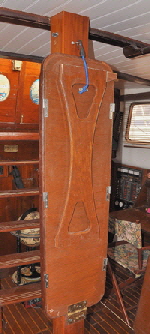 The mainmast compression post on Britannia is a 4-inch square post passing through the saloon to the keelson that offering a perfect support for one end of the table center section and I used a 4-brass plated butt hinge to support that end of the table, screwing one half of the hinge to the compression post with a teak block spacer and the other to the underside of the table. This enabled the center section to hinge upwards and hang with a strop to an eye-pad, when I needed access to the floorboards. It also allowed the table to be removed completely by simply knocking the hinge pin out to separate the two halves. To support the other end of the table I shaped a leg out of the plywood and hinged it using a short piano hinge. This allowed the leg to fold flat to the underside of the center section whenever it was in the stowed position on the mast. I located the bottom of the support with a pin that locates into flanged bushings I set in the floor. I made the pins by screwing a ¼-inch stainless wood screw into the bottom of the support then hack-sawing the heads off and rounding them with a file.
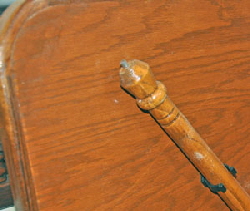 To support the leaves I bought two attractively turned white wood table legs grandly named ‘Early American table legs’, for $5.78 each. I fastened the top of the legs to the underside center edge of the leaves using a sturdy stainless steel hinge so when not in use the legs fold to the inside of the leaves and lock into plastic C clip. I screwed ¼-inch diameter pins in the bottom of each leg which then dropped into bronze flange bushings sunk into the floor. This made a simple yet very secure support for the leaves - much better than supporting them from a slide-out center section like I have had on other boats that nearly always caused a table leaf to sag. I also bought two brass barrel bolt latches for $1.97 each that I screwed to each leaf. The bolt drops into flanged bushings set in the floor and stops the leaves swinging about in the folded down position, when the boat heels.
I stained the white plywood on the underside of the panels and the table legs with teak stain which when rubbed with a rag, made the wood look amazingly like real teak. This is made by Zar (www.ugl.com) and called Teak Natural 120 which I bought from a local hardware store for $14.65 a quart. When all the woodwork was complete I varnished it with two coats of Epifanes high gloss wood varnish and the result is difficult to distinguish between the real teak trim and the laminate
When both leaves are extended the new table is more than twice the size of the old one and looks positively baronial. But more importantly it is very much more functional and easily seats six, yet when the leaves are down it is smaller than the original and allows access all round.