
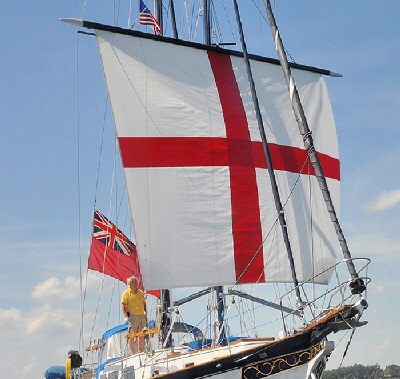
Anyone with a Bermudan rig knows how tricky it can be to keep the sails filling and holding a steady course when running before a good breeze, especially if a big sea is also rolling up astern. It is usually necessary to set preventer poles and an assortment of lines to hold the sails out, and even then the helmsman still needs to keep a keen eye on his course and the wind, to prevent the sails collapsing then re-filling with a loud crack that imposes great strain on the sail and rigging. A concern with polled-out twin headsails is that they cannot be reefed unless they are roller furled, and if the wind picks up crew have to go forward to deal with the situation, which is usually when nobody wants to go forward.
With a squaresail correctly braced there are none of those shenanigans on a run. The boat remains very stable yet the helmsman’s course can vary and the sail still remains full. There is minimal concern about broaching and the helmsman or autopilot will have little difficulty in maintaining a steady course. A monohull rolls less when driven by a squaresail because there are no opposing forces, as with twin headsails. Having sailed on a few square riggers and experienced all these situations in different conditions I decided to try and fit a different squaresail on Britannia.
The main issue with having a large flat sheet of canvas hanging high up on a mast is how to reef and furl it. This used to be done by sailors climbing up the ratlines, then inching their way along unsteady footropes to claw the canvas into submission and tie it to the yard. It was a very dangerous operation at the best of times, but if left too late or in a sudden squall it could be fatal. Since it didn’t have a crew of brave lads, and my wife adamantly refused to scale ratlines to furl a squaresailI, I needed to invent a system whereby the sail could somehow be controlled from on deck, or better still the cockpit.
In squaresail terminology: the complete horizontal spar is called a yard. The section outboard of the lifts is the yard-arm from which condemned men would be hoisted, and then “dropped.” The outermost footrope is called "the Flemish Horse," and if you have ever been out there at the end of a long swaying yard you will know why it’s called a horse. In heavy weather when the sail needs to be reefed or furled it is more like riding a wild bucking bronco and the "horsemen" of old were the elite of the topmen. However nobody rides the Flemish Horse on Britannia, nor do I have leechlines, buntlines, bowlines, clew garnets or tack lines—all of which are needed to control a traditional squaresail. I simply have two lines in the cockpit marked, squaresail up and squaresail down.
I have sailed boats with different squaresail arrangements. One hauled the sail outwards on a track along the yard like opening and closing drapes (curtains). Another hoisted the sail attached only at the gooseneck and the ends of the yard. Both methods work fine when the sail is set, but have serious drawbacks in that they cannot be reefed—they are either up or down. I also looked at another intriguing method that utilized a standard headsail roller-furling gear mounted horizontally in front of the yard. This did allow the sail to be progressively reefed from on deck, but the point where the foil was attached at both ends of the yard imposed point loads and necessitated a heavier spar, and the furler bowed outward when the sail was pulling hard. The sail was also open to the elements at all times the same as a jib.
The obvious answer to all these drawbacks would be to house the sail inside the yard, like in-mast furling. This would allow for infinite reefing, uniform distribution of loads along the yard, reduced windage and protection from the elements. But that sounded to me to be a pretty tall order.
BUILDING THE YARD.
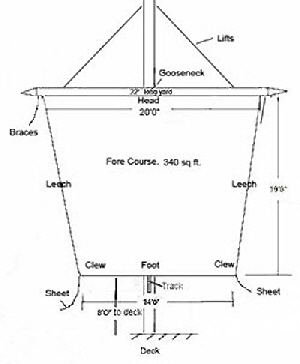 Before anything could even be designed some serious questions needed answers, not least how long the yard should be, and how big should the sail be? I contacted several marine architects and sailmakers, but none were able to tell me even how long a yard should be for my size boat, how large the sail area should be, and what extra stresses the yard and sail would impose on the mast and rigging. I finished up at the Old Naval Dockyard at Chatham, England, and in the archives I found a formula for yards and sails for a British frigate. It was all I found to work with.
Before I could even begin to build my design I had to find a strong 22-foot-long tube with a slot all the way along to become my yard. The answer dawned on me one day as I pondered an in-mast furling system. Here was the mast, a long aluminium tube with a slot all the way along it, in which the sail was rolled. So why not just cut off the front section of that extrusion and leave just the sail stowage part as my yard? bingo!
In-mast furling extrusions are made in many sizes, so first I needed to find out what diameter tube would be needed to accommodate my sail when rolled up inside. First I measured down from the point where I thought the yard would hang to a point where I would still be able to see under a sail, about 19-feet. I then did a practical test by simply winding a 19-foot-long strip of sailcloth around a 2-inch piece of tubing the same diameter as the internal mandrel, that would wind my sail in and out. This resulted in twenty turns of the mandrel with a finished diameter of 5-inches, I therefore decided to find a mast section with about a 5½- inch internal diameter.
I telephoned several mast suppliers, who sounded surprised, if not a little nervous when I asked, "How much do you want for a 22-foot long section of your xyz mast?" Some manufacturers would not even sell me a section when I told them what I wanted it for. I finally convinced the sales manager of Charleston Spar in Charlotte, North Carolina, to sell me a suitable section. Charleston Spar were also the dealer for a rope-operated sail winding drum which they normally use on their in-mast furling systems. This is the superbly made French Facnor driver with roller bearings and operated by a single line. So I bought the drum and the mandrel as well as the mast section. All this suited me very well in another way; I planned to fabricate the yard at my daughter's printing factory warehouse in Hickory, only fifty miles from Charlotte.
 I had plenty of room to maneuver the long tube in the factory warehouse where I first sawed off the complete front section of the extrusion, using a skill saw with a new 60-toothed carbide-tipped blade. The saw screeched alarmingly causing some employees to pop into the warehouse and see who was being tortured. “It’s okay, it’s only Samantha’s dad.” said the foreman, “He’s making something for his boat.” I made lugs to carry lifts, hoists, braces, and fairleads and found a local man to weld them to the tube.
 After some shaping with an angle grinder I managed to slide the rope driver snuggly inside the end of my tube/yard, so that only the furling line sheaves were visible. The mandrel was bolted to the driver and the other end attached to a large thrust-bearing mounted on a thick plate that enabled the mandrel to be tensioned to reduce sag. I also hand-carved a couple of yard ends out of cedar blocks that are removable to give access to the mechanisms at each end. Finally, after a lot of manual labor and a large pile of aluminum shavings, I suddenly found myself with a square sail yard.
THE SAIL

 Now all I needed was a sail, but I didn't want to buy an expensive Dacron sail without first finding out if the system worked. I bought a cheap plastic tarpaulin sheet and just glued the edges with contact adhesive, to produce a trial sail of the correct size and shape. My sail was not in fact square and the sails on “square riggers” were not square either. “Brace her square to the wind.” was my order. I shaped it as a trapezium 20-feet-wide at the head (top) but only 14-feet-wide at the foot, with a fall of 19-feet. (a total of 266 square feet). Britannia’s beam is 14-feet so the sail’s twin sheets fell level with the running blocks, and therefore did not need extra lines. When the sail rolls up inside the yard the leeches (sides) then "barber pole," without bunching up, that might otherwise have caused the sail to jam in the tube
With my home-made sail stowed inside the yard I was itching to test it in a wind and I had my eye on a large wooden telegraph pole outside the factory. But my daughter quickly put a damper on that potty idea. "You mustn't do that Dad you'll get me locked up!" I reluctantly demurred, but I still say there isn't actually any ordinance in Hickory, North Carolina that forbids anyone hoisting a squaresail up a telegraph pole. I settled for hoisting it on pulleys to the roof beams of the warehouse, then used two of their large electric fans to provide wind. This worked amazingly well and I was able to wind the sail up and down quite easily. So far, so good.’
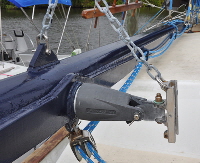 I now needed a strong gooseneck to attach the yard to the mast. This had to pivot to be able to brace the yard when the wind was not dead astern. It also had to rotate, permitting the yard to be canted (sloped) when docking in confined marinas. It certainly would be asking for trouble to try to squeeze Britannia into a normal-sized slip with a twenty-five-foot pole sticking out the sides. I made my multidirectional gooseneck by modifying a
  spinnaker-pole end attached to a traveler car sliding on a track up the front of the foremast.
Much to the relief of my daughter and her workers the yard was finally strapped securely, (I hoped), to the roof-rack of my SUV and I set off 650 miles to Britannia in Florida. I was very relieved to finally arrive with the yard still attached to the van.
RIGGING
While taking a break from the construction I had to set up lifts and braces on Britannia to control the yard. I also felt that the foremast standing rigging should be strengthened to carry the extra weight of a 130lbs spar swinging 35-feet up the mast. The spreaders also had to be angled backward to enable the yard to be braced. I fitted new 3/8-stainless wires for the lower and cap-shrouds and new 30 degree-angled spreaders. I also installed two running backstays, anchored to pad-eyes bolted aft into the deck. The winding drum lines led along the yard and down the mast, then through up-and-over sheaves and finally through jambers into the rope deck, thus enabling the sail to be furled and unfurled from the safety of the cockpit. finally, and to great interest from fellow boat owners, I hoisted my strange spar up Britannia's foremast. It caused even more astonishment as a large green and brown sail suddenly appeared out of the tube, then vanished back in without a single person touching it.
 A TRIAL SAIL
We motored out into the intercoastal waterway for our first trial. Then, after turning Britannia downwind I gingerly hauled on the "down" line and my makeshift sail began to unroll out of the yard. As the sheets were hauled in Britannia slowly picked up speed and was soon making four knots with only a light following wind. Zack, my 11-year-old grandson asked if he could steer, not the sort of thing you would normally entrust to a young lad who had never steered a sailing boat before. I gave him the wheel and watched as he first over-steered in a zigzag path as landlubbers always do, which would have been troublesome with normal head sails, that requires skill to keep them filled. However my squaresail remained full, even over Zack’s erratic course. It was a very successful first trial.
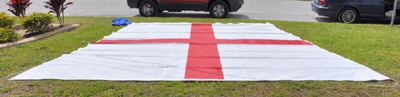 By this time I had invested a great deal of time and money on my experiment, and if I was going to continue I was now faced with the most expensive item, a real sail. This turned out to be not that easy to buy either, because I couldn't find a sailmaker who had ever actually made a squaresail—never mind one that would roll up inside a five-and-a-half-inch diameter tube. Doyle Sails, in Stewart, Florida, showed the most interes so I placed the order with them. When the new sail finally arrived the last stage of the grand experiment could now be undertaken.
THE DAY OF RECKONING.
The breeze was ideal, ten to fifteen knots straight down the intercoastal waterway. We motored up-wind for a while then turned around and I cut the engine, to face the moment of truth, that had taken over a year to arrive
As helpers tendered each of the squaresail sheets I hauled on the "down" line and the sail began to unwind from inside the yard. As the wind caught it it actually began to unroll itself, but I controlled it by slipping the "up" rope around a cleat and cautiously eased out more sail, until the whole 266 square feet billowed majestically before us. The sheets were winched home and I felt the boat gather speed. It was a great feeling to see the beautiful white sail filling so well.
Britannia did not roll at all, the motion being more like a catamaran than a monohull. It was so steady I felt no trepidation in steering straight through the narrow gap under the first fixed bridge. At least it seemed narrow when my 14-foot wide boat was suddenly 25-feet wide. A speedboat overtook us with people yelling "Fabulous!" "Great show!" I felt very proud.
Lowering the sail was easy enough, but would it roll smoothly back up into the yard with the wind still in it? At that precise moment I earnestly hoped so, otherwise we might have been in trouble since you can't just turn a squaresail into the wind. There was only one way to find out. As my crew eased the sheets, spilling some wind I wound the "up" rope around a winch and began to wind the sail up into the yard. It was certainly harder than unfurling, but became progressively easier as the sail was reduced in size and it finally disappeared into the yard "as clean as a whistle!" Wow! Another milestone passed, what a relief! Knowing the sail can be quickly progressively reefed and stowed had overcome a major concern, and a great reassurance if the wind pipes up.
I now wanted to see how many degrees we could sail off the wind. I unfurled the sail and steered a 30 degrees zigzag course downwind without bracing the yard to port or to starboard. Amazingly the sail never lost wind even when three points on either tack. This will allow a lot of latitude when sailing downwind with a big following sea, that tends to try to broach a Bermudan-rigged boat. It will also be less power-consuming on the electric autopilot, that won't have to constantly correct that tendency.
The trial was the successful conclusion of considerable hard work and expense, and we celebrated with a bottle of Champagne as we steamed back to the marina. And no, the bubbly and euphoria did not cause me to forget to cant the yard before entering our birth. It was a most satisfactory trial of my new invention.
LATER:
Months later, after I had become more familiar with the characteristics of the new sail, Britannia actually hurtled up the intercoastal waterway at eight knots with a southerly 30 knot wind, yet as steady as any catamaran and straight through the fixed bridges as well. This was something I would never dream of risking under sail in such a confined waterway, and we would most likely have anchored and waited for the wind to subside.
THE FLAG
The red cross on the white squaresail is the English flag, that overlays part of the Union Jack. It is also the Templar's Cross and the emblem of the Red Cross Association. But that will only add to the mystery as my "little tall ship” is spotted on the horizon.
THE COST
The following are the main costs of this project:
Winding drum. 600
Yard and mandrel. 400
Gooseneck and track 380
Sail. 1550
New lines. 400
Subcontract welding. 200
Ancillary equipment. 206
Total 3736
Like most things on a boat, the cost ultimately just comes down to what you actually want to do, and what you are prepared to do if you can't actually buy something ready-made. There were times when I was ready to quit, and my family thought I was nuts anyway—which is probably true. But now, when I unfurl my beautiful sail, that I designed and engineered all on my own, and watch it billowing forth, I'm very pleased and proud that I persevered. My small square-rigged brigantine schooner is now unique.