|
When I bough Britannia the aft cabin shower drained directly into the bilge where it was pumped out automatically by the boat’s regular bilge pump. This is not a good method because even with the boat’s powerful bilge pump that quickly discharged the soapy water there was always a small amount of residue left over that soon began to smell. I therefore considered fitting one of the automatic self-draining shower systems at a cost of $200 or more from various marine suppliers. That’s when I thought about making one myself.
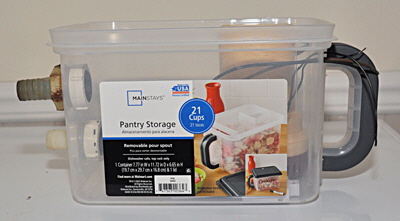 Automatic shower drains are not sophisticated and work simply enough: A small bilge pump is mounted inside a watertight container along with a float switch, and as the shower water runs into the container the switch activates the pump and pumps it overboard. Shower water dribbles into the box and the pump clears it as quickly as it runs in so there is no overspill or leakage into the boat’s bilge. I already had an old bilge pump I could use but it needed a container that had at least 6-inches clearance inside its lid and after scouring through three major houseware stores I Automatic shower drains are not sophisticated and work simply enough: A small bilge pump is mounted inside a watertight container along with a float switch, and as the shower water runs into the container the switch activates the pump and pumps it overboard. Shower water dribbles into the box and the pump clears it as quickly as it runs in so there is no overspill or leakage into the boat’s bilge. I already had an old bilge pump I could use but it needed a container that had at least 6-inches clearance inside its lid and after scouring through three major houseware stores I 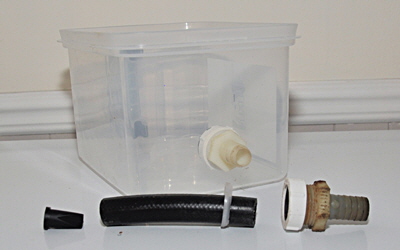 finally found a plastic container with a tight-fitting lid at Walmart for the vast sum of $7.95, where I also bought a float switch for $9.50. The container then needed an inlet and outlet pipe, and I found the ideal fitting at my local hardware store. The nylon fitting had a ¾-inch barbed pipe one end that matched the shower drain pipe and a 1-inch pipe thread on the other. The thread just happened to be a nice tight fit into the 1¼-inch holes I carefully cut in the side of the container with a hole cutter, (a 1-inch standard pipe thread is actually 1¼-inches OD). I was not able to find a nylon nut to fit the 1-inch pipe thread to secure the fitting to the box and I didn’t want to use steel or even stainless steel in a water filled box. I therefore bought a cheap PVC pipe coupling that had the same threads as the fittings in both ends and sawed ½-an inch of each end with a hacksaw to give me two round nuts to secure the fittings. For good measure I also fitted a 1¼-inch internal diameter plastic sink drain washer to make double sure the seal would be waterproof. All these items didn’t cost more than $22.00 finally found a plastic container with a tight-fitting lid at Walmart for the vast sum of $7.95, where I also bought a float switch for $9.50. The container then needed an inlet and outlet pipe, and I found the ideal fitting at my local hardware store. The nylon fitting had a ¾-inch barbed pipe one end that matched the shower drain pipe and a 1-inch pipe thread on the other. The thread just happened to be a nice tight fit into the 1¼-inch holes I carefully cut in the side of the container with a hole cutter, (a 1-inch standard pipe thread is actually 1¼-inches OD). I was not able to find a nylon nut to fit the 1-inch pipe thread to secure the fitting to the box and I didn’t want to use steel or even stainless steel in a water filled box. I therefore bought a cheap PVC pipe coupling that had the same threads as the fittings in both ends and sawed ½-an inch of each end with a hacksaw to give me two round nuts to secure the fittings. For good measure I also fitted a 1¼-inch internal diameter plastic sink drain washer to make double sure the seal would be waterproof. All these items didn’t cost more than $22.00
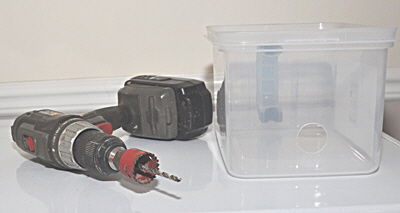 I found a short length of rubber pipe in my spare pipes locker that pushed snuggly into the pump outlet, and equally well into the outlet fitting through the container. There was no need for any pipe on the inlet fitting because the shower water would just run freely into the container. I also didn’t see any need for the internal filter that is fitted to shower drains, because only soapy water would flow into the box and the bilge pump had a filter base anyway. I found a short length of rubber pipe in my spare pipes locker that pushed snuggly into the pump outlet, and equally well into the outlet fitting through the container. There was no need for any pipe on the inlet fitting because the shower water would just run freely into the container. I also didn’t see any need for the internal filter that is fitted to shower drains, because only soapy water would flow into the box and the bilge pump had a filter base anyway.
I also bought a ¾-inch diameter one-way check-valve that fitted exactly inside the discharge pipe from the pump. This little rubber valve is important in preventing water from running back into the container from the uphill passage of the discharge pipe over the side and without it the process would repeat all over again. These parts all fitted together perfectly, and I drilled tiny holes in the side of the container for the four wires from the bilge pump and float switch and sealed them with Goop glue.
My pump was quite heavy on a 4-inch circular flat base and when it was connected to the outlet fitting it was retained firmly in place with no need to actually fasten it to the bottom of the box. The float switch needed fastening down but I didn’t want to drill a hole in the base of the box and screw it in place in case it leaked, so I glued it with Goop glue and left is 48 hours before I tested the new apparatus. Goop is a superb glue for waterproof applications.
I connected one of the float switch wires to the black positive wire from the pump. The other wire from the float switch went to a single pole switch I mounted near the shower so the pump could be activated at the time of a shower. The switch was powered from a 12-volt contact breaker on the electrical distribution board.
The complete box was mounted on a shelf in the engine room adjacent to the shower floor but a little bit lower so water would drain directly into the box by gravity then pumped out through an existing hull fitting.
This superb drainage box cost me no more than $22, but that was because I already had the pump. Even including the cost of a new pump, about $60.00, a float switch and a few fittings my shower drain was very much cheaper than buying one. There are many different types of shower drain systems available varying from about $200 to $350, but if you are a true DIY man there is always a way to save money.
|