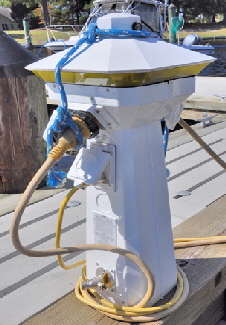
 Shore power electric is very nice to have in a marina or dock. It enables the ship’s batteries to be charged and if a “ring main” is installed in cabins and galley all AC appliances can be used like in a house.. All marinas have individual pedestals for each dock that usually have connections for electrical plugs with 30 amp 120 volts. Some also have connections for 50 amp plugs for boats with heavier power draw and there frequently is a 15 amp connection like in a house for a regular domestic plug but what is often marked “not for shore power” and only to be used to run a single appliance like an electric drill or other power tools, but not the heavier amperage used for the rest of the boat.
The heavy cables that are needed to connect a boat to shore power can be bought on the web and at chandlers. The most common type in the US is made by Marinco Inc., (www.marincopowerproducts.com) There are also other makers having the same terminal connectors. All have a male and female plug on each end of cables that are available in various lengths. It is also possible to buy the wires and the plugs separately to make special lengths to suit a boat that is always moored in the same dock. It is better to use a length that is not overly long to reduce resistance and overheating of the cable that is exposed to the element’s day in and day out.
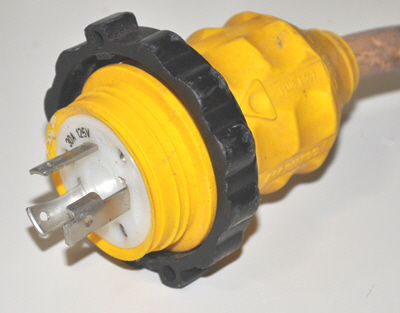
The actual plugs on the ends of these cables are a special configuration that consists of power (black), return (white), and ground (green) and they only plug into a receptacle one way. They may also have a black locking ring that enables it to be securely attached to a pedestal or a boat that has corresponding threads.
Some pedestal receptacles are angled downwards to reduce the incursion of rainwater that could short out the plugs. If there is no locking ring facility this type of angled connection is very susceptible to working loose due to the movement of the boat or even the wind, and the only remedy is to tie the plug to the pedestal. If there is no locking ring facility on the pedestal it is still useful as a 1/4-inch rope fits nicely between the ring and the boot that can then be tied to the pedestal. If through a bad connection the plug gets hot inside the receptacle it usually trips the contact breaker, but if it continues to short out it can start a fire inside the pedestal. Over time the plugs also become corroded due to the environment they operate in, and it becomes necessary to replace the entire plug or the outer plug connector part of it.
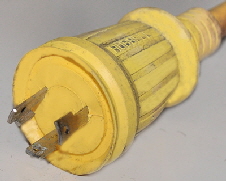 NOTES: If either plug of a manufacturer's shore power cable still has the original plugs attached they cannot be dismantled because they are one-piece molded assemblies. The only way to fit a new plug to these cables is to saw the old one off then fit a completely new male or female plug in the manner described here. This is not at all difficult and much cheaper than buying a new shore power cable set.
The male and female plugs at each end of the wire use different boots and the spare parts are not interchangeable.
A single 1/4-inch thin flat blade screwdriver is all that is required to do these repairs because the Phillips screws all have one open slot across the head of the screws.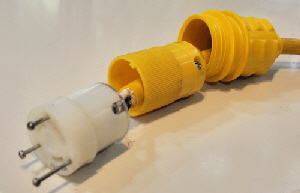 DISMANTLING A FEMALE PLUG.
To replace or rebuild a failed female plug first pull the boot away from the plug and slide it a few inches down the wire because it need not be removed from the wire unless a new boot is to be fitted. Now remove the three screws in the end of the plug and loosen the two on the side of the body but do not completely remove these two as they  only clamp the cable in place. The white plug part can now be pulled out of the body exposing the wires inside. Move the body back down the wire a few inches and if this is difficult the two side screws may not have been loosened enough. It should now be possible to see what has caused the failure of the connection and there may even be signs of burning on a wire. To remove the wires simply loosen the three side screws and the plug can be pulled clear of the wires. The screws are colored, red, green, and white, to match the wires.
 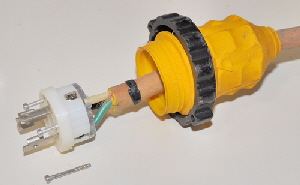 DISMANTLING A MALE PLUG.
Unscrew the three screws in the front of the male plug and the boot can then be drawn back down the wire. On the male plug there is no inner body and the plug screws directly into the boot. This exposes the three wires attached to the plug that can now be unscrewed from the plug and repairs made in the same way as the female end.
REASEMBLING BOTH PLUGS.
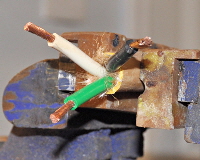 Depending upon what is discovered when the plugs are dismantled Marinco parts may have to be ordered. If the wire shows any signs of burning or brittleness the cable should be cut back until the wires are clean. This is usually only about two or three inches and is best done with a hacksaw in a vice. If a new boot is to be fitted it will be necessary to trim one of the rings off at the end of the boot to be able to slide it onto the 5/8-inch diameter cable. Now, using a box cutter (Stanley knife), a scalpel (Exacto knife), or similar knife with a new sharp blade carefully trim the outer cover back 1 5/8-inches and remove it along with its inner strings until only three new wires are left. One method of doing this is to place the cable in the vice and slice into the top half of the outer cover which is normally quite thin and flexible but not too deep as to nick the wire insulation. Then score a straight cut from the circular cut back to the end of the cover and peel it open and it will then be easier to score around the rest of the cover. Now trim 5/8-inches of the wire insulation to expose the copper conductors and twist them to stop them fraying. Now push each wire end into its corresponding colored hole in the plug until the insulation fits inside the little raised hole and tighten the locking screw. It is important to do this correctly – green wire into the green hole, white to white and black to black. If done incorrectly the polarity of the plug will be wrong. On the female plug push the plug end into the body that locates with a small square keyway and tighten the screws to fasten the plug to the body, then tighten the two clamp screws to secure the plug to the cable and pull the boot back over the complete plug.
This completes the installation of both male and female plugs with a DIY cost saving of approximately 200% percent, over the cost of a new shore power cable set.