FIVE DAYS AFLOAT WITH A ROOKIE CREW.
or
A SHORT SHAKEDOWN CRUISE, WHICH TURNED INTO A BREAKDOWN CRUISE.
Don and Renae Shore had flown down from Minnesota to join us in Florida for a week's cruise, and experience the gentle art of sailing—or so they thought.
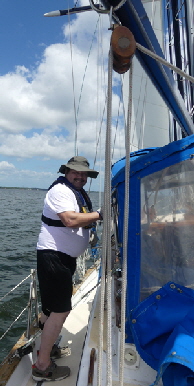
 !It was only going to be a quick jaunt up or down the Inter Coastal Waterway on Britannia. The ICW is an ideal place for newbie sailors and also test the extensive modifications and fittings I had installed over the past year. There was also a possible excursion out into the Atlantic ocean if things went well.
The Shores had never been on a sailboat before and they wanted the experience—such as it could be in a week on the ICW—to see if they liked sailboats with a view of possibly buying one eventually.
After they had stowed their gear I showed them how to flush the electric toilets and not to drop anything in them either. I showed them how to operate the shower, and words of caution about leaving lights and running water on. Due to their inexperience I insisted they wear lifejackets when walking about on deck even in the dock. It is just as easy to trip and fall overboard in a marina as when underway. I then started them off with re-fitting the roller-furling jib, fore staysail, and 'tweenmast staysail. After this I showed them how to coil a rope and heave it ashore, tie a few knots and bend a line to a cleat—all very simple stuff for boaters, but complete mysteries to newbies.
The next day, after topping up with water the engine was started and I began to back Britannia out of the slip, but after only about ten feet we became stuck on the bottom. We were docked in the semi-tidal barge canal near Cape Canaveral, Florida, and been stationary for some time. The combination of over a ton of additional water in the tanks and shifting mud caused the grounding. I tried to drag her through with the engine, but that just caused clouds of black exhaust smoke and mud. Finally, I had to call the marina manager to tow us out with his 150hp tender. This dragged us through the mud and into deeper water, but not a very auspicious start you might think. That was nothing, more was to come more.
Half a mile down the narrow canal towards the ICW the engine oil pressure gauge dropped to zero and I immediately cut the engine. My wife jumped behind the wheel as I rushed forward to set the anchor - which was stuck in the pulpit and I hurt my hand freeing it. As Britannia slowed I let go thirty feet and she swung to a shuddering halt. I then lifted the floorboards and checked the engine oil which was okay. I suspected electrical trouble and disconnected the oil sender, cleaned the connection and restarted the engine. Bingo! 50Lbs oil pressure. Strange, it never happened in the slip… Obviously Mr. Murphy has his eye on us already.
I hoisted the anchor and we got moving again and I switched the depth gauge on—nothing! Having a working depth gauge is quite important in the shallow intercoastal waterway. It’s almost impossible not to run aground with one, but driving blind more or less assures it. I hoped the transducer on the outside of the hull had become clogged by dragging her through the mud and it might clear on its own—it never did.
The wind was southeast 15 knots so I decided we would go north, and I set a jib. It was interesting to see complete novices handling the sheets, (what’s a sheet?) and winding them the wrong way round the self-tailing winches. Don suddenly found out how much load there can be on a relatively small sail when it’s pulling 24 tons of boat along, and why I had suggested he wear gloves. Cameras immediately appeared as though we were under full sail at nine knots, instead of motor sailing at about three. I say about three because the log had also packed in by that time.
 The ships log was a diddly-little paddle wheel and I supposed it too had become clogged by all the mud kicked up at the start. We had to rely on Kati’s I-phone which has a GPS app giving speed over the ground and was probably more accurate than the boat’s log anyway.
We sailed under a fixed bridge then had to roll the jib back in to transit a bascule bridge that opened to my VHF request. This delighted our guests, who said it was a change to be on the other side instead of waiting in their cars.
Over a particularly straight stretch I decided to give our guests the feel for real sailing and pressed the stop button for the engine—nothing! I had to scramble into the engine and pull the solenoid by hand. There were a couple of startled glances as the engine stopped and all went quiet. I have seen this before and it’s something which can both disconcert and amaze landlubbers, that a whopping great boat can actually move along without an engine. I’ve been asked questions like, “How do you stop it?” and “What if the engine doesn’t start again?”
Just for good measure I decided to fly our ‘tweenmast staysail which my crew set about with a little more enthusiasm and knowledge this time. It was a bit more complicated because the leeward running backstay had to be unhooked first. Eventually the sail billowed out to more camera clicking. This was about all I thought prudent as the wind was picking up gusting at about 20 knots. Using these roller furling sails soon convinced Don that they were worth all the loss in power attributed to them, simply for ease of handed. All Britannia’s sails are roller-furled and controlled from the cockpit, including the large fore-course squaresail halfway up the foremast. We sailed past NASA’s Vehicle Assembly Building where the shuttles were built and within sight of Pad 39b where they were launched. More camera clicks.
We decided to pick up a buoy for the night in the City of Titusville mooring field. The crew hooked the mooring line successfully and I showed Don how to set a bridle, then we celebrated their first successful “voyage” with champagne. We had traveled the magnificent distance of twenty miles, but our friends thought it was about a hundred because they were used to travelling that distance in the time it had taken us to do twenty.
 In the morning we had a leisurely breakfast, slipped the moor and sallied in a northerly direction once again. The twisty intercoastal made it impractical to sail until we passed through the canal into the large Mosquito Lagoon passage that is almost dead-straight north to New Smyrna Beach. Here I had them pull out the mainsail as well as the jib and ‘tweenmast staysail and we sailed majestically at a steady five knots for 15 miles even through some of the narrower sections with houses both sides of the waterway. People waved and shouted “fabulous boat,” and words to that effect. I felt very proud.
We arrived at New Smyrna Beach just after lunch, still with no depth gauge to maneuver into an anchorage. I then presented Don with my lead-line and ushered him to the bow. As Kati steered very slowly into the anchorage Don swung the lead and counted the knots disappearing under the surface. When we were in two fathoms I slowly let go fifty feet of chain as Britannia drifted astern. At this point I showed Don how I attached our second anchor to the chain with a specially made strop then we heaved that over as well. I then ran out another fifty feet to be well and truly secure for the night. I told him it was my practice to never-ever lie to one anchor at night. Even in the protected ICW storms can come through and unstick you.
As the sun set it was still very hot below decks so I decided to start the generator to run our twin air conditioners. It fired immediately but spluttered to a halt after a few minutes. I suspected another clog-up in the water filter due to our dirty start, but I couldn’t unscrew the plastic filter bowl. Don said, “let me have a go,” and put so much leverage on the filter it snapped the seacock clean-off the through-hull and an associated gush of water through the 1-inch hole in the hull. Don received a face full and a soaking, but had the presence of mind to press his hand over the hole and stop the water that had already fired the automatic bilge pump. I rummaged through my wooden plugs box and found a suitable size that Don shoved into the through-hull and stopped the influx. A few taps with a hammer and the emergency was over, but it had left me with a dry mouth so Kati put the kettle on while I wedged a length of wood over the plug to make sure it wouldn’t pop out, and we never touched it again until we were back in the marina. It was actually the first time in fifty-plus years of boating that I have ever used these special tapered wooden plugs in an emergency, but I didn’t want to discourage Don who was quite upset. “Happens all the time,” says I and made a mental note to fasten a plug on every seacock when we got back, which is where they should be and saved precious minutes.
Luckily Don has had a wealth of experience with diesel engines and didn’t mind getting his hand dirty either. We re-routed the generator inlet pipe to another seacock and the genny started but then stopped again. Clearly it was not a clogged water filter or pipe and we finally diagnosed a faulty electric fuel pump. I decided to go ashore to find one in an auto supply shop somewhere, because I knew the pump was the same as used on vehicles.
There was a lot of dinghy traffic in the anchorage so I hailed one who looked like he might be heading ashore and hitched a lift. My taxi driver then took me in his car to a nearby auto parts store where I bought a fuel pump. After doing his own shopping my good Samaritan took me back to Britannia, then with a wave continued to his own boat. Our guests were impressed to learn that it was easier to thumb a lift on the water than on the highway and that boating people tend to help each other more readily.
Don and I installed the new pump and the generator ran continuously enabling the ACs to run. Anyone who has been to Florida in height of summer will appreciate the difference air conditioning makes to living conditions in a house. It is even more important in the confines of a boat. Still I did get up a couple of times in the night to inspect the seacock, but all seemed well.
With the wind easterly blowing 20 to 25 knots onshore and four to six-foot seas in the Atlantic I decided it would be prudent not to venture out through Ponce inlet—with a wooden plugged seacock and guests who had never been to sea before. That really would be tempting Murphy and both our guests seemed relieved to hear it. We stayed another day at anchor enjoying the passing boats and the nautical scene in general. but when we were ready to weigh anchor Murphy stuck again and the windlass button failed—through lack of use I suppose. Still it gave Don a taste of what it was like hauling in 100-feet of 3/8-inch chain and a 100Lb anchor, while I watched, making a nice change for me. We then set off south.
The wind was still southeasterly so we could only set a tight jib as we motor-sailed back the way we had come. This time one of the horrendous rainstorms that sweep through Florida in the summer months smacked into us but was thankfully short, and allowed our guests to test their new foul weather gear.
Halfway back the engine water temperature gauge failed and I had to throttle back for fear of overheating. I guessed it would be another electrical fault but I kept an eye on the motor just in case
We arrived back at our berth late in the evening and I fully expected to get stuck in the same mud, and as I edged Britannia into her berth she bottomed but a quick burst on our trusty “Perky” Perkins pushed her through. I attributed this to having used up a good load of the water amounting to a slight reduction in the draft.
Later the forward toilet refused to flush and I diagnosed a faulty circuit board. My reasoning for having both toilets the same was now confirmed because I carried a spare circuit board that is common to both and I soon got it working again.
Don and Renae said they were delighted with their first yachting experience, notwithstanding that things had not gone so swimmingly. It had given them an insight into the many things which can go wrong on a complicated cruising boat and for which they needed to be prepared. They said it had not put them off their dream one bit, but my wife and I just looked at each other and shrugged. Most people go on delightful sunset cruises, but we thought we might advertise “breakdown cruises” just to be different, and would-be boaters would certainly learn more.
After seeing Don and Renae off to the airport, Kati and I stayed aboard for the night and unbelievable as it may sound the aft cabin AC broke down - later diagnosed as a faulty compressor and a burned-out relay that cost me $1500 for a new unit.
After a few years looking at various boats Don and Renae have finally bought a 39-foot C & C sloop. They bought the boat that includes tenure to the liveaboard mooring, so they can live on it whenever they are ready for their dream. It will be interesting for me to see how they have matured in the boating life when I next meet them on their own boat.
EPILOGUE:
1.The electrical problems were due to bad connections and earth grounds on the gauges and senders.
2.The engine solenoid just needed the piston oiling after which it has worked flawlessly—so far.
3.I repaired the broken sea-cock without even lifting the boat using a British product called a Sea-bung. A rubber mushroom-shaped device which, when inserted down a skin fitting opens out with the pressure of water and seals the through-hull enabling repairs to be affected. Even so, there is now a wooden tapered plug attached to all seacocks.
4.I withdrew the log impeller and found it completely clogged with mud and barnacles. I don’t really like these little impeller type logs but after cleaning it works fine—until the next time...
5.The depth gauge is still not working properly and probably also due to an electrical fault. I couldn’t properly test it anyway being in only 4-feet of water at high tide in the marina.
6.A circuit board for the toilets cost $110.
7.The AC compressor had failed and at eight years old it was not worth trying to repair. I bought a new 16,000 BTU unit for £1500.00 and installed it, but this does not bode well for the equally old forward unit.
8.I freed the windlass ‘up’ button with penetrating oil which solved that problem.