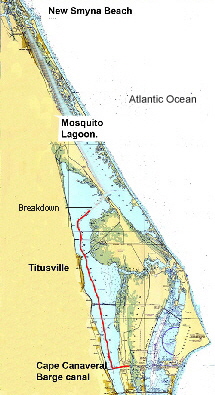
 We had moved house from Orlando Florida to Fairfield Harbour, near New Bern, North Carolina, (www,fh-poa.com) and I now needed to move Britannia from Cape Canaveral where she had been docked for five years, to Fairfield. t was January 2022 and my crew was Bob Snell, a very experienced mariner and his girlfriend Lisa who was quite new to boating.
Britannia had not been to sea for some time. I therefore thought it prudent to have a run up the Intracoastal waterway, “Just to check that everything works.” I told my wife, before stepping out into the Atlantic and a voyage of 530 miles to Beaufort Inlet, NC, then up a river into the Pamlico Sound and New Bern. An intracoastal trip would also help Lisa acclimatize to the boat, before an ocean passage of possibly three or four nights.
All our friends from four years in the marina were gathered on the dock to see us off. The lines were let go and I eased the gear-shift lever astern to back out of the slip, but it would not move and was rock-solid. The lines went back on while I freed the shifter with some WD40 and it was soon working properly. Not a very auspicious departure though. We chugged north at a steady seven knots expecting to easily make New Smyrna Beach, a mere 47 miles by nightfall.
We were just north of Titusville when the saloon suddenly started to fill with acrid smoke and I immediately cut the engine thinking we were on fire - as it must have looked like to anyone on shore. I eased Britannia into the side of the channel and she came to a halt in the soft mud. We flung all hatches open from on deck and the breeze began to slowly disperse the smoke. An inspection all around the engine bay showed no sign of fuel or water leaks. “Start her up for just a minute,” said Bob, “and I’ll see if we have any pressure leaks.” This immediately revealed a small crack in the pressure side of fuel lift pump and fuel was being sprayed all over the hot engine block. Thank goodness diesel does not self-ignite, because if it had been a gas engine there could well have been an explosion and a fire. Bob wrapped the leak with duct-tape to at least prevent fuel spurting all over the block, and we limped back to the Titusville mooring field where we picked up a buoy
The crack in the pipe was up against the nut securing the fuel pipe to the lift pump, so it would not be possible to splice it with a piece of rubber tubing. I couldn’t find any rubber fuel pipe small enough to cover the 3/16-inch pipe anyway, so it meant a trip ashore.
I lowered the dinghy from its davits and the outboard was secured to the transom, but it stubbornly refused to run continuously and would only fire with a squirt of engine-start into the carburetor intake, then it would again die, indicating to me a carburetor jet blockage. Bob hitched a lift on a passing dinghy to try to find suitable rubber fuel pipes. I took the carburetor off the outboard and cleaned everything with carb’ cleaner which finally got it running smoothly.
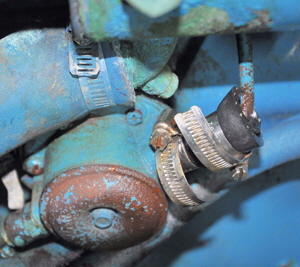
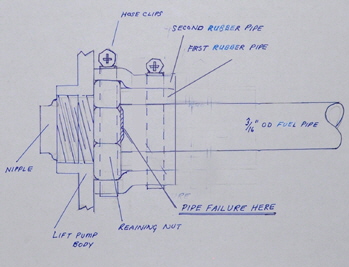 Bob soon returned with a selection of different sized fuel pipes and we devised an intricate way to stop the leak. I sliced a short length of rubber tubing down its length, but at about 65 degrees so it could be wrapped around the pipe and pushed up against the crack near the nut. Cutting the tube at an angle instead of straight allowed the edges to overlap as they were clamped together, with more chance of making a tight seal. I then made a similar “bandage” of a larger diameter tube that fitted over the actual nut head and long enough to overlap the smaller tube. The two slices were positioned at 180 degrees to each other then tightly clamped with two small hose champs—one over the nut head and one directly over the crack in the pipe.
This done I gingerly pressed the engine start button as Bob examined the repair and pronounce the success or otherwise of our seal. “Dry as a bone” was his exclamation. Wow!
With this major breakdown repaired and a working outboard I felt we were getting somewhere, after all this was the purpose of the ICW trip. The following morning we decided to continue north towards New Smyrna Beach, where I hoped to find material to be able to make a more permanent repair.
We had not motored three miles when steam started seeping up through the saloon floorboards. I immediately anchored in the fairway and dut the engine. An inspection revealed a crack part-way round the rim of the bolted on water filler neck on the engine header tank. This had reduced the engine pressure to zero and boiled all the water out of the header tank. Oh! and didn’t I mention that the engine water temperature gauge had stopped working earlier that meant we couldn’t read the engine temperature, which allowed it to overheat and blow the filler cap. The gauge was working fine when we left.
I had a pack of JB Weld, a two-part epoxy that is supposed to be heat-resistant up to 450 F. Bob meticulously cleaned the filler neck and applied a good thick layer of the mixed goo all the way around the rim. The pack was the extended curing version, so we decided to let it set overnight before starting the engine. We were safe enough, (I thought), anchored at the edge of the calm channel—except at 2.30 am the wind came up and pushed us to the side of the channel where Britannia began bumping sideways on the bottom. This became excessive as the wind picked up to 25 knots and we had no engine with which to pull her off, or which we could even rely upon to get us back to Titusville in the pitch-black night.
OUR KNIGHT ARRIVES, WITH SHINING TWIN VOLVOS TO THE RESCUE
 I called Towboat US who I had only joined a week previously, “But I don’t suppose we will need it” I told my wife. Less than an hour later Kevin Derr, with his towboat, Scout, passed the twin looped hawser bridles over, which we fed through Britannia’s bow fairleads and over the Sampson post bits on each side of the bowsprit. The anchor was hauled in and we were swiftly on our way back to the mooring field where it took Kevin a few passes to steer us onto a mooring buoy in the wind and dark. It had certainly been a memorable night for Bob and I, Lisa has stayed in bed the whole time and It would have been nice to have had a cup of tea during the melee.
One of the things that had continued to work faithfully was the 6.5-kilowatt generator that powered the air conditioning, but while the genny kept going the AC suddenly failed showing a water shortage fault, but that could wait until the morning. We all went back to bed, presumably also Kevin, our gallant rescuer.
In the grey light of dawn, with the wind still blowing, the AC water filter was unscrewed and I was absolutely astonished to find the whole of the 6-inch long round gauze filter completely solid with muck! It must have been drawn into the filter when we stopped the side of the channel. The pipe from the seacock to the AC pump was also clogged, so it all had to be removed and blown clear before the AC would work again. Anyone who has lived on a boat in Florida will know that air conditioning is very necessary, even in January.
Another annoying fault was that the engine-stop-solenoid began to fail intermittently and it was sometimes necessary to lift the floorboards to pull the lever by hand to stop the engine. It seemed like as soon as we fixed one problem another reared its ugly head, none of which were apparent before setting out.
Over breakfast I held a council of war and it was reluctantly decided we should return to Cape Canaveral to repair the faults, then think about trying again later. In retrospect it was the correct decision.
The water filler cap repair looked like it had set hard, but after only half an hour of mororing the pressure blew through the edges of the sealant and we had to slow the motor to tick-over as we limped back to our berth, continuously refilling the header tank as we went. It took five hours in light airs assisted by the squaresail and ‘tweenmast staysail.
Poor old ‘Perky’ Perkins and his owner were worn out, but I think it is a fine testament to these sturdy old engines that it ran at all considering the condition it was in. To say I was exhausted, both physically and mentally, would be an understatement and I simply could not bring myself to start the repairs and just closed her down, then rented a car and drove 700 miles north for 10 hours to our new house in New Bern; where it snowed.
EPILOGUE
It was another long drave back to Cape Canaveral to find Britannia sitting sereanly where I had left her.
Apart from the outboard motor refusing to start, none of the other breakdowns could have been predicted. A fuel pipe break, a water filler neck crack and a failed temperature sender are rare failures. Therefore the moral is that a boat owner needs to learn every single aspect of his boat and develop many skills, plumbing, electrics, mechanical, engine, AC, etc., in order to be able to fix the unexpected.
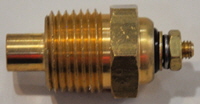 Over the next few weeks I bought a new filler cap for $195, yes $195! A new water temperature gauge sender for $17, and a section of new pipe for the lift pump $50. I also bought a new fuel lift pump for $50 and a new fuel filter for $15. While fitting the new pump I discovered two cracks in the fuel line from the tanks to the pump that meant a new 9’6-long fuel pipe for $105.
 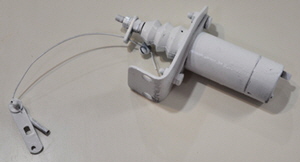 The engine solenoid turned out to be a bad earth to the engine block and after cleaning it has not failed - yet.
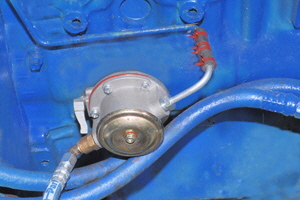 The new fuel pipe enabled me to make a good connection to the old pipe that snaked round the back of the block to the fuel filter and injection pump. A short piece of rubber fuel line and line clips connected the two pipes securely and leak free. These types of fuel line clips are better than tiny water hose clamps because they exert equal pressure all the way round a rubber pipe. On a tiny regular hose clamp the worm drive part is straight, not circular.
It took a long time to bleed the new fuel line all the way from the tanks, through four filters and the new lift pump to the engine, but eventually it fired and has worked perfectly thus far. Total to date, not counting rental car and fuel $432
Bob and Lisa were not available to make an immediate delivery of Britannia to New Bern, so I drove all the way back and left her lone again. A month later Bob and Lisa agreed to help me move her north and the successful voyage is covered in another article here.
RESCUE ON THE SHALLOW SEAS