and a fail-safe shore water supply system.
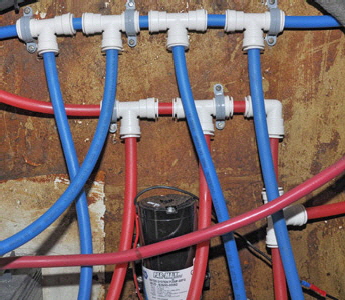

 The original plastic water pipes on Britannia were a horrible spaghetti-like mess in the bottom of the bilge and constantly leaking. It was always a contortionist-like job to even tighten up a fitting that had either vibrated loose or cracked. On talking to other owners of old boats it would seem to be a common problem as plastic pipes and fittings become brittle due to heat, cold, and plain old age. I therefore decided to replace my whole system with new modern fittings and pipes, along with a more powerful water pump than our present three gallons a minute unit, not powerful enough to allow both bathrooms to be used at the same time.
 I found an ideal system used in new home construction for replacing copper and lead pipes. I reasoned that if they were considered suitable to install permanently behind walls then they should also be suitable for my boat. The system is called PEX Piping and consists of ½-inch internal PVC pipes and numerous connectors.
I bought two 100 foot coils of half-inch diameter pipe. One coil red for hot water the other blue for cold. This in itself would be a great improvement because the old pipes were all grey and it was difficult to know which was which without running hot water through them. The connectors are guaranteed up to 100 psi and I worked out roughly how many elbows, tees, and straight connectors I thought I might need and actually used 28.
The original pipes had also been routed in the most difficult manner possible behind bulkheads and panels. This is easy when building a boat but not for owner maintenance. I planned to re-route my new pipes more visibly, so I could inspect them and get to any connections or breaks and this shortened the length of the pipes in many cases.
 The connectors are easy to join to the pipe. A small insert is placed in the end of the pipe to make a more solid join, then the connector is simply pushed into the pipe until it bottoms through an O ring that seals the joint. The pipe is prevented from blowing out under pressure by an internal barbed ring. Yet they are also surprisingly easy to disconnect - a small C-shaped removal tool is placed over the pipe then pushed against the fitting while at the same time pulling the pipe, and out it pops. This was a far-cry from the original connectors where the male connector bezel first had to be slid on the pipe along with a sharp barbed ring, (which I cut myself on more than once), and a plastic ferrule. The outer coupling then had to be screwed into its male connector—but not too tightly or the plastic coupling could crack and you would have to throw it away and start again. Repairing one of these in the bottom of the bilge was a tedious operation that was happening more and more frequently especially behind a panel or in a locker
INSTALLATION. Cutting this type of pipe is made very much easier using pipe cutting shears that slice through the pipe effortlessly and perfectly square and burr-free. However, uncoiling the tightly rolled plastic pipe was like wrestling an octopus, and it didn't want to form into anything like a straight length. I had to tie one end to the pulpit and uncoil it down the deck then tie it to the stern rail and leave it there in the Florida sun. This worked beautifully and within half an hour the pipe had succumbed to the heat and become workably straight. I still had to drill some awkward ¾-inch holes through bulkheads to route the pipes more directly to the aft cabins and the galley. Britannia has ten separate hot and cold outlets, including a dishwasher so I didn't have many pipes left over after I had routed both colors to the various appliances.
We had been living with the three-gallon-per-minute electric pump for years but it never really had enough pressure to supply both bathroom washbasin faucets at the same time and simultaneous warm showers were out of the question. I therefore decided to double the flow using a Par-Max Plus six gallons per minute pump. This is a big powerful pump and I was a bit worried about increasing the pressure from 35 psi to 60, but if it proved to be too much I knew I could return it for a pump with a slightly less power. I did have to fit a larger contact breaker in the circuit board, from 15amp to 20amps to carry the increased draw of the larger pump.
After I had laid all the twin pipes to the various outlets and returned them to the pump I set about making hot and cold manifolds using T connectors joined together. These were screwed to the side of our equipment bay just below the cabin sole where they would be easy to get to in the event of a failure. I installed the heavy pump just below these, head down per instructions. It was then just a question of connecting the various pipes to the manifolds.
It had taken two days to get this far and I had left the old pipes and pump in place to keep our water supply on and it was helpful to be able to double-check the old connections against the existing layout to be sure I was joining the right pipe to the hot and cold side. This was made much easier by the color-coded pipes.
Before I disconnected the old pipes we filled a few pans and the kettle with water, because it would not be possible to run any water until all the faucets were reconnected.
Stretching inside cupboards and unscrewing the old connectors and fitting the new ones took all day. One reason was that the various appliances didn't all have the same size threads did they? After all, it is a boat! So there were an inevitable couple of trips back to the store to buy adaptors and exchange fittings.
Britannia also has a shore-water connection, also known as a city water supply, that we connect when in marinas to save using the pump and batteries. A hose connects from a dock faucet to a pressure-reducing inlet on the boat and pressurizes the boat's water system. This gives a constant pressure without using any pumps or battery power and also means no noisy pumps and a more even flow to a shower. It also saves having to fill the tanks all the time. We liked the advantages and convenience but if a connector parted or a pipe broke I realized there was nothing to prevent the boat completely flooding or even sinking if nobody was on board to hear the bilge pump running. For this reason some people will not use a shore-water hose at all, We always switched the water off on the dock when we left the boat but that's not foolproof because it's easy to forget. But then you might say the same about a shore power electric that everyone uses without a second thought, but which have been the cause of many an electrical fire.
My thoughts therefore turned to how I could make a fail-safe system because there was no accounting for an internal failure even with new pipes and connectors. As a cheap added safeguard I fitted a second shut-off tap at the shore hose boat connection just in case anyone switched the dock faucet on again after we had left the boat. This was still not an automatic safety measure so I considered how I might install some sort of automatic shut-off.
AUTO SHUT OFF FOR SHORE WATER. 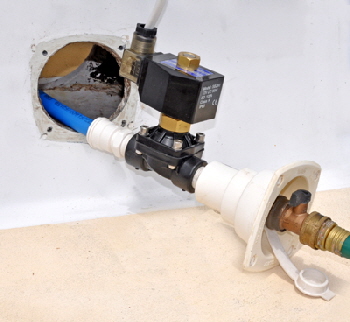 I found a 12-volt solenoid water valve online that is normally open, but instantly closes when voltage is applied that I connected directly after the pressure inlet and wired it to the bilge pump float switch. When the float switch operated the bilge pump it also closed the solenoid and stopped the shore water flow.
  On tests it closed flawlessly but after the bilge pump lowered the water the float switch switched off and the solenoid opened again allowing the shore water to flow and the cycle repeated continuously. To prevent this I incorporated what is called a latching relay. When activated by the float switch it stays live even when the bilge float switch power shuts off and thereby keeps the solenoid valve closed. The relay will only power-off when the circuit is manually switched off at a breaker. Britannia now has a fully automatic fail-safe shore water system and I even wired a bell into the circuit that rings when the system is activated. So she also now has a high-water bilge alarm that is favored by marine insurance companies. I fitted shut off valves on water supply to the dishwasher that we close when it is not being used in case the valves on the washer fail.
THE MOMENT OF TRUTH
 Since there was only air in all the new pipes I opened all the faucets, said a little prayer, then pushed the contact breaker to start the pump that immediately started up, then ran, and ran and ran, but with absolutely no sign of water at any faucet. These new style diaphragm pumps are capable of running dry so I was not so much bothered, but after a few minutes I began to wonder why not even the slightest spurt was coming out of even the nearest outlet to the pump. Then it suddenly dawned on me: both water tanks had shut-off valves which enable each side to be closed off as required. I remembered closing these while I connected the new system, but I couldn't remember opening them. Without thinking to switch off the pump I quickly lifted the floorboard where the values were located. Both valves were closed and I quickly opened one!! The pump instantly changed its tone, as though it was talking to me and what it was saying was not complimentary!
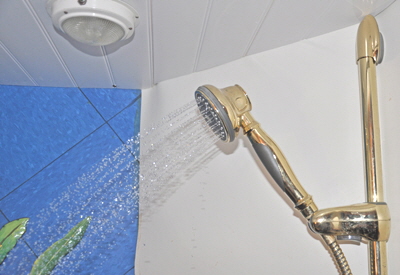
In an instant water gushed out of all the faucets with so much more force than we had been used to and water was splashing all of the place. I switched some taps off then turned on the shower in the aft cabin. This was now as powerful as our house shower. I quickly inspected all the connectors and found that I hadn't pushed the pipe fully into three connectors to engage the O ring seal, but that was easily remedied. There were also a couple of straight threaded connectors which dripped and easily stopped by a few extra turns with a wrench. After these adjustments all became silent - until I opened a faucet and the pressure drop activated the pump that again stopped the moment the pressure increased. Wow!
I tested the automatic shut-off valve by filling the bilge with fresh water until the switch activated the bilge pump and simultaneously switched the relay on that cut the shore water supply off. This then remained switched off even after the bilge pump lowered the water level.
This was good job done in restoring worn-out systems on an otherwise soundly constructed ocean cruiser.