
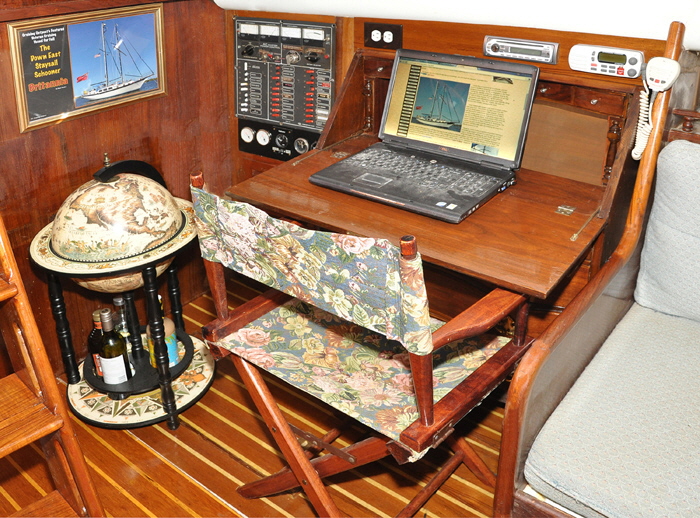
Since the advent of the Global Positioning System of navigation (GPS), I had not found much use for Britannia’s old chart table. Most of our passage-making navigation is done on the Raymarine multi-function display on the helm pod, then transferred to a paper chart on the saloon table roughly every hour. The chart table was only used to store things that didn't have a permanent home and a desk for my laptop.
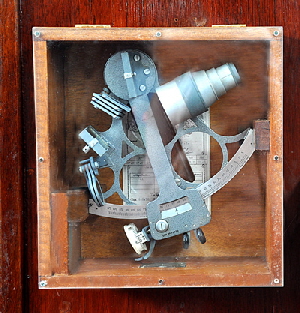 I am a sailing traditionalist—I wouldn't have built a square-rigged schooner if I wasn't. But advancements in equipment, particularly electrical and navigational devices should cause us to re-think some of the more traditional methods and layouts, including chart tables. Our trusty sextant served us well on past ocean passages but now hangs in its teak box on the saloon wall, an enchantment and reminder of bygone days.
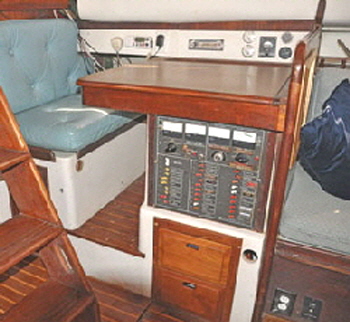
The chart table and seat took up over 40% percent of the length of the port side saloon that was not a very efficient utilization of space. The layout also left a lot to be desired; the space between the edge of the table and companionway ladder was a narrow 10-inches and squeezing into the seat frequently resulted in accidentally tripping contact breakers on the master power distribution panel at the side of the table. The chart table and seat were 9-inches higher than the remainder of the saloon—for only one reason I could think of—so anyone sitting there could look out of the windows. The half bulkhead separating the chart table from the rest of the saloon also made it difficult to slide in and out of the saloon table seats.
The layout needed to be improved
I thought about doing away with the chart table altogether and extending the saloon seating into the corner, where it would have made a lovely snug spot in a seaway. But not having a chart table at all might be considered by some as a negative for resale.
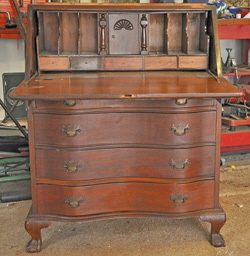 I spotted an ornate secretary's-desk in an anique antique mall in Orlando, Florida where I lived. It has a hinged drop-down lid with drawers and compartments inside and four large drawers below. With the lid open it was nearly the same size as the chart table and would easily fit in the existing space. But the important measurement was the companionway the desk would have to pass through into the saloon. The bureau was 31-inches wide and the maximum diagonal opening of the companionway was 32-inches, whew! Unfortunately, it was also stained a horrible brown/black color so I wasn't quite sure what type of wood it was made of, but I took a chance and bought it for $214.00.
Before I could install the desk the complete chart table and seat molding had to be removed. This was complicated by the location of the master AC/DC power distribution panel. I knew this would be a tough job because in places the molding was a sandwich of 3/4-inch thick marine plywood plus two layers of fiberglass, all heavily bonded to the side of the hull. I christened the structure "Stonehenge," because the manufacturers clearly never meant it to be removed or to fall over! It certainly was well made but a pity it was so "big" and un-ergonomic. I think the Druids of Stonehenge could have actually designed it better!
Before starting to dismantle this edifice everything loose was removed from the saloon and galley, and things that could not be moved were covered with cloths because I knew what was about to happen. Removing the solid teak chart table was easy enough, it was just screwed to the top of the molding—except it was so heavy two people had to lift it off the boat. The instruments at the side of the table also came out, along with the two small drawers and cupboard and all the teak fiddles.
 I then set about sawing the fiberglass support structure into small enough pieces to pass through the companionway. I used a combination of circular saw, reciprocating saw and oscillating cutter—along with a big hammer and pry bar! Dismantling Stonehenge was hard going, with fiberglass dust all over the place. I tried to minimize this by positioning my shop-vac nozzle near the cutting edges of the saws to suck in the bits. Altogether, including the chart table lid the pieces weighed 200Lbs! Next I attacked the half bulkhead which no longer needed to be so high. This was two plywood bulkheads thick totaling 1½-inches of plywood and fiberglass. I carefully removed the teak edging trim, reshaped the panels then refitted the trim to form an armrest.
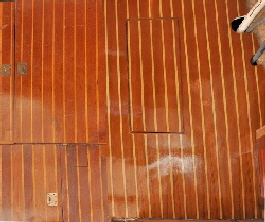 The builders had not extended the teak and holly cabin sole under the chart table as they had on other parts of the boat. It was just raw plywood under which was the conglomeration of wires leading to the electrical panel. I cut the floor completely out and after rerouting the wires I made a new floor with 3/4-plywood, including a hatch, to givebetter access to the three sea-cocks and filters below.
During all this work I needed to keep the boat's electrics running, particularly the air conditioning, so I had to be very careful not to cut through any wires. I soaked my aching back in the hot tub every evening and with Stonehenge finally excavated I now had a large open space to play with.
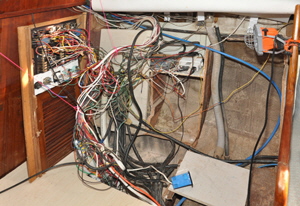
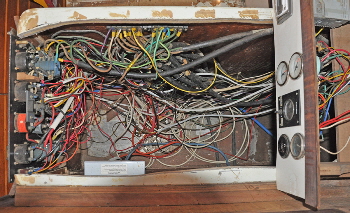 The first thing to relocate was the electrical panel with its spaghetti maze of wires, buzz-bars, connectors and relays, some original, circa 1977, and some I had installed when I fitted new equipment. The whole conglomeration could only be described as a wiring nightmare that had needed sorting out for a long time. Some wires went to devices not in the cockpit, some to the engine instruments mounted lower down on the pedestal and some didn’t go anywhere at all and must have been just cut off by the two previous owners.
I planned to reposition the panel higher up in the corner, where the breakers could no longer be accidentally tripped. For this I built a teak framework under the curve of the deck then used an old louvered door to give access to the wires leading to the panel above. I fitted a piece of 1/2-inch plywood below the panel to carry the four generator and water tanks gages.
Rewiring the panel with its hodgepodge of wires could easily turn into a real nightmare if I got them muddled up. It is at moments like this my wife always reminds me of the timeless boater's adage: "If it ain't broke, it will be when I fix it." Actually, that really needed tattooing on my right arm, so I could contemplate it before I started complicated projects like this
 There are different ways to re-wire an old boat. You can buy individual lengths of wire; you can convert to an NMEA (National Marine Electronics Association) networking system that interconnects nearly everything and can be read on a multi-function display screen - including engine instruments. You can even convert to WIFI wireless and have hardly any wires at all. These last two options were well outside my budget for this project so I decided to use regular wire but instead of buying individual lengths I bought a twenty-foot length of multi-conductor cable containing 20 wires of 14 AWG. (American wire gauge).These all have different colors and are very much cheaper than buying individual wires. However a problem can occur when using multi-conductor covered wire—they can become hot, even with just 12-volts. I completely stripped off the outer rubber casing and peeled it away from the wires, exposing each separate wire. Individual wires are less susceptible to overheating and easier to pull through holes and curves in boats. Also, I could pull a few strands out of the cluster to go to places other than the electrical master panel.
I first disconnected the AC and DC power to the panel and supported it so I could work on the back. For temporary lighting and power I used an extension cord direct from the marina dock. As each wire was replaced I switched the power back on to check if the particular equipment still worked. It was a slow, tedious and at times quite a strenuous process—reaching behind panels and pulling the old wires out. I also used an awful lot of crimp connectors. I drilled a hole in the cockpit sole and ran the wires to the back of the electrical pod then encased all the wires in a nice plastic split wire casing to keep them tidy down the side of the pedestal. On the 120 volt AC side the heavy-duty cables leading from the two ships/shore power plugs were long enough to reach the repositioned panel and thankfully did not need extending, just sorting out from the tangle in which they had been installed. It took four weeks to completely re-wire the panel then transfer it to the framework I had built next to where the new desk was to fit.
A dedicated engine start battery that had sat under the seat of the original layout needed relocating. I built a shelf under the new floor and fastened a battery box to it. This was now easily accessed through the hatch in the new floor. I was actually quite amazed that everything continued to work as before, and for once I proved the old adage wrong. I didn't need that tattoo just to remember to work carefully and methodically.
During breaks between all this “stonemasonry” and re-wiring I found time to renovate the bureau desk in my garage. The moment I put my sander to it I knew I had a gem—it was hardwood with a beautiful Walnut veneer and a pleasure to strip all the stain, clean the veneer and re-varnish it. I even found some ornate brass drawer handles on the web to replace the horrible black painted handles and look superb on the curved Walnut drawers. To fit my large screen laptop into the desk I had to remove the vertical dividers and mount the five small drawers at the top of the desk. With the flap open the table is almost the same size as the original chart table but when closed it takes up less than half the space. I infilled between the ornate feet with a plywood plinth to stop things rolling under the desk and the four drawers below add nicely to our storage.
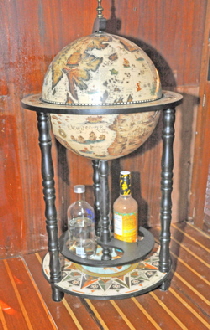 I hoped my companionway measurements were accurate as my wife and I carefully manhandled the posh new desk down the deck and into the cockpit, trying not to scratch the newly varnished sides. On its side it slid through the opening with about 1/2-inch to spare. but an inch is as good as a yard for a job like this. The desk then slid sideways neatly fitting under the curve of the deck
I already had a comfortable folding deck-chair that fitted perfectly and can be used at the dining table when needed. As an added touch I bought an antique-looking 16th-century globe drinks holder that fits nicely next to the bureau, secured in two teak collars in the floor
It is now considerably easier and much more comfortable to sit at the desk and the saloon appears bigger. The electrical panel is easier to operate and not a single breaker has been accidentally tripped. It is now more akin to a neat little office than a navigation area.
Smaller boats might greatly increase living space by redesigning their chart table area, or doing away with it completely. It just needs a bit of bold out-of-square thinking. I even sold the old chart table, offsetting some of the cost.