

 One of the nice things about the Down East 45 is the row of opening portlights on each side, which in addition to the deck hatches, allow for superb ventilation at anchor or at sea. They are all mounted in the coachroof side, not the hull, and can be opened when the boat is healed without fear of water sloshing in. The portlights on
  Britannia are the Beckson Marine "Newport" style, with their unique cam-latches. These latches are fully adjustable to clamp the ports waterproof, but once set they can be opened and closed very easily and quickly without having to screw and unscrew hold-down knobs, like on many old-style portlights. They also come with bug screens and self-draining rain gutters, and when properly adjusted they simply don't leak even when bombarded with solid water.
 Britannia had eleven Beckson ports
 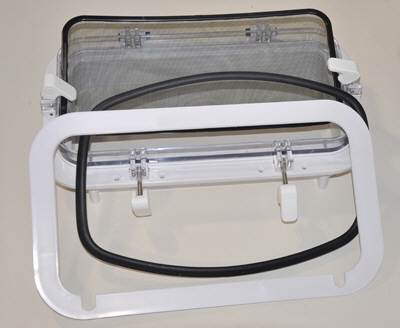 that must have been refitted by a previous owner, because only one of the original old styles remained, with their five screw-down knobs. This port never leaked either, because we had become familiar with knowing just how much to screw the knobs down to the correct pressure, to seal the rubber gasket. One day however, it did start leaking during a rain storm and I discovered that one of the hinged pivots had broken. This meant that one side of the widow could not be tightened down at all and water was dribbling in past the gasket. Some friends had just been sleeping in that cabin and I suspect that they had tightened the knob a bit too much, and cracked the plastic boss. There was no way the broken boss could be re-attached to the body of the portlight because even epoxy glue would never have resisted the screw being tightened sufficiently to seal the port. A new portlight was the only option, and since it was the odd man out I decided to buy a new Beckson port, to match all the others.
 After finding the correct size on Beckson's website, www.beckson.com. (Number 714 roughly 15” x 8” inches), I ordered a new unit and upon arrival I set about removing the old portlight. This turned out to be not as easy as I thought because it was completely glued solid with old caulk, on both the inside and outside flanges.
The first piece that had to be removed was the trim ring around the outside of the port. Using a combination of chisels and a box cutter I tried to ease the trim ring off the side of the cabin but it would simply not move at all. The caulk underneath the flange was holding the whole outer ring firmly against the coachroof side and I was reluctant to try to pry it out, for fear of damaging the paintwork.
 I searched the internet with the question, "How to soften marine caulk" and the results offered me numerous methods. The one mostly recommended was rubbing alcohol and since this is a liquid I hoped I would be able to run it into the joint between the trim ring and the cabin side. I soaked an old rag, then squeezed it along the seam. It ran in between the joint on the top of the flange and partly on the sides, but it would not run "uphill," along the bottom flange. After an hour of repeated applications the flange was still showing no signs of giving way. I then tried the second suggestion, vinegar, but with more-or-less the same non-result. The top of the trim ring had softened a little, but the sides and bottom were still solidly attached to the boat, and it seemed like the trim was perfectly happy to stay that way.
The new portlight came with a trim ring, so it didn't really matter if the old one was damaged in removal. I finally decided that I had little choice but to wrench the thing off with brute force. I hammered my 1½” inch chisel hard all the way along the top of the flange and managed to lever it part way off the cabin side. I then worked down the sides using the chisel to slice through the more reluctant caulk. It was more  difficult to hammer the chisel into the bottom flange which would still not budge.
My wife Kati had heard all the hammering and banging, including some choice expletives, and came to see how I was getting on. "Perhaps that's the reason the last old port was still there," she exclaimed, "The fitter probably had a heart attack before he could fit that one."
Finally, after using a long pry bar the trim ring suddenly cracked and broke. This was the point of no return and I started to apply some serious leverage on the flange, finally removing it in broken pieces. I could now see that the frame had been sealed to the cabin wall with what must have been at least a couple of tubes of caulk. The ½” inch gap all around the port body and the cabin side was completely solid with old caulk - but now that I could see what I was fighting against I definitely knew how I would handle that!
 I fitted a ⅜” inch diameter plunge bit to my hand router and set it at 1” inch depth. I then literally routed all the caulk out from inside the joint all the way around the rim. It was a good thing I had kept the portlight closed all this time to stop the dust and mess from entering the cabin, and I also wore a face mask and big gardening gauntlets. With this done, and after removing the screws holding the inside frame to the
 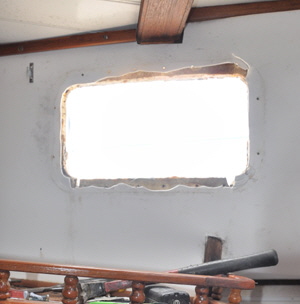 cabin wall I whacked the frame with a heavy hammer from the outside, and the whole assembly suddenly gave up the struggle and fell into the cabin. I then cleaned up the edges of the aperture ready for the new port.
This was the point where I would normally have taken a tea break, or even left the job until the next day, but if I had done that it would most likely have hurtled down with rain in the 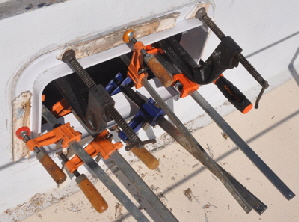 night and I had a 16” x 9” inch hole in the side of the cabin wall, that I could not easily have sealed watertight.
After cleaning up all the piles of caulk and bits of plastic, I offered the body of the new port into the hole and marked the position of the ten screw holes in the inside flange, then pre-drilled them to the screw size. Next I ran a caulk bead from my gun around the inner flange and screwed the port in place. These held the assembly rigid as I filled the gap between the cabin wall and frame with 100% silicone caulk that Beckson recommends, and it actually did consume nearly two tubes. I then completely removed the inside window by unscrewing and pulling the hinge pins which enabled me to use clamps to hold the trim ring against the cabin wall. I then caulked the ring and placed it over the protruding frame of the portlight, then clamped it tight. When the caulk had set, it was just a matter of trimming the excess from around the inside and outside flanges and my brand new portlight, which now matched all the others, was installed.
I still can't decide whether I should thank whoever broke the old portlight, or send them a large bill.