Britannia had a 6500-watt diesel generator, (6.5Kw), so why did I want an inverter when with the flick of a switch we could have oodles of 120-volt electricity to power the whole ship? The reason is simple – silence. Even though it is well insulated under the cabin sole we hated to run the generator for long periods, especially at night because of the noise and possible annoyance to others anchored nearby. It was always nicer when we switched it off, but then there was no AC power anywhere, so this is where a good inverter comes in to silently run all the 120 volt appliances.
Simply put, inverters work the opposite to a transformer; they take 12-volt DC current from the batteries and miraculously convert it to 120 AC to run the AC devices on your boat. Even small boats with hardly any electronics can benefit from an inverter - provided they have adequate batteries - because it offers an easy way to be able to operate equipment like a laptop or to recharge a phone. Small RV camper-vans nearly always have inverters to run their appliances when on the road if there is no room for a built-in generator. I even have a small portable inverter in my car to charge our phones and laptops while driving.
The power needed to run electrical devices is expressed in Watts (W) and usually printed on the actual device label. The term was named after James Watt, (1736-1819), a Scottish engineer. Watts is the amount of power needed to run a device and the result of current multiplied by voltage. Current is the rate at which the energy flows down a wire, measured in amps (A). Volts (V) is the number of electrons between any two points in an electrical circuit. One watt is therefore equal to one volt multiplied by one amp: W = V x A. Personally, I have always regarded these in comparative terms, (even when I could remember them), knowing for experience that something rated at 1000 watts needs - or rather consumes - ten times more power than something rated at 100 watts, and most people know that a 60-watt light bulb is brighter and uses more electricity than a 40-watt bulb.
During the modernization of Britannia I fitted two 16,000 Btu. (British thermal units), air conditioners of 1560 watts each, a dishwasher, twin 1500w water heater, a 1225w microwave, a 1200w electric toaster, and an electric kettle and coffee maker. In addition there are 14 AC lights throughout the boat. The Inverter also powers all the outlets in every area of the boat to be used for all kinds of personal devices that we take for granted in a house. Using this lot all at once would require towing a power station, but of course they are never all used at the same time. If we ever needed to use some of the larger consumer equipment simultaneously, like the dishwasher and the air conditioners I just switch the ‘genny’ on that is powerful enouph to run everything at once. Britannia is a true live-aboard vessel with all the mod-cons of a small apartment.
Due to the number of AC electrical devices now on the boat I decided to invest in an inverte,r and there certainly are a lot to choose from on the web. After comparing specifications and prices I decided to buy a Egscatee 4000-watt unit. This model is what is called a pure sine wave inverter that develops the same electricity as that used in a home and is best also for a boat, allowing all AC devices, especially domestic appliances, like an electric kettle, coffee maker, etc. to work at their maximum. It is of course possible to find inverters of greater power and internal quality - and price, than the one I bought, but I only needed one as a supplementary power source to compliment the other sources when at sea.
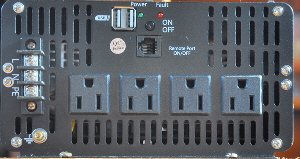 Inverters rarely actually generate their advertised wattage, so if I wanted to draw say 3000 watts I would need one that was rated about 25% higher and this turned out to be a pretty accurate rule of thumb. There is also the consideration of start-up surge voltage that is needed to kick-start many electrical devices and have a higher initial start-up watage than the working wattage. This inverter also has four 120-volt plugs in the back, so I plugged four of the more frequently used appliances directly into these receptacles, thereby bypassed the heavy duty wiring that can cause a reduction in power output. It also has two USB terminals that I extended to a twin USB terminal near the chart table so we can just plug-in our laptops and phones.
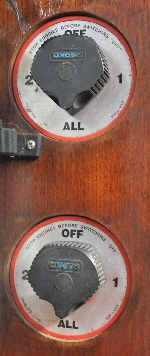
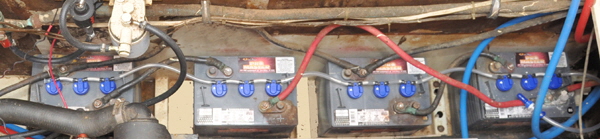 I added up my total 12-volt battery capacity at around 2000 watts. This comes from eight 6-volt golf-cart batteries connected to give four 12-volts DC. There is also two large 12-volt batteries for engine starting and windlass operation. All these can be interconnected or disconnected through two heavy-duty switches that allows great flexibility to switch batteries in or out of the system.
 INSTALLATION.
I guessed that my inverter had arrived when I saw the female delivery driver trundling an obviously heavy box down our driveway on a dolly. I found out just how heavy when I tried to lift it – it weighs 75Lbs!
The first decision to be made was where to install this beast. The instructions said they should be in a dry, well-ventilated space, but all owners of an old sailboat know that there is no such place in the bowels of a 40-year-old yacht. It is best to install these things flat, i.e. on their bases, and not sideways like they are often dipected. To help with ventilation I mounted it on two 1 1/2-inch wood blocks to allow air circulation all around and underneath. This done I screwed it down into a place where an old battery once stood, leaving plenty of room at either end for the input cables from the battery switches and at the other end the power outlets.
The next consideration is the thickness of the 12-volt input wires from the batteries. These need to be extra thick to carry the possible high draw from the batteries. After discussing this with the makers, and knowing the length of wire I needed they advised 4 AWG (American wire gauge), which is almost 3/4-inch in diameter, a really thick heavy wire! This ran from the battery change-over switches to the inverter's positive terminal with the return to the boats negative buss bar.
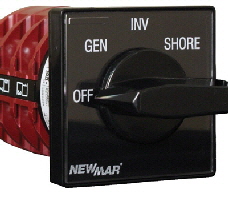
When introducing more than one source of AC power into a boats system, one being shore-power in a marina or from a built-in generator, it is very important to be able to isolate the sources to prevent any two AC sources colliding. I was introducing even a third source from the inverter, so I bought a four-way switch to replace the existing shore and ship AC inputs switch. A good one is by NewMar electrics but costs a whopping £160! It has switches marked OFF, GENerator, INVerter, SHORE power and ensures that only one AC power source can be introduced into the boats system at any one time. The input wires come in from the various sources and the output wire from this switch goes to my two AC distribution panels and from there through appropriate contact breakers to all the boats AC appliances.
 To complete the installation I sealed-off the compartment from the rest of the machinery space with a 3/4-inch thick plywood panel to help insulate the inverter from the engine bay heat. I also added a small 12-volt fan that comes on whenever the inverter is used and vents any hot air out of the compartment. The inverter has a remote start/stop display panel that shows the input and output voltages and the battery condition.
After completing the wiring it simply remained to cross my fingers and turn the master-switch to INVerter. I then gingerly pressed the inverter display start/stop button and bingo – the display showed 14 volts DC input battery voltage and an output of 120-volts AC. It also showed a battery condition of about three-quarters charged.
As a test I switched all 120-volt lights throughout the boat and they responded with a brightness the same as from the shore-power. Next I carefully tested each major appliance separately and they all came to life without a single murmur from my mighty new power source. It certainly is nice when at anchor to be able to boil the kettle for a cup of tea or the coffee-maker in the morning and also switch any of the AC lights on without having to start the generator.
Of course, one must never lose sight of the fact that all this power is coming from batteries that have been charged previously from another source, whether it be the engine alternator, the generator, from a shore-power via the battery charger, or solar panels, and that this power is merely being stored in the batteries. When an inverter is being used on a boat under sail with the engine switched off nothing is being put back into the batteries, (except maybe sollar), so even with such a large battery capacity as Britannia’s it is easy to inadvertently run the batteries down. It is therefore important to make sure the engine start-battery is out of the loop when the inverter is on and keep a watchful eye on the inverter display. But then there are many systems on a sailing boat that have to be treated with caution, in order to continue to enjoy the facility.

