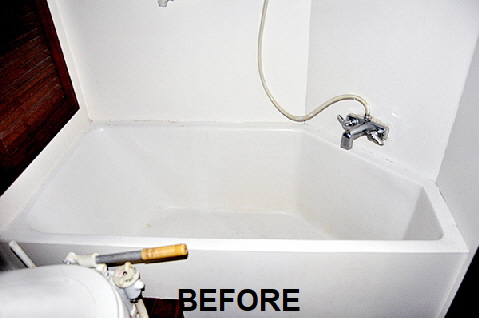
 When it was first built in 1977 Britannia had a bathtub of sorts built-into the aft cabin en-suite bathroom. It was only a short tub with a tapered end, so for anyone over about five feet tall it was an uncomfortably tight squeeze, and for me at six feet it was useless. Also the boat only had an 11 gallon hot water tank that was not enough to even half fill the bath.
My first thought was to rip it out and install a shower cubicle that could have been quite large and modern looking with a nice plexiglas door engraved with some nautical scene. However, in the process of taking measurements I began to think that if I encroached - just a bit - into the adjacent engine room, I might be able to squeeze an actual full size bathtub into the space, that would of course serve as a shower tub as well.
I have had hot-tubs at my homes where I always enjoyed a good hot soak especially after a day of back-aching work on a boat. The therapeutic benefits of a hot soak have been known ever since man first discovered hot springs. If you suffer aches and pains after physical work there is nothing finer than to immerse yourself in a nice hot bath and if this happens to also have invigorating massaging jets and a place to put a beer it’s only one step from heaven. So I thought, what if I could convert a bathtub into a hot-tub and enjoy the same relaxation? Power boats of Britannia’s size often have full size bathtubs but a monohull sailboat...not so much.
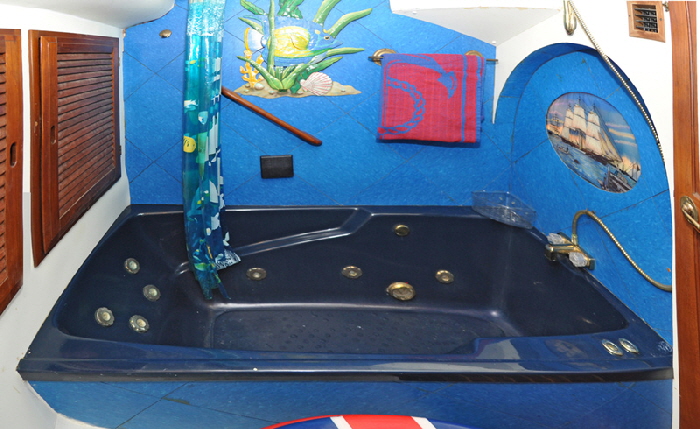
Firstly I needed to find a bath that would fit that had to be the type with a sloping back to conform to the shape of the hull. I went to see a local spa/bathtub manufacturer and asked the salesman if they had ever fitted a hot-tub in a boat? His blank expression gave me my answer, but after explaining what I wanted he saw no reason why they couldn’t fit jets into one of their regular household baths. He showed me a beautiful dark blue acrylic molding with a sloping back, which could be fitted with any number of massaging jets. He explained that there would also have to be a blower motor to shoot water through the jets on demand, and some sort of heater to maintain the water at about 102F degrees, but these could be mounted anywhere. This idea was starting to sound expensive.
ince I was going to pull the old bath out anyway I decided to first gut the space, then I could measure accurately and consider what to do—shower or hot-tub.
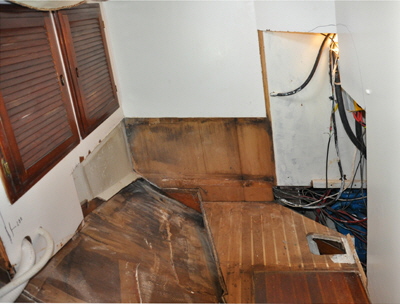 Like many jobs on a boat, removing the old tub turned out to be very much easier said-than-done. I thought it would just be a simple matter of cutting the bath moulding out, but au contraire! It was an unbelievable monolithic structure with two thicknesses of 3/4-inch marine plywood all round sandwiched between layers of glassfibre and resin, all moulded into the side of the hull and bulkheads! It all had to be hacked and levered out, bit by bit using a reciprocating saw, a die-grinder, a large pry-bar and an even bigger hammer! The whole lot must have weighed something like 200Lbs and I imagined the boat coming up three inches on her marks! I wore-out five heavy duty saw blades—and myself! I really could have jumped into a hot tub there and then.
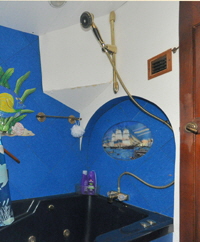 After three days of struggle and sweat the last piece finally went through the hatch and the whole area was laid bare down to the floorboards. To be able to fit the bath in I had to “steal” 4-inches out of the engine room. I did this by making an alcove and installing a nice glass picture of a square rigger with a light behind it.
Back at the tub manufacturers I discussed possibilities and price and finally decided to bite-the-bullet and order the bath. I lay in the tub while they marked the position of ten adjustable jets directed on my back legs and side.
It certainly caused some strange looks from fellow boaters in our marina as a friend and I wheeled a full size bathtub with all sorts of pipes sticking out of it down the dock and humped it on to Britannia’s deck. I joked to one inquisitive fellow that I planned to install it in a big hole on deck and he didn’t seem to be too perturbed. Evidently I had a reputation for other whacky jobs by then.
 The bath plunked down exactly where I had planned it and looked like it had been custom made—which it had. I couldn’t resist the temptation of see how it felt even with no water. This was not the end of the installation of course. I then had to buy a new mixer faucet and a shower wand and plum it into the hot and cold water pressure system. The sides of the bath also needed boxing in which I did with vinyl tiles all round and on the exposed side
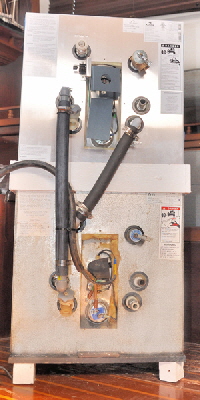 Having finished the actual bath installation I now turned my attention to heating enough water to fill it. The 11-gallon water heater tank sat on a raised platform below the saloon sole and would never be enough to supply 55-gallons of hot water at 104F so I decided to fit a second heater. I removed the existing tank and its platform and built a new one lower down in the bilge, thereby lowering the heater. I then positioned a new heater on top of the old one and piped them together in series. It was a welcome change to be able to work on the two tanks while they were sitting on the saloon floor instead of hanging down in the bilge like a blind bat in a cave. An added benefit of doubling the hot water capacity was to enable both bathroom showers to be used at the same time when we had guests.
The engine hot water pipes were connected together, then back to the  engine, and I fitted a shut-off valve on the engine pipe to close off the heater circuit to allow the engine to initially come to operating temperature more quickly.This system ensured a continuous flow of very hot engine water pumped through both coils inside the tanks and while I had it out I fitted a new immersion heater element in the old tank, The tanks had no water temperature gauge so there was no way of knowing what the temperature actually was. I removed the top drain tap and screwed an automobile capillary engine temperature gauge in its place that shows the temperature. If I ever need to drain the tanks I just open the lower tap and drain the fresh water into the bilge where it is pumped overboard. Both tanks were then lowered into position using a tackle strapped to the ceiling handrail supports. I then lagged all the hot water pipes using split foam tubing.
Britannia has two shore power receptacles supplying two separate distribution panels. These split the load of some of the higher electrical draws like the twin AC units and the dishwasher. I installed fresh wiring to the new heater through a second breaker. The reason for wiring the two heater elements separately is that if one fails - as they often can after years of use - I could at least heat water in the other tank from a shore power without running the engine.
After all these shenanigans both units were finally installed, wired and plumed and it was time to test my armature hydro-electrical engineering theories. The ambient temperature of the outside water was 45 degrees on the day of the test– which would affect the time for the engine to achieve maximum temperature.
I first switched on both heater elements and the gauge showed a discharge of 23-amps from the single 30-amps shore supply. I closed the engine pipe shut-off valve and started the engine to run at 2000 rpm - its normal cruising revs. The thermostats on the heater elements are set at 140F degrees and are non-adjustable and when they reached 140F the electrical side switched itself off. I then opened the shut-off valve to allow hot engine water to be pumped through both tank coils and I had to remind myself the engine was now having to heat 22 gallons. The whole process took about an hour and I then had 22 gallons of water at 178F. This is obviously much too hot for use but would it be enough to fill the bath with piping-hot water for a long soak?
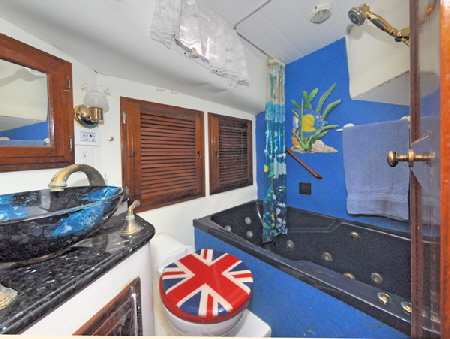 I opened the bathtub hot water faucet fully then watched and waited. Scalding hot water crept slowly up the sides of the bath until it slowly began to cool as both tanks depleted their initial hot water. The heater elements had come back on as the water dropped below 140F so I left them on. I let the cooling hot water continue to run as it slowly lowered the overall temperature. The engine and immersion heaters must have wondered what was happening to their valiant efforts to keep the water in the tanks at a steady temperature. As the bath became almost full the water was still too hot at 110 degrees so I switched the hot tap off and cooled it to 102F with cold water
I then climbed into the luxuriously warm water and switched the jets pump on to feel a nice massage on my back. I had even fitted a holder for my beer glass because it would be a disaster to have that tip over from rocking the boat, even in a marina berth. The bath pipes and jets had been insulated with foam when it was made so I was very pleased to find the temperature did not drop much for a half hour soak.
When we have been out sailing and motor back to our berth usually for about an hour, the water is piping hot solely through the engine and I can enjoy a nice long soak. I don’t anticipate using the bath when at anchor and have a big power boat cause their usual large wake heaving 20-gallons of hot water all over the floor.
It has been suggested, why I didn’t just use the hot tub at my home, which would have been a lot easier. The easy bit is definitely true, but then how would I have a nice soak when visiting other places on a cruise?
