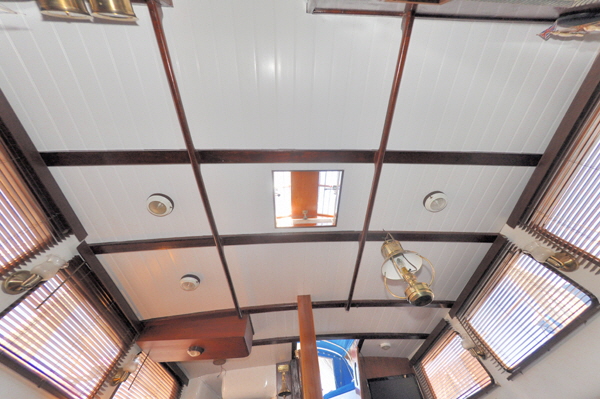

One of the inescapable truths about owning an old boat is, well—it’s old! If you are pushing 45 like Britannia many things need renovating or completely replacing. One of the more common things that often needs attention is restoration of the boat's headlining.
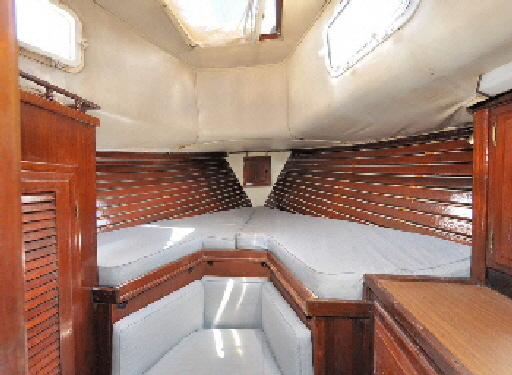 Let’s start by using the correct terminology for “headlining, or ceiling.” On a boat neither term is correct and the correct nautical term is overhead. Don’t ask me why, but “ceilings” are the wooden slats that are fitted on the sides of a hull, usually in cabins and notably in the fo’c’sle. They can make a small cabin seem wider but they are devilishly difficult to clean behind.
The overhead liners on Britannia had irritated my wife and I from the day we bought the boat. It was the usual vinyl material with felt backing stretched and stapled between the deck beams throughout the whole length of the boat, including both heads. Originally I’m sure it was a nice white color but over the years it had faded into a dirty beige. You know - the color of cigarette smoke - that at least one previous owner must have immitted in voluminous clouds. It was much too far-gone to clean and frequently fell to pieces when trying.

 Changing the boat’s rig from a ketch to a schooner didn’t help either, because it meant bolting new fittings through the deck - things like eye bolts, winches, rope jammers, liferaft cradles, etc., and not least relocating the main mast, that now came right through the center of the saloon. I had to cut the liner to install all these things and the only way I could think of to repair the slits was brown masking tape that didn't match too well at all. The vinyl soon looked like a patchwork of quickly applied band-aids and I would notice visitors glancing upwards, but politely saying nothing.
Eventually ‘replace vinyl ceiling' came to the top of my 'to-do' list but even thinking about it on my 50-footer gave me palpitations. The saloon overhead alone was nine-feet wide and eleven-feet long consisting of five full-width sections between the wooden deck beams. In addition, there were three other cabins, two bathrooms, and two corridors.
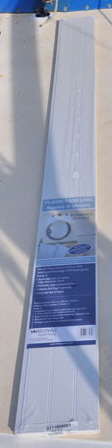
I certainly didn’t want to replace the liners with the same material because it looked like quite a skilled operation to first hold the floppy stuff in place, then fasten it so that it was smooth between the beams. The soft material is also very difficult to keep clean. I found a more suitable replacement in my local home improvement store. It is called plank paneling and is plastic (PVC) tongued and grooved planking often used as waincote panels on house walls. Each board is 7-inches wide 1/4-inch thick and comes in packs 8-feet long. It has two different sides, one moulded with two strips 3 1/2-inches wide, and the other side with three thinner strips and I decided to use the two-strip side. An important benefit particularly when used on a boat is the rot and mildew-free lifetime guarantee and the ability to wash it properly with soap and water. I also thought the added thickness to the vinyl would give better thermal insulation from a hot deck.
REMOVAL OF THE OLD OVERHEAD LINER. The first operation was to remove the old vinyl from a section between the beams. It was secured into a wooden bead which was in turn stapled to the deck beams with mild steel staples and every single one was rusty. Every 12-inches of liner contained roughly 24 staples, and on a 50-footer that means an awful lot of staples.
I cut the vinyl with a sharp Stanley knife along both sides and ends of the beams close to the staples and the lining frequently dropped on my head. It contained nearly five decades of dust and more than a few dead cockroaches and it always amazes me that cockroaches don’t seem to decompose over years…The remedy for this was to wear my wife’s shower cap after which, for some inexplicable reason she insisted on buying a new one.
Now came the monotonous job of removing all the old stapes from the wooden bead to which the cloth had been fixed. Luckily the teak bead was still in good condition so I used a thin blade flat-head screwdriver to prize the staples up one at a time then lever them out with long nosed pliers. Each section between the beams contained more than 500 staples.
INSTALLING THE NEW PANELS.
The new plastic panels were self-supporting between the approximate 2-foot space between the beams so I found I could secret nail them to the beads with one-inch stainless panel pins.
To cut the panels I mounted my miter saw in the cockpit and it sliced through them like cutting butter. Unfortunately it only make a six-inch wide cut so I had to turn the board over then very carefully finish the cut from the other side. A sliding compound saw would have been better to cut straight through a 7-inch-wide panel, but on boats one learns to use the tools one has. For this the lazer-guide on the saw proved invaluable firing an accurate red line down the cut. The material can also be cut with a sharp knife but that is a slow process and hard on the hands.
 I cut my first piece off an 8-foot long board slightly longer than the space between the beams. I then held it up between the beams exactly down the center line of the boat which I had marked with a thin string, fastened from one end of the saloon to the other. The deck beams were remarkable parallel to each other but each individual panel still had to be checked and sometimes trimmed to butt seamlessly against the beam. I marked the other end of the panel using a wooden ruler against the opposite beam and scored a line with a pencil. All this cutting meant that I had to climbed the six steps into the cockpit, carefully cut to the line then back down to try the fit, then frequently back up again to make minute adjustments to seat the panel snugly between the beams.
 Next, I drilled pilot holes with a 1/16-inch drill into the corner tongues of the panels to stop the pins from splitting the edge then I nailed the small thin pins in at a 45-degree angle into the wooden bead. After I had hammered my fingers a few times I held the pins with long-nosed pliers, then drove them home with a nail punch. I did consider gluing the panels in place but then they would have been practically impossible to remove if I ever needed to bolt another fitting through the deck. I have since actually removed a section to fit a new through-deck fitting, then replaced them exactly as before. The next panel was measured and cut exactly the same then tapped into the grooves of the adjacent panel that covered the pins then secured with pins on the other edge of the panel.
It was all easy enough and I soon got into the swing of measuring and cutting, but I would be lying if I said I didn't make a few wrong cuts and even found myself trying to mount a panel upside down more than once
When I came to the ends of a section where the last panel met the saloon sides they were all different shapes with tapers and rounded sides, the edges of which also needed chamfering to form a seamless fit against the cabin sides. Here I made cardboard templates then cut a board to the exact shape. All the side panels had to have templates throughout the whole length of the boat. The overhead lights had been removed and had to be re-screwed through the new panels and into the underside of the deck that helped to hold the panels in place. It was slow progress, but quite gratifying to eventually see a completely new clean section of panels sitting between the beams.
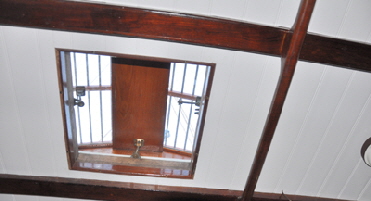
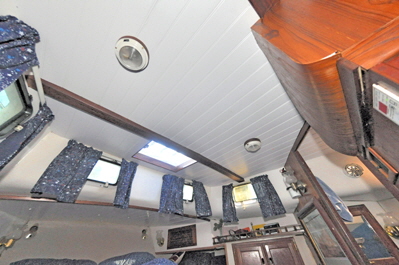 There is a butterfly hatch in the center of the saloon and the sides had to be extended before I could infill that section. The saloon took nearly a week of full-time work to complete then another three weeks to work through the whole boat.
The longer panels in the bathrooms and bedrooms had to be supported to stop them sagging which I did by screwing up into the under deck and covering the screw with a white plastic snap-on cap. The section under the aft cabin bed was especially tricky as I had to lie on my back on the bed to measure then cut and nail a panel in place. But it was worth it to have such a clean overhead above the bed.
I used ten packs of panels and made about 200 cuts. I removed more than 4000 rusty staples and pre-drilled and nailed some 400 pins in place—one at a time. It was tedious back-aching work - continuously reaching upwards and my arms ached for days afterward. But we now have a very professional looking overhead throughout the whole boat that has noticeably improved the appearance and caused a few compliments as well. And yes, we do call it the ceiling. There has also been a noticeable reduction in the heat felt through the deck on blistering hot Florida days and the effort has probably also increased the value of our old boat.