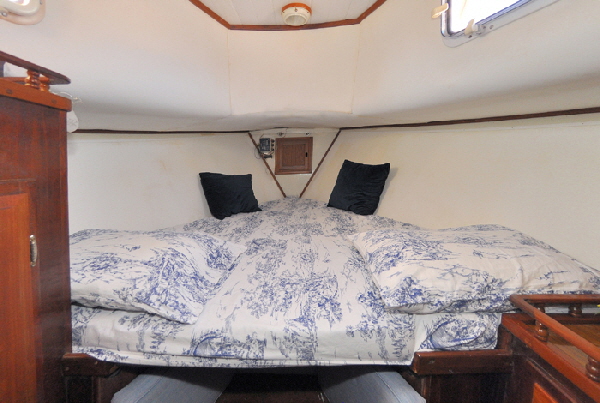

I have been messing about on boats for more than fifty years but it still never ceases to amaze me how many new things you learn when you restore an old boat. One example: who knew that the ceiling on a boat is not the ceiling at all? “Ceilings” are those wooden slats often fitted by manufacturers on cabin sides, mostly in fo'c'sles. The correct nautical term for the actual roof of a cabin, (that is, the ceiling in non-nautical lingo), is the "overhead." I learned this archaic snippet, (who’s only value are in impressing fellow boaters), when I decided to renovate the forward cabin of Britannia.
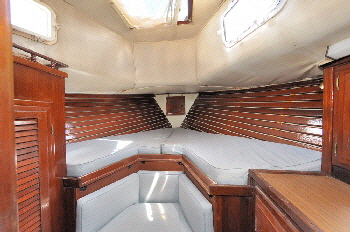 Nautical expressions can get confusing when referring to ceilings, which are really slats, and overheads which are really ceilings. So for this article I decided to use the commonly understood term, “roof,” to mean the underside of the deck that forms the actual roof of the cabin. On Britannia’s Fo’c’sle this will also include the underside of the lower deck, forward of the bunks. “Slats” are the teak strips on the sides of the hull. “Side” means the sides of the cabin, both the lower slopping sides with the slats and also the upper sides with the portlights in them.
Teak slats look nice but they are extremely difficult to clean behind and harbingers for dust and mildew. I therefore decided to remove all 22 of these 2-inch wide by ½-inch thick teak strips and replace them with easy to clean hygienic plastic sheeting. With six plugged screws securing each slat to the hull ribs that was a lot of unscrewing - 132 to be precise! This madke the cabin appear larger even though it had actually only widened by a little over an inch.
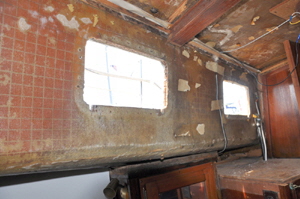 I also cut out all the dirty vinyl covering on the sides and roof that was glued and stapled to the glass fiber deck. I also removed the three portlights, two on the starboard side and one to port, then temporarily sealed the outside with duct tape to try and keep any rain out until I could reinstall them after I had fitted new side coverings.
Everyone who works on boats knows it is usually much easier to strip things out than to rebuild them and this project was no exception. After cutting all the dirty vinyl out, along with a few dead roaches and spiders, I then had to make templates by taping sheets of art-board together then cutting and adding bits to form the exact shape of each side. Then I traced the template on a plastic sheet. Plas-Tex plastic sheet comes in 4-feet by 8-feet sheets about 1/16-thick. It is very pliable, waterproof, and washable, and easily trimmed with scissors or a box cutter. I bought it at my local hardware store at $19.99 per sheet and used a total of five sheets on this project.
 I glued the panels to each side of the hull using contact adhesive on the side ribs and the battens which ran along the top of the cabin. I used gel-type adhesive because it is not stringy and doesn’t drip like the regular glue, which is quite important when applying glue upside down. I screwed a teak batten along the bottom of the sheet which stopped it from sagging between the ribs and reinstalling the portlights also helped to keep the large side panels in place.
With the lower panels in place I then made templates for the upper sides that curved around the shape of the deck. These were larger than the lower sides and more difficult to glue underneath. The largest and final piece of Plas-Tex had to be glued to the forward underside of the roof. I made the template by taping the artboards to the roof with masking tape to hold them in place while I trimmed and added pieces where required.
After cutting a plastic sheet to shape I pre-glued the glass fiber roof and the plastic. Offering it up after about ten minutes was a delicate once-off operation because contact adhesive sticks - as its name suggests - on contact. I lay on my back while my wife slid the large sticky sheet over me and I carefully pushed it up to where I had made marks from the template. It was then a question of ‘push and hope, then pressing it in place with arms and legs while the glue made contact. I used props to hold the sheet in place while the glue hardened.
I trimmed where the sheets joined each other with a ½-inch overlap. Then, using a box-cutter with a sharp new blade I cut through both overlapping layers at the same time then stripped of the top layer and peeled the inside layer away, giving the two pieces a perfect butt joint to each other that did not need any filler or trim. It was just a matter of cleaning excess glue with Methyl Ethyl Ketone (MEK) solvent. I cut other teak trim pieces from the slats I had removed, varnished them then glued them to cover the joints between the sides and roof.

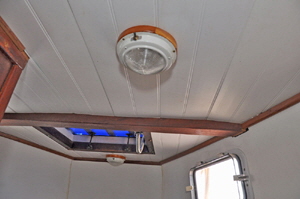 There were two sections in the roof of the cabin that needed covering between the deck beams and round the hatch. For this, I used the same tongued and grooved plastic boards I had used throughout the rest of the boat. It is called Plank Paneling and is (PVC) planking used as waincote panels on house walls. Each board is 7-inches wide and ¼-inch thick and comes in a pack of three boards each 8- feet long, for $22.00 from most hardware stores. It is reversible with different sides; one ihas two strips and the other three thinner strips and I decided to use the two strip side. An important benefit, particularly on a boat, is the rot and mildew free lifetime guarantee, along with the ability to wash it with soap and water. I had also found the thickness gave better thermal insulation from the hot deck compared to thin vinyl. I measured and trimmed these panels individually to accommodate any unevenness between the deck beams, then slotted them into the previous panel and secret nailed them to the wooden beads which had supported the original vinyl.
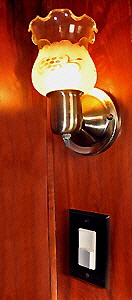 I added a second 12-volt dome light to give better light into this cabin and wired two 120 volt sconce lights into the boat's 120 volt system and connected both to a double switch mounted near the door. These are regular twin house switches that can be completely isolated from each other by snapping the bridging connection. I wired the top switch to the sconces and the bottom to the dome lights. This is a much more practical method than groping in the dark for those tiny overhead dome light switches.
There are two hanging lockers in this cabin, one on each side that had been varnished with multiple layers over the years and not very carefully either because runs could be seen down the doors and sides, I removed both doors, along with the pin rails round the shelf tops. I also removed the cabin door and the chain locker door and framework, along with four sliding drawers. These were all taken to my home to be restored in my garage. The locker sides and tops had to be stripped in-situ with varnish remover then scraped down to the original teak. This was then cleaned with teak cleaner and given two coats of satin varnish that brought out the beautiful golden tones of the wood. The inside of the lockers were then painted white. Old varnish even had to be cleaned from the nice brass reading lights.
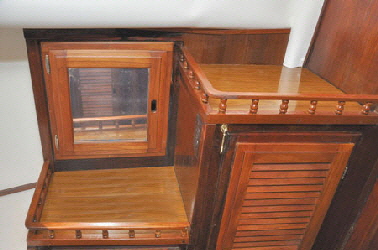 I wondered what to do about the imitation teak laminate shelf covering on top of the lockers. These were not scratched or damaged because Formica laminate is very resilient, but they had lost their luster and no amount of polishing would bring back the slightest hint of a shine. After experimenting with a small section I decided to varnish them with clear gloss varnish. I cleaned the laminate with soap and water then slapped a liberal coat of clear gloss on with a 2-brush. I then left the tops untouched for a week so the varnish could thoroughly dry to a hard finish. It dried to a fine smooth shiny finish with the advantage that when it gets scratched - which it undoubtedly will - it will be easy to re-touch with a dab of new varnish.
 I then re-installed the freshly varnished pin-rails round the edges of the shelves but instead of the square corners which the original rail had I made rounded corners out of spare wood. These look much nicer and more importantly they are not as painful when you bump your arm against the sharp pointed corners as the boat rolls.
Kati removed the bed foam coverings and machine washed them all. When everything was replaced and the bed made we found ourselves with a pristine new double cabin. It had not cost a lot of money if you don’t count the labor, but that’s supposed to be fun on boats.