
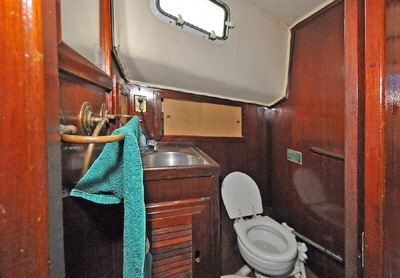
 When I bought Britannia the forward head was a poky little hole with a tiny 'rusty” stainless' steel washbasin and a minimum size manual toilet, that I could not stop leaking even after fitting new valves and seals. The toilet was not plumbed into the holding tank either, as I was led to believe by the seller, but discharged directly overboard which is illegal in American waters. One reason for this was because the aluminum holding tank had more holes in it than a cullender! There was also no shower because there was no room to shower - unless you wanted to sit on the toilet and soak everything else as well. Consequently there was no shower drain system under the grating and any leakage went straight into the bilge - not a good idea when a toilet leaks.
I closed all the sea-cocks and we never used the bathroom except for storage of fenders and ropes. It was a waste of space, so I started to consider what could be done with it.
The main problem was the tiny space - only 3-feet wide and 3-feet 6-inches long. However, there was an 18-inch wide full depth hanging locker just forward of the bathroom with a door opening into the corridor and not part of either of the two forward cabins. After careful measurement I decided to incorporate this locker space into the bathroom then consider what could be done with the extra space.
 I first cut away the bulkhead between the bathroom and the locker using a saws-all and a big hammer and chisel. Then the locker door and frame was removed and I used the bulkhead plywood to infill where the locker door had been. This immediately increased the bathroom area by 60% percent. The old washbasin and toilet, along with their pipes were removed and thrown away along with the smelly backing panel and side panels. The vinyl ceiling material was discolored and old, so that was ripped out as well. On removing the panels I discovered the portlight caulking had perished and leaked so that was re-bedded with new sealing compound.
As is well known to boat owners, one thing leads to another, and another...
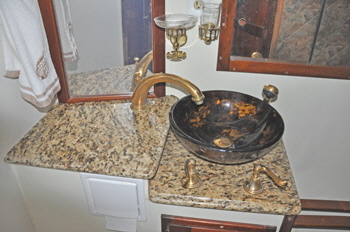
I could now began to see what I had to work with, yet I still had no clear picture of how it would all go back together. After repeated measuring and sketches I decided that the widest part of the area where the old toilet had fitted, would make a good shower stall. A new toilet would fit nicely in the old locker space and between them I could install a similar vessel washbasin and faucet like in the aft bathroom.

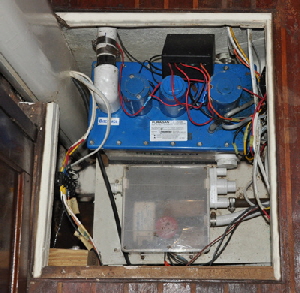 I bought the same 'Elegance' model toilet that I installed in the aft bathroom, along with the same style faucet and taps. I decided to also install the Purisan waste system which was working so well in the aft head. I would then have two completely independent heads, both with a US Coast Guard-approved waste treatment system. I installed the percolator for the system behind a side mirror and nothing can be seen of the working equipment and the macerator sump was installed under the floorboards. The toilet also fitted flush against the bulkhead and I was able to route the inlet and discharge pipes down through the floor, so no pipes are visible at all in this bathroom. I hate to see marine heads with exposed pipes and valves, when with a bit more effort they can usually be hidden.
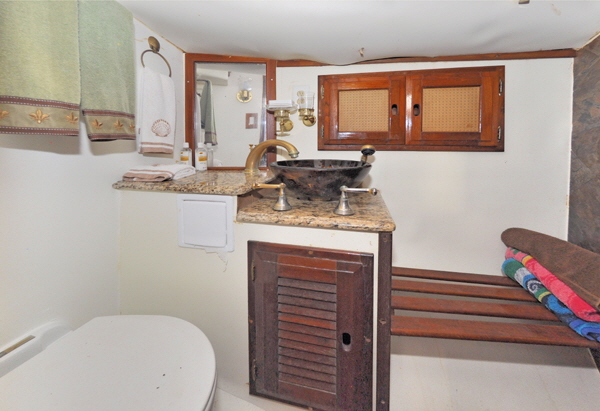
Positioning the toilet where the locker had been left a nice space for a shower and I bought a faucet set the same style as the aft bathroom, but with a shower head on a flexible cord that when pulled out hooked to a polished and adjustable wall mounting bracket. The single faucet needed mounting higher to be able to pour into the bowl so I built a raised section and fitted both levels with polished granite tops like in the aft bathroom.The shower drains through the 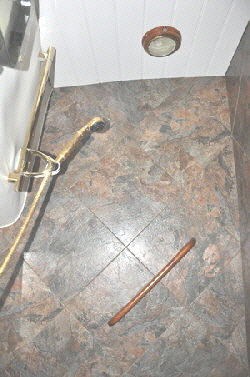 grating into an automatic discharge sump that pumps out through a vented loop into the washbasin sea-cock. I tiled this area with 1/8-thick waterproof vinyl tiles, glued to the wooden panels and thoroughly calked. The back panels were finished with plastic sheet and I built a seat of teak slats to be able to sit down while showering underway. I replaced the old wicker sliding door lockers with mirrors, giving the room a much larger and brighter feel.
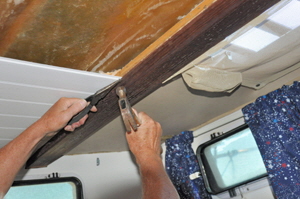 The ceiling, which now spanned the old ceiling and the locker was clad with PVC Ever-True Interior wainscot planking. These are tongue and groove panels that form a very nice rot-proof ceiling and offer a degree of insulation that the old vinyl did not. They were simply screwed and pinned to the existing ceiling cross members and with all the wiring for the ceiling lights concealed above.
I installed two 120-volt wall sconce lights. Both the 12-volt and the 120-volt lights work from the same dual toggle switch. When in port we use the 120-volt shore power supply and when at sea the 12-volt lamps.
The bathroom now looks more like an elegant yacht of a bygone era, yet it is modern and extremely functional. New bathroom.