
When I bought Britannia it had an old front-opening refrigerator that didn't cool very well, along with a large built-in icebox which only kept 20Lbs., of ice for a day before it melted.

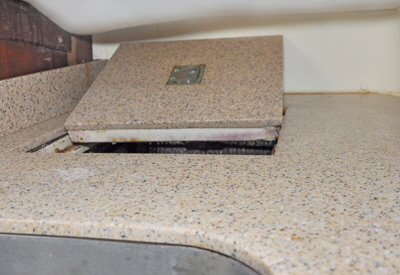 The first thing I did was remove the old refrigerator and slide a nice new stainless steel Indel unit in the same place but this only had a tiny space for frozen food so I began to consider if I might be able to convert the useless icebox into a proper freezer. The box was completely encapsulated in the side of the galley with one side bonded against the hull. It was 29-inches deep and extremely difficult to reach the bottom through the small 12-inch square lid, but there was a shelf halfway where food could be placed and ice packed underneath.
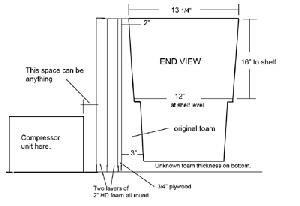
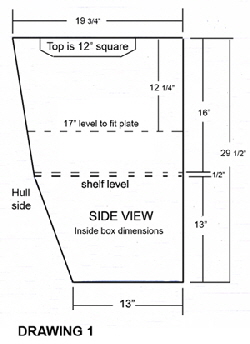 I had absolutely no experience of installing freezers and I wasn't even sure if it was possible in this layout. So I posted a question on the Cruisers Forum and received over 130 messages which varied from, "Impossible—buy a self-contained fridge/freezer box," to, "It depends on the thickness of the insulation." The thread was viewed by more than 6500 members worldwide, so there is evidently great interest in what I was considering doing.
From these replies and talking to people it became apparent that insulation is the single most important portion of any boat freezer. I was advised that no less than four inches, and preferably six inches of insulation thickness would be necessary to insulate the compartment for a freezer. The reason why insulation is so important on a sailboat is because the equipment needs to be running as little as possible to reduce battery drain. This is not so important on a power boat where the engine(s) will replenish any power used by the freezer. When the freezer compressor is off the inside of the box slowly starts to de-thaw, so the thicker the insulation the slower the de-thawing process. The compressor also works less with good insulation.
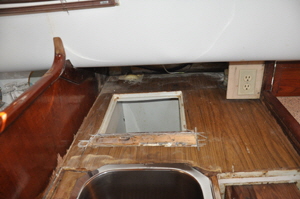 The inside of my icebox has a fiberglass inner shell 13-inches wide at the top and only 10-inches at the bottom. I therefore could not consider adding insulation to the inside of the box because it would reduce storage space. Nor could I do anything about the side of the box that is bonded to the hull but I could get to the other three sides. I first tried to discover what type of insulation was actually in the existing shell and what condition it was in after 40 or so years. I removed the new Corrian worktop I had previously fitted on the galley then drilled a few 1/2-inch exploratory holes in the sides and top of the freezer that brought out only dry foam. I also tried to cut into the top of the box in the hope of being able to better examine the insulation and replace it if necessary. This was one time when I wished Down Easter's are not built like Sherman Tanks because after hacking through two 1/4-inch thicknesses of fiberglass and two 3/4-inch thicknesses of marine ply, I still could not lift a section of the top. The only other thing I could do was take measurements on the three sides of the box which I could reach and assume the insulation foam inside was still good. These measurements indicated about 2-inches of insulation on two sides and 1-inch only on the other that was totally inadequate to maintain an icebox never mind a freezer.
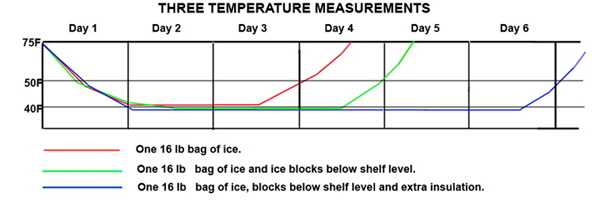
I bought a refrigerator thermometer and hung it inside the box. Then started a series of tests to see how long and at what temperature a 16Lb bag of ice would keep the temperature for the longest.
The first test was with a single 16Lb bag of ice in the upper section of the box above the shelf. This eventually reduced the temperature to 42F, but only for about 24 hours before the ice began to melt and the temperature rose. I could also feel the outside of the box was colder than the surrounding panels which meant there was leakage through the insulation to the outside .On the second test I filled the space below the shelf with solid block ice, which I had made in our home freezer. This time a 16Lbs bag of ice lasted 42 hours before it began to melt. Strangely the block ice still remained three-quarters solid, which I think was because the cold from the bag of ice sank and kept the blocks frozen.
 These tests over several days were quite consistent, because we have two very efficient air conditioners which can keep the saloon at a regular 75F. If the saloon ambient temperature had varied from day to day the test results would have also varied inconsistantly. It was obvious even to my inexperienced eye that a lot more insulation was needed. After again consulting with the Cruising Forum pundits I decided to buy a 4-foot x 8-foot sheet of 2-inches thick high-density foam called "Parma R," for $27.50 from the local hardware store. It has a tin foil backing on one side. I made accurate cardboard templates of the three sides and cut the foam carefully with a sharp knife. I made two pieces for each side panel so my insulation thickness would be an extra four inches on three sides
I glued the foam panels to the outside of the box using Liquid Nails, Panel and Foam adhesive, the tin foil side outwards. This glue does not melt the foam like other contact clues. I allowed the first layer to dry for a day before sticking the second layer on top then filled in all the joints and areas where I could not fit any foam using Aerosol foam insulation.
When all the new insulation was glued in place I conducted another test using another 16Lb bag of ice and a solid block below the shelf. This time the temperature inside the box sank to 39F and stayed there two extra days. Better still I could not feel any cold on the outside of the new insulation.
I felt some satisfaction in achieving this small advance because I had improved the insulation significantly for only a small cash outlay. Even if I decided to keep it only as an icebox it would be more efficient. I asked myself why the builders didn't do this when the boat was built?The temperature graph shows the differences between the three tests, But I remained mystified why, after all the new insulation was fitted the temperature did not drop much below 40F? I was told that even in a well-insulated freezer the holding plate temperature must be about ten degrees lower than the temperature set for the freezer. Therefore, in order to maintain freezing inside the box the plates needed to go down to minus 22F. Assuming the temperature of the bag of ice was at freezing, (32F), I was doing quite well to read 39F on my test.I now had to decide whether to buy a freezer unit or keep my much more improved ice box. Marine freezer units are not cheap, starting around $1900 to upwards of $4,000 for different specifications.
Refrigerators and freezers all work on the same principle, and with an abundance of detailed explanations on the web there is no need to repeat all the technical details here. Simply put: a compressor pumps freon gas through plates mounted inside the freezer box. The freon absorbs heat in the box and causes the inside to go cold and freeze. There are basically two types of freezer plates: evaporator plates and holding plates. Evaporator plates are like those in a household fridge/freezer - thin corrugated wrap-round plates usually in the top of the fridge. These freeze quickly but because they are so thin they also de-freeze quickly, so the equipment needs to be running almost continuously to keep them frozen which is no problem when you have household electricity but something you don’t want on a sailboat. Holding plates are much thicker, up to 3-inches if there is space inside the cabinet. they take longer to freeze but stay frozen longer, so once they are frozen it takes less power to keep them cold. For any boat particularly a sailboat, holding plates are the best solution for a freezer.
BUYING THE EQUIPMENT
I sent a drawing to four suppliers of marine refrigeration equipment asking for recommendations, specifications, and prices. One didn't reply at all, another was so difficult to drag a price out of that I gave up. Finally, I choose Sea Frost in Barrington New Hampshire who were the most helpful. (www.seafrost.com) They could supply all the equipmen, along with custom-sized holding plates. The owner, Cleave Horton, is extremely knowledgeable and recommended two holding plates, one on each side inside the box connected together to the compressor. These would be 15-inches square x 1-inch thick and would just fit through the 12-inch square lid of the box. I would therefore lose 2-inches in the upper box width. I asked Cleave if it wouldn't be better and cheaper to have one 2-inch thick holding plate? His reply was, "Think of it as standing in front of a fire in your house. Only your back gets warm, but if you were between two fires you would toast evenly." I thought this was a good analogy and I'm sure it is the sort of thing an inexperienced buyer likes to hear.
Another important item to consider in any freezer system is the compressor and associated equipment. There are electric compressors, of which by far the most popular make is Danforth. Then there are engine-driven compressors that are more powerful and don't deplete batteries when the engines are running, so these are ideal for power boats. There are also air-cooled compressors and water-cooled compressors. Difficult choices indeed for an apprentice.
As usual on boats there are pros and cons for each type. My boat has a very large battery bank of over 1300 amp hours and numerous ways to keep them charged. I have a wind generator, solar panels, a 6.5kw generator with both a 12-volt alternator and 120-volt outputs, not counting the main engine alternator. I therefore decided to buy a 12-volt air-cooled system.
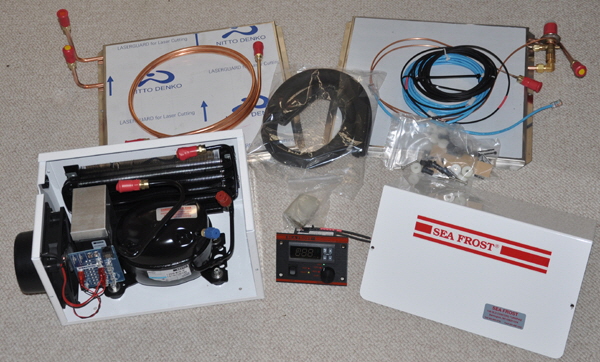
The compressor, along with its condenser, (the radiator part which dissipates the hot air), and the control electronics are particularly well made on the Sea Frost units. All the items are enclosed in a strong metal box that keeps dust and dirt out and allows for other things to be stored in the same locker without them resting on the equipment. All the other manufacturers I looked at had open equipment. The control unit can be mounted anywhere and is connected to the holding plates with pipes pre-loaded with liquid freon and employing self-sealing couplings. My pipes were made exactly the right length to my drawing and connected to a holding plate inside the box.
Sea Frost's instruction manual is meticulous which was very helpful to me, a novice. They even include photographs of how to bolt the pipes together using two wrenches so as not to over-tighten or strip the connectors. I had ordered the latest Danforth BD80XP compressor which they said uses less power, along with a fully programmable remote electronic thermostat. Sea Frost built and shipped my order in one week. The total cost was $2312.
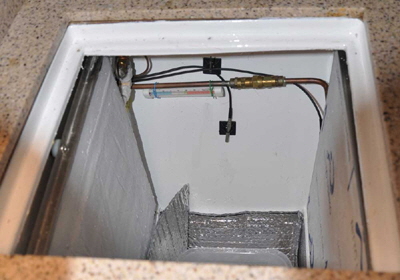 Before installing the holding plates I decided to repair a few chips in the fiberglass and paint the box with two-pot epoxy paint that made the inside look new. I found the installation to be quite straightforward. I first screwed the plates to both sides of the box, using the special fasteners supplied that hold them about 1/4-inch clear of the side walls, permiting all-round circulation. Then I drilled a 1-inch hole through the side of the box and passed the pipes and thermostat wires though. The most difficult-to-fit pipes were the ones to connect the holding plates inside the box. I followed the detailed pipe connecting instructions and managed it all with no loss of freon. The other end of the pipes connect to the compressor unit.
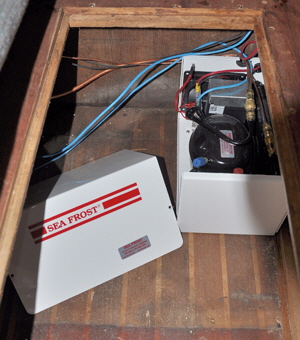 I mounted the compressor cabinet under a saloon seat next to the freezer. A small fan circulates air through the condenser radiator inside the cabinet and blows it into a cupboard under the sinks that has a louvered door. I therefore had a good circulation of ambient air through the unit.
I then wired the electronics into my 12-volt circuit board with a 30 amp breaker marked "freezer."
Finally, and on further advice from my trusty Cruising Forum friends, I lined the inside of the box with 1/4-inch thick bubble wrap with foil on both sides. This is used to line freezers and iceboxes in RVs and is easily removable for cleaning. I also fitted a ball valve on the water drain pipe in the bottom of the box to prevent even the slightest amount of cold water from escaping down the pipe.
When the moment of reckoning arrived everything started to hum with no leaks and was amazingly quiet. The holding plates immediately became cold to the touch and after about two hours we found ourselves with a superb little freezer, which stays at minus 26F all the time.
It is certainly one of my better modifications to our good old boat.