
 When I bought Britannia she didn't have any engine room ventilation, either through natural aeration with cowls or electric blowers.
The term, "engine-room" is a bit of a misnomer on Britannia because the area is 26-feet long—from the forward saloon bulkhead to the aft cabin and all under the saloon floorboards. This space doesn't just contain the main engine, a Perkins 4-236, but all the other machinery that runs the ship, including a diesel generator, a water heater, nine batteries, a large battery charger and five electric pumps. All these fit in what I call the "equipment bay."
When everything is humming and especially when both the generator and main engine are running together, the heat permeating through the 3/4-inch plywood cabin sole could be felt on bare feet. I once placed a thermometer in the space and after five minutes it registered 150F which isn't good for the machinery or our feet.
Whether you have a large underfloor area or a small engine compartment it will always be beneficial to ventilate the space. All mechanical devices create heat and diesel engines are designed to run hot, but internal combustion engines also run better when drawing cooler air which has the effect of increasing the swept volume in the cylinders.
It was obvious to me that a single electric fan would be hard-pressed to suck all the hot air out and draw cooler air in over such a large volume area. I thought about whether to have two fans sucking the air out, but theoretically that would mean a bigger inlet. A fan would be needed to blow fresh air into the front of the compartment and also one to suck hot air out somewhere near the stern. Since the floorboards aren't air-tight I was also a bit concerned air might be sucked below from the air-conditioned living areas.
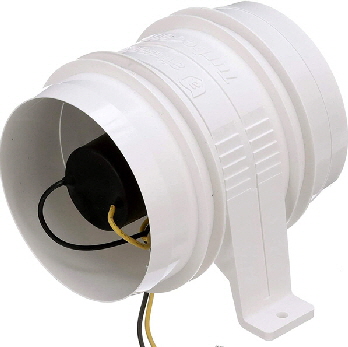
I found a 4-inch diameter five blade fan on Amazon.com for $35.00. The Attwood 1749-4 Turbo 4000 is a 12-Volt in-line blower designed to fit 4-Inch interior diameter piping. The specification said it was water-resistant and guaranteed for three years.
The problem was how to route the trunking to achieve maximum flow and what type of trunking to use. I have used flexible plastic wire-wound pipe before and it is frequently used on boats for air conditioning trunking, but my experience has been that it doesn't last very long. Even if the pipe is protected from vibration through bulkheads, which it inevitably has to pass, it only takes one small tear in the plastic sheathing to cause a leak and reduce the airflow and which sometimes can't even be seen and gets worse as time goes by. Furthermore, because it is so thin-walled it conducts heat very easily but my objective was to get the heat out of the boat as quickly as possible not to warm the various lockers the pipe passed through. I also found 4-inches diameter corrugated aluminum pipe in my local hardware store, which is stronger than flexible plastic, but also conducts heat even more. Flexible pipe can also be squashed by other items in lockers, sometimes severely limiting airflow.
After much thought and lots of measurements I finally decided to use 4-inch diameter rigid plastic pipe—the type used in houses for sewage lines. This has a wall thickness of about 1/8-inch and a smooth interior bore offering the least resistance to airflow. 90°degree and 45°degree bends are also available enabling a pipe to be routed just about anywhere. Rigid pipe is also self-supporting between bulkheads
I bought two fans, three 10-lengths of pipe and a pile of different bends. With this type of project it's difficult to know what type of bends will actually be needed, so being able to return unused items to the store was a great advantage.
At the forward end of the equipment bay was a bank of six vertical lockers. Ideal to route a long inlet vent pipe straight down from on deck to the forward end of the bay to become the air inlet pipe.
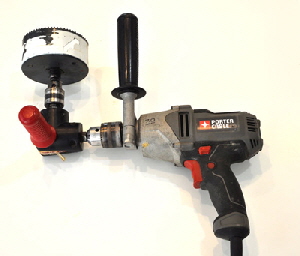
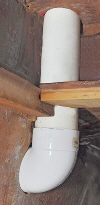 What I didn't count on was the effort needed to cut the large diameter holes, first through the deck then through seven more thicknesses of 3/4-inch solid teak. It was hard going using a 4¼-inch diameter hole cutter on a 90°degree drill attachment boring through each locker base then finally through the lower bulkhead into the equipment bay. It was difficult to get the holes exactly level so the extra ¼-inch gave me some wiggle room. I was finally able to slide a 10-foot long pipe straight through all the holes and using a 90°degree bend on the end the air was directed straight onto the generator engine. Not many boats will have such a convenient way to install a rigid inlet pipe, but it doesn't need to come into the center of the area. Anywhere at the front of your engine area will do
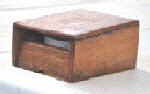 I mounted the fan halfway down the tube accessed in a locker big enough to be able to get at it in the event of a failure. When the locker doors are closed nobody would ever know there is a large ventilation pipe inside. I left the pipe sticking out of the deck an inch as I needed some type of cover to stop rain coming in yet still give a good airflow. I thought a classic Dorade style vent—where the air has to pass over a baffle—might restrict the maximum air the fan could draw. I therefore built a simpler teak box, with baffles to keep rainwater out but still allow good airflow.
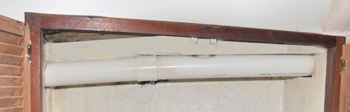 The pipes and bends slot perfectly into each other and into the fans with an airtight fit. I therefore didn't need to actually glue the pieces together, but I simply drilled holes through the joint then screwed two self-tapping screws in to stop the pipe from coming apart through vibration. There is always a chance of something breaking, so dismantling any section would be easier if it was not glued. One disadvantage of using rigid pipe, especially 4-inches diameter is that it is sometimes difficult to pass long lengths through lockers and bulkheads because it doesn’t bend. The way around this is to use a coupling and splice two sections of pipe together after they are installed from both ends.
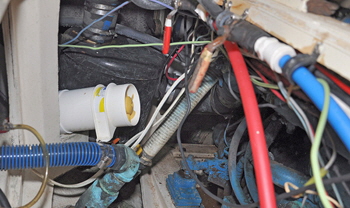
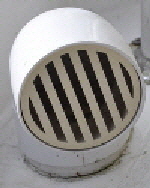 I positioned the rear fan alongside the main engine, so it would suck the maximum amount of hot air out. There was only one way the tubing could then be routed to the back of the boat. This was through the aft cabin starboard side lockers then up to the aft deck. I cut the holes with the hole-cutter and drill, that were by now beginning to show signs of fatigue—as were my arms and shoulders. It took a lot of scrambling through lockers and bulkheads to get the rear piping lined up but eventually, using both 90° and 45° degree bends I managed to bring the pipe out through a hole in the deck. I then caulked it and used a 90°degree bend and grating to act as a cowl. I also bought a cap which fitted on the pipe, keeping the rain out when we were not using the blowers.
There is no on/off or reverse switch on these fans, so to reverse the airflow it's just a matter of mounting the fan in the opposite direction so one blows and the other sucks. Wiring them was also easy by connecting to spare 12volt contact breakers on the main distribution pane that I marked, "extractor fans." I wasn't concerned about the current draw either because I only use the fans when the engine or genny are running, both of which have alternators.
When I first switched both fans on and felt the enormous rush of air shooting out the rear cowl like a jet engine I had visions it might give us at least another knot? The real test however was how much the system would displace the hot air and reduce the temperature in the whole equipment bay when everything was operating normally underway. For that test I waited until the temperature had risen to 150F then switched the fans on. The heat coming out of the rear vent would have melted varnish! But it still took fifteen minutes to drop the temperature to 100F and a further fifteen to reduce it to 85F which was the outside temperature that day. When I started the fans with cold equipment the temperature remained steady near the ambient outside temperature. The forward fan blows out directly in front of the generator motor thatich runs cooler when the blower is on. Even blowing 95° air in is cooler than normal running temperatures inside I could even hear the equipment breathing a sigh of relief, and there was another unexpected benefit I had not considered. The air rushing out of the rear vent smelled - a machine-shop smell - so the fans were also removing odor that would normally congregate in the equipment bay. Whenever I arrive at the boat I now switch both fans on immediately and they seem to help remove that "closed up boat smell," quicker.
This was a very satisfactory outcome for all the effort and not much actual cost. It would be a worthwhile addition to any boat especially one with all the machinery like Britannia.