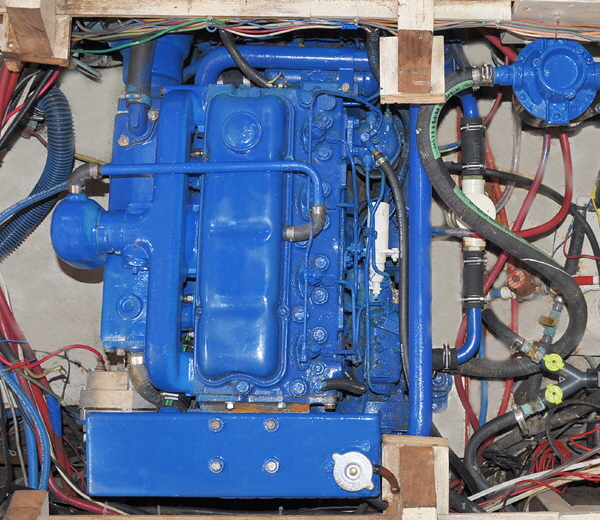

One of the problems of navigating a sailboat that draws 6’3-inches in the shallow Intracoastal waterways in Florida is the inevitability of the occasional grounding. This does not normally cause damage for a long keel boat, because the bottom is mostly soft black mud, but depending on how hard she goes on it can be a quite a trial to refloat because the mud is better than contact adhesive and the boat can become well and truly stuck. With any attempt to refloat, the propeller that is whirling madly only a few feet from the muddy bottom is certain to disturb lots of silt and sludge that can be drawn into an engine water cooling intake and cause havoc. This degrading process can also go on for years without actually grounding.
Most freshwater-cooled marine diesel engines operate on similar cooling principles. Simply put, cold seawater is drawn in by a pump and this cools the hot fresh water in the engine through a heat exchanger. The residual warmed seawater is then pumped out of the back of the boat, usually through the exhaust pipe.
The large mesh filters fitted to most seawater intakes will capture larger lumps of debris like sea grass and other debris, but minute particles of sand and sludge can still pass through, first clogging the neoprene seawater impeller pump then working their way into the engine’s heat exchanger(s) and cooling passageways. The first sign of this is often a rise in the engine’s temperature along with a reduction in revolutions and performance.
STOPPED IN HER TRACKS.
This finally occurred when we were traversing a short 20-mile section of the Intracoastal between Titusville and New Smyrna on Florida’s eastern coast in 2022. The Perkins 4-236 diesel would simply refuse to run its normal 2000 rpm cruising revs and the water temperature had started to rise above its normal 180F. When we arrived at the New Smyrna anchorage I examined the large primary engine filter to find the 2-inch diameter wire gauze completely blocked on the outside - which is where any debris should be - but also completely solid on the inside, something I had never seen before!
I had topped up our water tanks to 340 gallons that weighs 2.75 tons and had been enough to cause us to ground leaving our slip in Merritt Island near Cape Canaveral. We had to be pulled out by the marina tender with its 150hp motor assisted with Britannia’s engine, that caused considerable silt and backwash to be disturbed off the bottom. From the condition of the primary filter It was obvious that a lot of this muck had been sucked into the engine.
DISMANTLING.
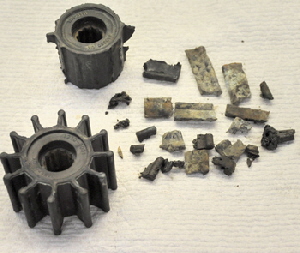 I removed the plate on the front of the Jabsco seawater pump and to my complete amazement the impeller vanes had disintegrated and vanished leaving only the hub on the shaft. This must have happened when the primary filter become completely clogged, causing the impeller pump to run dry and shredding the vanes. There is only one place the broken bits can then go—into the bowels of the engine.
A new impeller was fitted and I cleaned the filter and pipes to the pump and we then limped back 15 miles to the mooring field at Titusville at low engine revolutions because the engine was still overheating. We had to restrict the engine to only 1200 rpm as we trudged back to Britannia’s marina berth 20 miles south that took five hours.
clearly there were other blockages and I decided to follow the flow of seawater from the impeller to the next piece of equipment and then onward - or rather inward, into the bowels of the engine. I will mention here that all this was in the height of the summer with daily temperatures in the 90s Fahrenheit and sometimes over 100F inside the boat. All I had for protection against the blistering heat was the boat’s air conditioning that managed to keep the inside temperature at around 75F, otherwise I would still be at it.
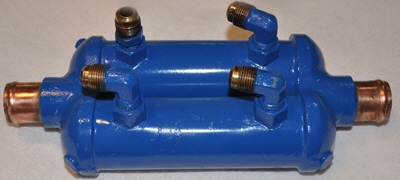 The first place the water went was into the oil heat exchanger situated right at the back of the engine—naturally. I removed the water hose and poked a finger inside—pulling out soft rubber and dirt! It was solid! This meant removing the double-barreled oil cooler that was no easy task because a bulkhead was in the way. I finally managed to lever it out and using long-nosed pliers I pulled as many bits of impeller out as I could, then back-flushed the twin pipes with water until I achieved a good flow with no more debris.
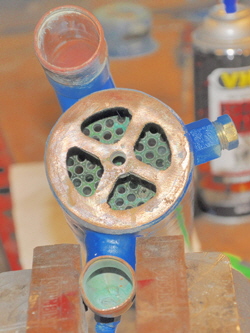 The next path for seawater was to the larger engine heat exchanger that was also partially blocked with tiny bits of the impeller and lots of sludge. This was when I decided that there was nothing else for it but to completely dismantle
  and clean all the seawater passageways in this big old engine.
All the parts of the cooling system had to come off to be examined and cleaned. But two floor beams had been positioned right over the engine and it was impossible to get a wrench on some of the nuts. These beams had to come out, so I used my circular saw to make 45 degree cuts on each end and removed the beams. I glued a sliver of wood on the ends of the beams to make up for the thickness of the saw cuts then fitted guides on the edges of the joint to prevent the beam slipping of when I replaced them. This would be much easier to gain access if I ever needed to ge to these awkward bolts in future.
To get at thelarge heavy main heat exchanger I first had to remove the intake manifold - to be able to get to the nuts to remove the heavy cast iron exhaust manifold - to be able to reach the nuts securing the heat-exchanger… It is at times like this when I would have liked to get my bruised knuckles around the necks of the people who built this boat! All these heavy cast-iron pieces were secured with rusty nuts and studs into the block and had probably not unscrewed in 45 years. Some were so welded up with rust I needed to soak them in Blaster-penetrating oil and use a long socket handle that I wacked with a hammer to break them loose. These I threw away and bought new fasteners.
Three hours later I had the heat-exchanger in my hands, It was not easy to clean the large device with its honeycomb of tiny tubes inside carrying the hot fresh water to where it is cooled, or exchanged, by the flow of cold seawater—that is when there is any! I counted about 100 1/8-inch diameter pipes inside the body of the heat exchange, yet only about were 30 capable of passing water and the rest were blocked with sludge. No wonder poor old “Perky” didn’t have any strength, he needed multiple bypass surgery!
 I bought a 24-inch long 1/8-inch drill bit and carefully rotated it by hand down every tube I could get to, and extracting reams of dirt from each. But some of the tubes were so solidly ingrained that I had to drill them clean using an electric drill. This is called “rodding” the tubes, and needs to be done very carefully indeed, because if the tubes become punctured freshwater and seawater will mix and the expensive heat exchanger becomes useless. I then immersed the whole thing in a bath of Rydlyme Marine dissolving fluid - a descaling liquid used by diesel engineers to clean inaccessible parts of engines. Then I pressure-washed the pipes until clean water flowed through both the seawater and freshwater tubes.
It was clear that debris had permeated through the whole seawater system and I think it must have been building up for a long time on our trips in the ICW, well before our recent grounding.
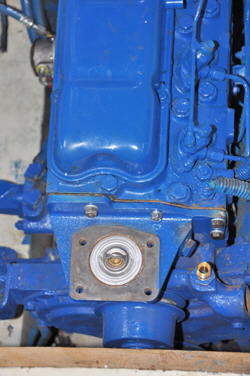 The next item to inspect on it’s cooling water passage was the thermostat, but it wasn’t where the engine manual said it was. I then found out that my so-called ‘British engine’ was a “North American model” and the thermostat was located under the large header tank at the front of the engine. When this tank was removed the thermostat was there completely covered by a great black blob of muck. I fancied it said “hello” as I looked a it.
By now things were completely out of control and I had bits of the motor all over my garage. I decided to remove the freshwater pump at the front of the engine to be able to examine the inside of the block. To do this I had to remove the thermostat housing bolted on top of it…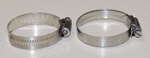
 Some of the hose clips had actually snapped leaving the pipes holding on by corrosion and simple friction and I had to cut many of the hoses and lever them off the pipes. The correct type of hose clips for pressurized engine pipes are the sort that have indentations where the worm drive engages in the continuous stainless band. The clips with open slots are thinner and weaker and liable to fail over time. I replaced twenty-one of these weaker clips.
 I had no Perkins part numbers for the damaged hoses so I took them to my local auto-parts store where I rummaged through the many shapes and sizes in their stockroom for similar shaped pipes. New gaskets cost $130.
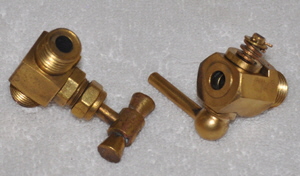 The engine block freshwater drain taps were completely seized and impossible to open. I very carefully got them out of the block, dismantled and cleaned them, then reamed the holes in the block by hand with a drill bit, that released a torrent of filthy brown water. Clearly the block also needed cleaning so I tipped all the remaining Rydlyme Marine fluid into it and left it for two days in hopes of dissolving much of the ingrained grime and silt.
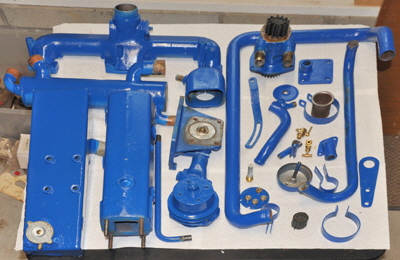
By now the engine was looking completely naked with hardly anything on the sides or ends of the block. After cleaning everything with degreasing fluid I spray-painted the block and all the parts with blue engine paint ready for re-assembly. At least I wanted my hard work to look professional.
REASSEMBLY.
After draining the dissolving fluid from the engine block—which from the looks of it had done an excellent job—I began the task of reassembly in the reverse order of dismantling - more or less. I couldn’t quite remember which pipes went where and I felt like one of “All the King’s men, who couldn’t put Humpty Dumpty together again.” It was a good thing I had taken photographs before I started.
I replaced the water pump on the front of the motor, along with the header tank and a new thermostat. On the starboard side, first the heat exchanger was rebolted along with its four connecting hoses, one of which was a long copper pipe coiling around the back of the engine to the other side. Then I bolted back the inlet manifold to complete that side of the motor. Then came the bulky and heavy exhaust manifold that had to be bolted to its equally massive exhaust elbow with new hose clips to secure it to the muffler. The two 4-inch diameter clips securing the exhaust elbow to the muffler were both broken and the joint was literally held on with corrosion. If it had parted, hot exhaust would have entered the engine bay and easily caused a fire.
At the rear, it was another scrabble to fit the oil heat exchanger and reconnect the oil pipes to the transmission and engine.
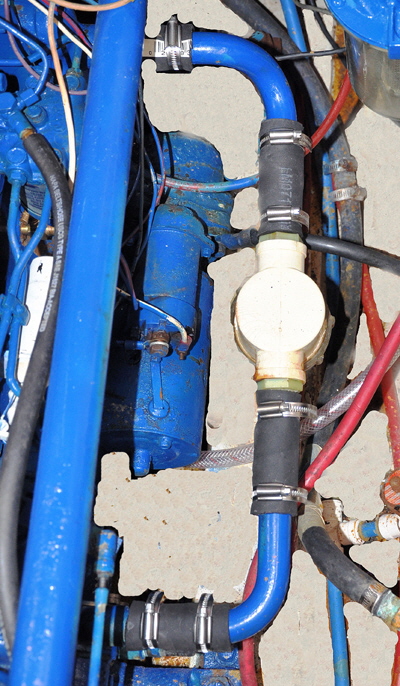 On the port side the all-important raw water pump was rebolted in place with yet another new impeller and glycerin grease. I decided to fit a second water filter directly after the impeller pump to catch anything that managed to pass through the water pump. I was a bit worried that this extra filter might restrict the flow of seawater but these were completely dispelled after seeing the torrent of water being pumped out of the exhaust.
As I was making my way back to the primary filter I had primed all the pipes with water - from the seacock through both heat exchangers and exhaust manifold. This would ensure that a circulation would occur the moment the engine fired instead of the impeller running dry, even for a few seconds. I then filled the block with water and checked for leaks in all the pipes and gaskets and thankfully there were only a few hose clips to tighten. The alternator belt was reconnected and tensioned and this very big job was now complete—well, nearly.
I had sucked all the oil out of the engine sump through the dip-stick using a vacume pump. then, by hanging upside-down over the engine I unscrewed the drain plug and replaced that with a 90o degree elbow and a reinforced pipe, up to a hand pump bolted near the engine. Changing the oil will now be much easier. I filled the engine with new oil and a fitted new fuel filter. The transmission had also been drained and was now filled with new oil
It was now nearing the moment of truth. I had little doubt that the the engine would start, but much more importantly whether it would run at its nominal operating temperature of 180F. I opened the seacock and gingerly pressed the start button. The dear motor instantly fired and all systems  were suddenly GO!
Within seconds there was 60 psi showing on the oil gauge and an absolute torrent of water was gushing out of the exhaust pipe - more than I have ever seen on any single-engine boat I’ve ever worked on. But then so it should be, because the whole water system had been completely dismantled and meticulously cleaned, probably for the first time since the engine was built.
It still took a few anxious minutes for the water temperature gauge to begin to move. It slowly rose to180F then stopped, when presumably the new thermostat had opened allowing for full circulation of water throughout the block. Whew, what a relief!
I engaged forward gear and slowly increased the engine speed to 2000 rpm, and with mooring lines bar tight the temperature remained steady.
Taking Britannia out for a longer trial run was next, and with the boat plowing along at 2,250 rpm, (maximum break horsepower), the engine temperature remained constant. When it had cooled down, I drained the block and refilled it with a 50/50 mixture of Ethylene Glycol, (antifreeze) and distilled water. Apart from the freeze protection an antifreeze mixture boils at a higher temperature, (230F), than water alone.
This was a long sometime very hard and very difficult revitalization of a 45-year-old engine. It is a fine testament to these heavy old motors that it ran at all with the condition it was in. However, I wish both the engine and boat builders had given more thought to their customers who had to work on them in boats. Many items could have been positioned for much easier access.
Britannia had been immobile since early May 2022 and it was now mid-August. Being retired, (that is, from an income-earning job, not a boat), I was able to work on her at my leisure, but delays in delivery of parts, repairs, weather, etc., all took their toll on my time. My actual work log on this job came to 130 hours and you can be sure I will be very careful in the future to (a), avoid groundings and, (b) if I have one, to immediately check the water inlet filters. I certainly don’t want a repeat of this hard labor, or the costs.