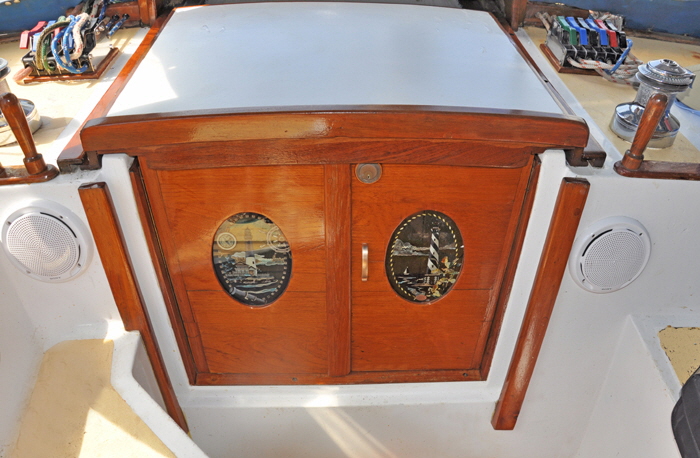
For some time I had planned to repair and modify Britannia's "front door" and hatch. The housing leaked, allowing rainwater to seep into the plywood sliding hatch top that had started delaminating. My wife and I were also heartily fed-up with the two heavy washboards used to close the companionway. When they were in place, they completely blocked all light through the entrance gangway.
I first needed to seal the hatch housing and repair the hatch. I also had an idea how to improve the actual companionway access and be rid of the horrible heavy washboards.
REFURBISHING THE HATCH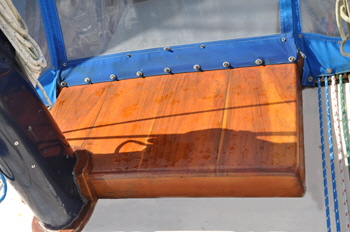 Sealing the cracks in the large teak housing was easy enough. I sanded off all the old varnish, filled the cracks then rolled on four coats of Cetol natural teak varnish, from Interlux paints. This is not just varnish it is more like brown paint and brings out the deep color of teak as well as producing a high gloss finish with added UV protection. More importantly, not sanding between coats results in a very good non-slip surface on which I would frequently stand when working the mast.
The large sliding hatch had been built as yet another, "permanent" structure” and it could not be removed without one side of the slider guides first being dismantled. It came as no surprise to find the guides weren't just fastened with self-tapping screws like 90% of the rest of the boat, but bolted through the glass fiber deck with 1/4-inch bolts and the nuts further encapsulated in the fiberglass underside. The guides also disappeared all the way into the hatch housing so I could only unbolt three of the fasteners. I then had to remove part of my nice new saloon ceiling panels and chisel the resin off round the nuts before I could hold them with vice grips to unbolt them. Having unscrewed the bolts I then had to cut the guide in half with my oscillating saw to be able to remove it and enable me to finally lift the hatch completely out. Who was it who said, "Working on boats leads from one job to another," Oh yes it was me!
I lugged the deceptively heavy hatch to my garage workshop where I dismantled it by drilling out all the wooden plugs and withdrawing the long stainless self-taping screws holding the four sides to the top.
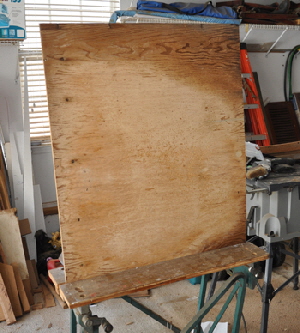
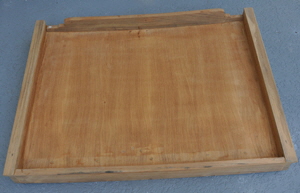 The top was made of 1/2-inch marine plywood with another 1/4-sheet glued on. This top had rotted and was beyond repair but the 1/2-inch base was still good, except for some delamination of the edges. I wanted to reuse it because I didn't think I could curve a new sheet the same shape. Using screwdrivers as levers I pried the damaged laminations open one edge at a time, then squirted wood glue into the seams and clamped the panel in my woodworking bench vice to leave it overnight. I wondered what to
  replace the rotten wooden top with?
Having dismantled the hatch I made short work with my belt sander of the flaking varnish on the solid teak sides and stringers. I then took all the parts back to the boat because I wanted to see if it was possible to make the hatch slide further into the housing to give more headroom in the companionway. I also needed to sand and varnish the companionway surround that was now much easier to get to with the hatch removed.
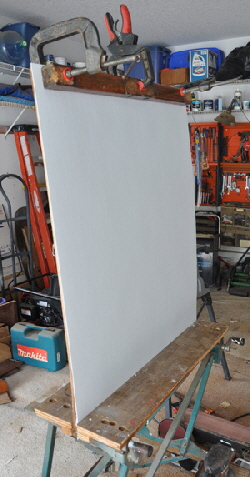 By trial assembly I found I could cut 2-inches off the back of the hatch so it would slide that much further into the housing, thus offering more headroom when climbing the ladder. The hatch was then carted back to my workshop for modification, re-assembly and final finishing.
From my local hardware store I bought a sheet of glass fiber paneling made by Crane Composites inc. (www.cranecomposites.com). It is only a little over 1/16-inch thick but very strong and completely waterproof and mold-proof. One side is dimpled and the other smooth so I used the smooth side uppermost to match the rest of the deck on either side of the hatch. This would waterproof the top and be stronger than plywood. I glued the glass fiber sheet to the plywood using Loctite Power Grab adhesive a type of waterproof glue suitable for glass fiber and wood. I trimmed the new top flush with the edges of the 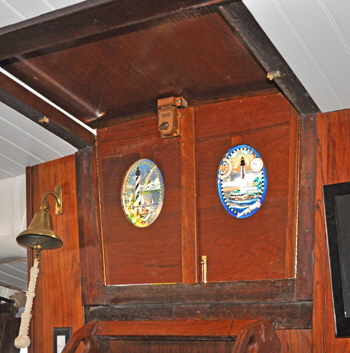 panel.
The underside of the 1/2-inch panel was teak veneered plywood so I carefully sanded and varnished this before reassembling the hatch. I assembled the hatch with waterproof woodworking glue and fastened it using the same stainless screws that came out. The original assembly appeared to have not been glued, which I think allowed water to eventually seep into the end grain of the plywood. With its new glass fiber top and glued sides that won't happen a second time. There followed quite a bit of finishing by hand sanding the side trim flush with the new top and gluing twenty-eight teak plugs into the screw holes and sanding them flush. As an added touch I ran a molded edge along both sides of the top using my hand router.
After masking the top panel I applied a coat of Cetol natural teak to the sides, then turned the hatch over and rolled Cetol on the teak underside, then applied three coats of Cetol gloss all over, rubbing down between coats with 250 grit. This produced a beautiful glossy finish which further enhanced the appearance in the saloon when the hatch was closed.
The finished hatch sat in my workshop for a week while the varnish hardened and I cleaned out the housing. I then sanded and varnished the remainder of the fixed teak surrounds and when everything was thoroughly dry I simply lifted the hatch back into the left side guide and refitted the right guide, but this time I used 1/4-inch stainless self-tapping screws to fasten it to the deck, bedding it with 3M 5200 adhesive caulk. This will be more than adequate since the guides carry no load amd just act as guides for the hatch. I filled the screw holes with 1/2-teak plugs and the hatch was finished.
NEW DOORS. Originally the companionway had two large solid teak washboards that stacked one on top of the other in slots in the sides. They were very cumbersome and heavy and my wife could hardly lift them in and out, and there was nowhere to store them in the cockpit.
The washboard concept is part of a ‘traditional’ design, which hypothesizes that if a giant wave floods the cockpit the boards would stop water from entering the saloon. That of course presupposes they would actually be in position since they completely prevent access to and from the cockpit. For a short-handed crew I consider closing off the companionway in this way to be downright dangerous, because it effectively prevents quick access both in and out. Also, the prospect of total cockpit flooding is remote on a 50-foot center cockpit boat like Britannia, with its high freeboard and cockpit coamings six feet above the waterline.
When in port or at anchor - which is most of the time - if we wanted to "shut the doors," it was a struggle even for me to lift the washboards high enough to slide them in their grooves. It was not conducive to harmonious living and they had to go.
I used the 3/4-inch solid teak from both washboards to make two separate doors.
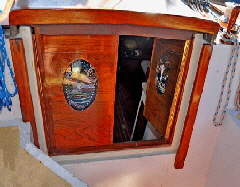 I first made a cardboard template the size and shape of the entrance then cut it in half to be the two doors. It then took a bit of working out which piece of teak should go where to match the grain from each washboard. Finally I make accurate butt-joints between the pieces and glued them with good quality wood glue, clamping them flat. Because the new doors were made of solid teak I didn’t think there was any need to edge them, so it was then just a question of shaping them to the templates. To complete the ensemble I bought two oval glass panels of lighthouses from Amazon.com. and recessed them into each door,t hus adding a touch of elegance when sunlight filters through.
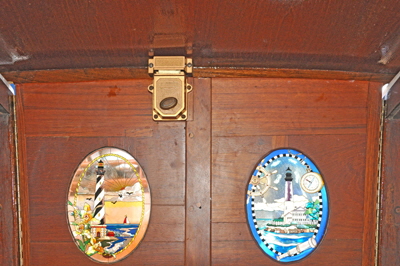 The doors had to open inwards due to the shape of the cockpit seats and I hung each with a piano hinge on either side of the companionway. One side locks with a sliding bolt into the sill, (bridge) and the other overlaps the join and latches with a heavy deadbolt into the solid beam of the sliding hatch. We can now easily close one door or both as we wish. They may not be utterly as strong as the old washboards but the number of times we go in and out, compared to the number of times we have been “pooped” - which is never - is a no-brainer.
I left the two long teak slots in place on either side of the entrance into which the old washboards slid, so boards can easily be fitted in front of the doors if we ever decide to venture out inrto 20-foot breaking seas, which I hope will be never
Britannia now has a totally waterproof companionway hatch and a very classy appearance to our "front door."
