A SERIOUS LOOK AT TAKING A DOG ON YOUR FIRST CRUISE
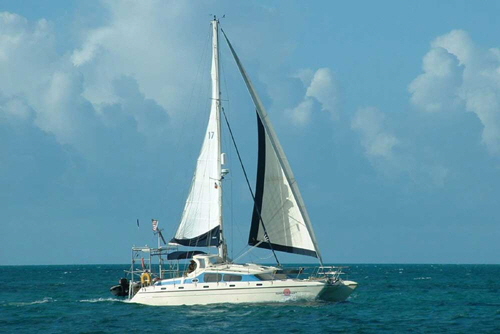 My wife Lynn and I never thought of ourselves as dog people, but it seems we have always had one, and Toby was part of our first ever cruise In 2004.
After years of dreaming and preparation we finally set off aboard Sunspot Baby, our 38’ Prout catamaran Departing in mid-February we left New Bern, North Carolina, USA to the central Exuma’s in the Bahamas and Toby, our four-year-old Entlebucher came with us.
As neophytes afloat we learned much about ourselves, our boat, and our relationship with Toby.
Size is relative with dogs, and after owning two Rottweilers, we thought Toby was quite small at 60Lbs. He was athletic and leapt on and off our dinghy with ease, but some fixed docks were difficult, especially with low tides near outlets. Then we wished he was of a size that could be easily handed over or carried, and we soon stopped thinking of him as small.
Nor was he deck trained, but we had no doubt he would figure it out, and fully expected a few bad choices at first. There didn’t seem to be any rush to teach him either, because we planned to go down the ICW, anchoring each night, so Toby could go ashore, morning and evening. Boy, were we naïve! There are fewer suitable anchorages along the ICW than we expected, and even less that are good for landing a good-sized dog. Every afternoon we combed our charts and cruising guides to find an anchorage with good access, and spent many nights in marinas simply to manage his dog duty.
The first time Toby missed a shore visit was on our passage from Bimini to New Providence,which we did in three short hops. The second night at anchor was one of those bad choices we anticipated, as we awoke to the sound of running water in the cabin. We then showed Toby that when he was desperate he could whiz on deck, but he never rewarded us with #2. We also continued to take him ashore as often as possible, some days twice.
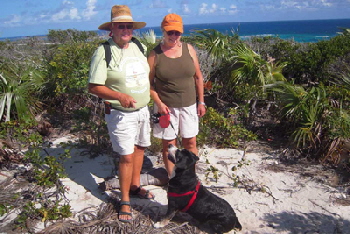 With a short flat coat, Toby didn’t look like a dog that would shed much hair, but looks can be deceiving. Every day we cleaned up and our shower discharge regularly became clogged with hair - and he was seldom in there. Despite sea and freshwater rinses he always brought sand aboard after a trip to the beach, then unintentionally distributed it all over the boat and our berth. We did our best to maintain a sense of humor, and thought about changing our names to Harry and Sandy, and joked that our cockpit now had shag carpeting.
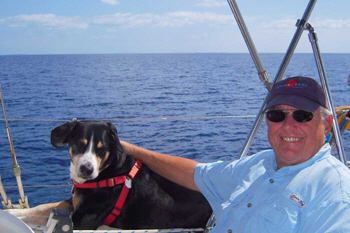
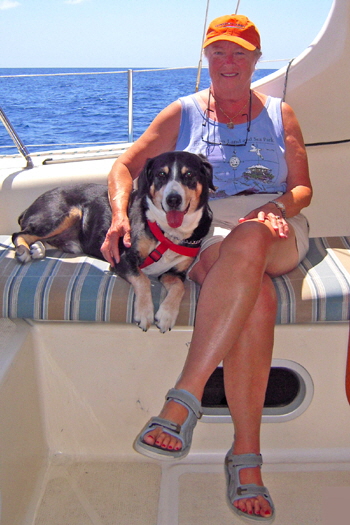
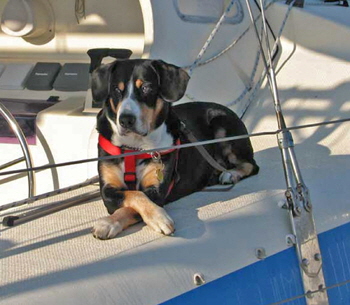 We did not joke about the possibility of a dog overboard situation. While making passage Toby wore a float-jacket and water-activated strobe, but he was allowed to go without float-gear when we were at anchor. One evening at anchor we couldn’t find him, and discovered him swimming near the sugar scoop. We speculated that he had tried to jump into the dinghy and missed, because he loved the dink’ and would leap in at any opportunity. After that episode we rigged a tether to his harness, allowing him access to the cockpit and surrounding deck but too short for a trip overboard. He figured it out quickly and seldom got tangled in the winches. The harness also provided a handle to pull him aboard and if he missed a leap, he was easy to retrieve. It was however, an excellent trip-point for the two-legged crew.
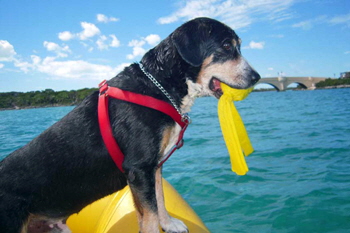 Entlebucher’s are not couch-potatoes and love and require exercise. I don’t mean a walk around the block on a leash either, because they love to run. If Toby didn’t get a chance to let it out he went into what we called, Ya-Ya overload. Unless he had that endorphin fix he was bouncing off the bulkheads and pestering us to play. Even when he had been completely deck-trained we had to exercise him and found no good option on-board.
We were learning to handle many new situations, and stress and exertion were common. Some days were downright trying, and after an exhausting day on the water a dinghy ride to shore with a dog was not something we relished, especially in a marshy area with muddy banks, or in choppy waters or high wind.
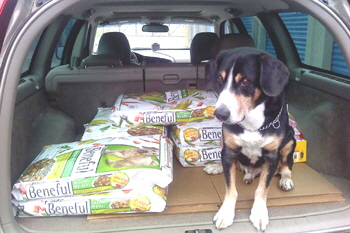 We carried enough food for Toby, but filling valuable stowage space with bags of Kibble can become an issue on small boats. You must really love your dog to give up that much space to stow wine instead of dog food.
Toby slowly turned out to become a good crew member, and went on subsequent cruises. Over time we managed to get both the boat and the dog activities in hand. We still continued to learn on every voyage of course, but the curve became flatter for both man and beast.
In summary, I offer the following opinions.
Perhaps, if your dog is well and truly deck trained, taking it with you might be okay. Otherwise, leave it at home on your own first cruise, because you will have enough on your plate as it is. Only after your own boat-drill becomes second-nature will you deal better with a four-legged crew. Of course, if someone had told us that, we would have disregarded it because we loved Toby and never considered leaving him behind
 When first choosing a dog and you have a boat, consider desirable attributes. A small dog is easier to land and requires less food to stow. All dogs need exercise, but one that doesn’t need much is better for a boat trip and a miniature might get enough exercise playing with a toy in the cabin. A non-shedding breed or mix is also desirable. A female or neutered male may also be more receptive when meeting other dogs.
Check with your veterinarian to make sure your pet is healthy enough to travel on a boat. If you go to a country like the Bahamas you must have a health-certificate anyway. Ask your vet to make up a dog first aid kit for you. Our vet was very helpful to stock our kit and advised us on dog sized doses of human medicines. Consider also that you may be days away from the nearest veterinarian.
Dogs also get seasick and we found that Tums, given before a long passage work well for dogs susceptible to motion sickness. They are not so drowsy as when given even a small dose of Dramamine.
 Whether you get a new dog or are taking reliable old Rover, try to deck-train them before you go, and whatever method you use stay with it until you find something that works. Take them on the boat frequently and stay afloat until they learn. As long as they anticipate that you will take them ashore, most dogs will try to wait you out - at least Toby tried.
If your dog likes to swim, rig a ramp or other method it can use to climb back aboard and train your pet to use it. Leave the device down while at anchor, so that if it does fall in, it can climb back aboard.
Better still, rig a tether to prevent it accidentally falling overboard. Buy a dog life-jacket that fits correctly and use it regularly. If the jacket is off, a harness usually has a better grab-handle than a collar. Remember you might be retrieving your retriever with a boat hook.
Cruising is wonderful; dogs are great, and they can go well together, but you should break the learning-curve into bite-sized chunks – for all your sakes.
On other extended Bahama cruises we took Toby ashore at every opportunity, and felt guilty when we could not. Eventually he finally became deck-trained and the reduction in stress - easier days with no time lost for shore trips, no launching and restowing the dinghy in poor conditions - made our cruising more enjoyable.
Subsequently we made seven cruises with Toby aboard. To the Bahamas - over 15,000 nautical miles and numerous trips up and down the east coast, ranging from Southern Florida to the head of the Chesapeake Bay, He finally became a crew member “par excellornce”
This story was written by some good sailing friends, Lynn and George Stateham, from New Bern, North Carolina. USA
I am delighted to include it here, since it is as much a DIY adventure as some of my own articles. It is a very enjoyable and informative read for anyone contemplating taking their pooch with them on an extended cruise, especially on their first ever overseas cruise, in this case the Bahama Islands.
Read on - yet take heed.
Roger, 10/17/26
Copyright, George Stateham.
New Bern, NC