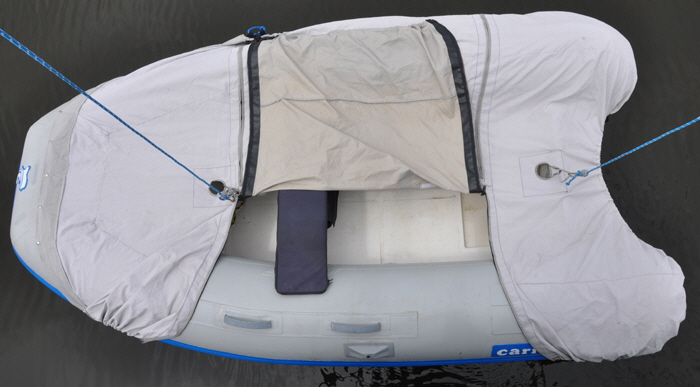
The rigmarole of stretching a cover over a dinghy while bobbing about in choppy water prior to hoisting it on davits can become a very wet business if you're not careful. Leaning right over either end trying to stretch a cover over the wet bow and stern pods can quite easily result in a head first dip in the drink. Britannia’s dinghy is an ten feet long Caribe RIB, so at least it has a solid floor to scramble about in. Soft bottoms are not as stable so the chance of slipping overboard is greater.
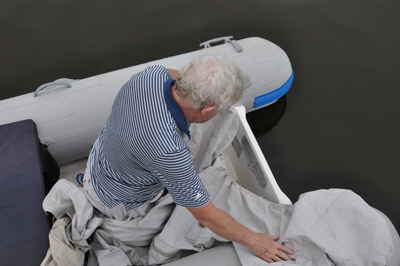 After disembarking any passengers at Britannia’s side boarding ladder, I would then hand walk myself in the dinghy to the stern where someone on deck would tie the dinghy's painter to the rail. The outboard motor could then be lifted off the dinghy transom using the crane hoist and locked on its mount on the pushpit rail.
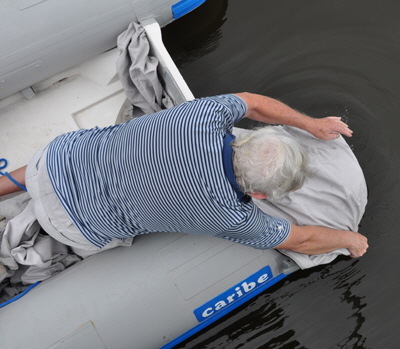 The dingy cover would then be dropped down to me usually in a big pile, whereupon the shenanigans would begin gleefully anticipated by anybody standing on the stern with a camera.
With the cover hooked over both ends and with the dinghy now secure I could only straighten the cover on the outboard side because I had to squeeze out the other side to climb up the transom boarding ladder. Every time I performed this balancing act and especially after falling in I swore I would find a better way…
I considered cutting the cover in half to make two separate bow and stern sections then zipping them together when both ends were in position. I'm sure this might work for others but trying to attach two halves of a zip is difficult enough on land for my old hands never mind in a lurching dinghy with wet fingers. I would have needed to stretch both halves together while balancing in the center and I only have two hands. I progressed to a better solution.
I had our local canvas man sew twin zips 4’ 6-inches apart from the side of the cover to the middle that gave me a sizable “flap” to work in. It is now even beneficial to leave the seat in position that I previously had to remove to give me more crawl space under the cover. With the flap open the cover also stretches easier on to both ends and I can then sit on the seat to effortlessly connect the davit hoists and easily climb up the transom ladder by leaving the flap unzipped.
I tied two lengths of 1/4-inch line to the outside edge of the cover and had two small loops sewed on the ends of the zips. When the dinghy is secured on the davits I then hook the dangling cords at the back with a boat hook and thread the ends thought the loops in the zip. When they are pulled tight these cords keep the middle of the cover from blowing about in a wind.
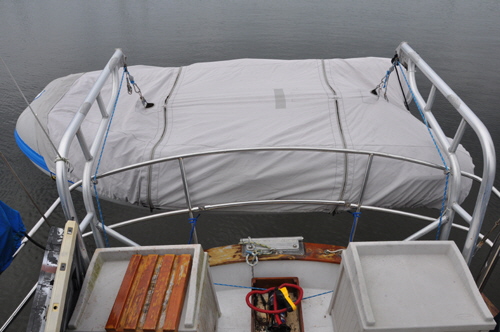 Having hoisted the dinghy to the top of the davits it is then a simple matter to zip up the flap.
Another advantage of having the flap is to stow our fenders in the dinghy that wasn’t easily do before when the cover was in one piece.
This was a marvelous improvement that was well worth the $75.00 to just have two zips fitted to the cover.
Finally, looking at the pictures you may think, “Why has he got a flap on both sides of the cover?” This is a keen observation, especially since I always lift the dinghy the same way round to be able to lift the outboard with its crane and the . flap on the outer side of the cover is indeed superfluous. So why two flaps? The answer is; because the canvas man stitched the first set of zips on the wrong side of the cover and took it back and did it again, so I got two flaps for the price of one. I have never used the other flap but I suppose when the plastic zips eventually crack in the hot Florida sun, as they surely will I can reposition the outboard motor and crane on the other side of the sternthen just turn the dinghy round and use the other flap. After all, on boats it's always good to have a back up isn't it?
It was then an effortless job to hoist the dinghy to the top of the davits using my electric winch, that pulled the dink’ up in seconds including the outboard if I had left it attached.