WITHOUT EVEN TOUCHING THEM
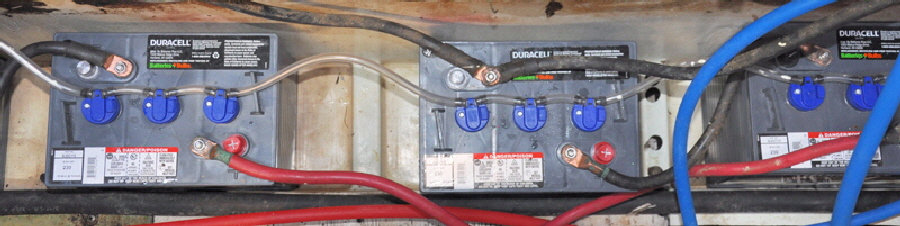

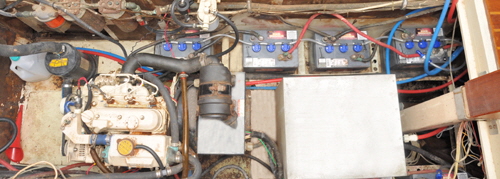 Britannia has eight golf-cart lead-acid batteries, (also called float batteries) in the house bank. They are mounted low down under the saloon floorboards in two rows on either side of the 6.5 kw diesel generator, a large water heater and the usual conglomeration of pipes, pumps, and filters—not to mention the mainmast compression post. These batteries are very hard to reach and fill with distrilled water occasionally. There are also two 12-volt batteries, one in the bow for the windlass and the other aft, as a dedicated engine start. That's a total of 36 cells to check and fill from time to time. The process usually took over an hour because the battery caps were not very easy to reach. Yet batteries are the beating heart of all boats, sail and power and should be one of the most accessible items. The water level in lead-acid batteries alters during charging and through evaporation, especially if mounted in warm engine compartments like on Britannia.
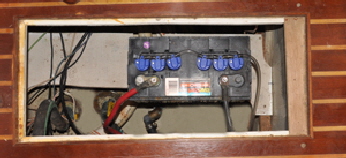 You would think any boat with a 14-foot beam would have lots of space for batteries, but with 325-gallon water tanks and 280-gallon diesel tanks on each side of Britannia’s hull the middle section of the machinery bay is pmly 36-inches wide. To simply inspect the water level in the batteries I had to first dismantle the saloon table and roll up the carpet, then lift up four large heavy insulated plywood floorboards, then lay flat over the floor-beams with a flashlight to unscrew the battery caps. If any cells needed water I used a long neck funnel stuck in each cell in turn, then poured distilled water in from a gallon bottle. It was simply guesswork how much was poured into each cell and I know I sometimes over-filled them, but how else could they be topped-up in such a confined space?
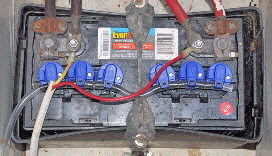 Britannia is not the only boat I have sailed on with awkward to reach batteries. I was once the skipper of a 77-foot Alden ketch with full standing headroom in the engine room. That voluminous boat had ten large 12-volt batteries sitting in a big custom-made box, a total of 60 cells. Even to just test the specific gravity meant clambering over the front batteries to get to others and that didn't get done very often.
Due to their weight it is of course advantageous that batteries be mounted as low as possible and Britannia’s weight over 500Lbs., But batteries that are difficult to reach often result in a lack of attention and maintenance, nor is it usually practical to relocate them to give better access, due to cable lengths and the boxes they sit in.
 A batteries charge is tested by drawing the electrolyte up into a hydrometer and reading the specific gravity on the scale. If water is needed it can be poured in through a funnel or special filling jug, but to do this easily, good access is necessary.
I hated to even test my batteries and what I really wanted was to change the whole lot for sealed AGM batteries, (Absorbent Glass Mat), which don't need any maintenance at all. But there was only one slight problem with that bright idea—about £1,200, and if I wanted to buy lithium I would have had to rob a bank!
I decided to look for automated filling systems on the web and a search for "battery filler systems," brought up a multitude of different devices. A cheap simple method is a half-gallon bottle with a special valve on the spout, which when inserted into a cell delivers water if needed then shuts off at the correct level. There are several other inexpensive filling systems to be found under these keywords but all of them meant I would still have to go through the same rigmarole to get to the batteries, so I discounted them. I continued to look for an automatic system that I might install permanently on the batteries themselves and which would work without removing the floorboards.
THE SYSTEM.
I found a company appropriately called, Water My Battery Inc, (www.watermybattery.com), advertising water filling systems for batteries on golf carts, RVs and boats. Under the system selector on their website I found, "Marine battery watering systems."
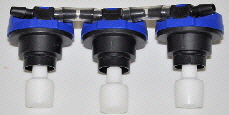 Their principle is simple enough when you think about it. All the battery caps are replaced with special valves interconnected with plastic piping. The valves open when the water level drops allowing new water to enter the cell, then they shut when the required level is reached. A common feed-pipe leads to a tank of distilled water high enough to give the required gravity pressure and the system self-feeds. Unfortunately, in practice it's not quite as simple as that
The company’s website offers a lot of ways to connect the valves and pipes but I still had questions specific to my boat:
1.The distance from my battery bank to the forward windlass battery is 15-feet. Would the system self-fill over that distance?
2.Can a hydrometer still be used to test the specific gravity of each cell from time to time, without removing the valves?
3.What is the height of the water level over the plates when the valve closes?
4.If a sailboat is on the same tack for many hours, or even days would the heeling expose part of the plates?
5.How do you know when the batteries need water?
6.What is the warranty on the system?
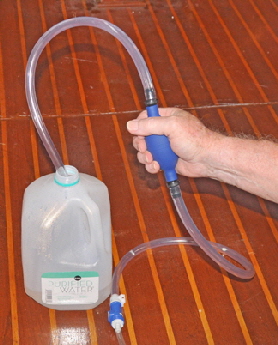 I telephoned the company and spoke to the manager, Desiree Flores, who suggested that because I had so many batteries over such a long area they would be best split into two separate feeds. I also learned that the header-tank method of gravity feeding is not actually fully automatic. The tank has to be disconnected after use because constant pressure might cause an overflow of a cell. An alternative method of filling is to use a hand pump similar to those used to feed fuel to outboard motors from remote tanks.
Unfortunately, testing the specific gravity of each cell with a hydrometer still requires the removal of the valves.
The valves set the water level at approximately 1-inch below the filler cap level, that is well above the plates on my batteries, so even if the boat remains heeled for some time it is unlikely the plates will be exposed.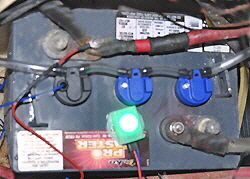
In answer to question 4 was interesting. The company makes a special valve, electrically connected to a neon light that changes color when the battery level is low enough to need filling. I also had a battery voltage meter on my power distribution panel, showing the voltage of each battery bank that gave me a rough idea of the condition of the charge.
Valves are made to fit the caps of all types of batteries and the warranty is five years.
I subsequently ordered 24 valves for my golf-cart batteries, and 12 valves to fit the two larger batteries, 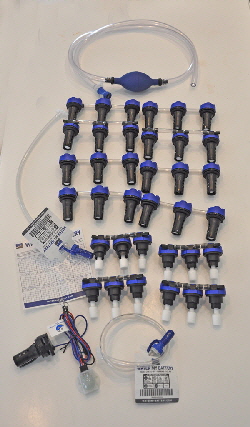 along with the hand pump.
INSTALLATION.
I planned to arrange my pipework into separate feeds on each bank of batteries. The port side run will also feed the 12-volt engine start battery and the starboard run will likewise feed the windlass battery. This worked fine even though the forward battery is 15-feet from the main bank.
The system must be installed when batteries are fully charged since this is when the electrolyte is at its highest. Mine had been on charge for three weeks without use and were fully charged.
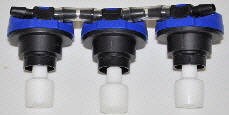 The valves came pre-assembled in threes with tubing and just push into the batteries. All I had to do was inter-connect each set with the tubing supplied to form a string, I cut the plastic tubes with a pipe cutter that produces a clean straight cut with no burred edges. The tubing was then just pushed over the barbs to join it to the next bank of valves and the end valve in the run was capped off with a plug. I routed my two fill-tubes to where I stored a gallon of distilled water and where I could easily get to them without ever touching a floorboard. All connections and pipes should obviously be free of kinks and tight bends.
OPERATION.
To fill the batteries I connected the fill-tube to the end of one of the battery banks with the quick connect plug, and the other end was placed in the distilled water bottle. When the bulb was squeezed a few times it pumped water along the tubes and into the valves. I could see water passing through the pipes and as I continued to squeeze the bulb it became harder, indicating that all the cells had been filled and the valves had closed. The quick connect was then disconnected which automatically sealed the end—it's that simple.
It took less than five minutes to fill both battery banks and I was kicking myself that I had spent the past ten years lifting floorboards and scrambling about in the bilge filling my batteries by hand. This system also fills the cells more evenly and accurately.
The neon light fill indicator only operated on one bank of batteries, and whilst it doesn’t use much power if the boat is left unattended it will be on all the time. I fitted a switch to the wire so I could switch it on to look at the batteriy then off when I was not there.
This system is another really good idea to make life easier on a boat..