

When I first started sailing, more years ago than I care to remember, it didn't take more than a couple of restless nights to realize that it was a lot better to anchor securely the first time rather than be staggering on deck at 3am on a blustery, rainy, pitch-black night, trying to haul in then re-set a heavy anchor and chain. That type of experience usually makes most people want to learn how to do it right the first time. Anchoring is an essential part of boating skill,s because it's just as important to anchor a boat securely as it is to make it move.
This article shows how to easily make a drag-proof method of anchoring that works for both powerboats and sailboats. Basically it uses two anchors joined together in tandem and is very easy to set up and deploy. Britannia has above-average windage due to the square sail yard and all the rigging involved, yet when using my anchoring method she has never dragged even in the heaviest weather, nor has any boat I have ever anchored with my system, even with different types of anchors and weights.
Before getting into details I want to say that I firmly believe any boat's main anchor should be as heavy as the anchorman, or woman can handle, irrespective of the size of the boat—within reason obviously. Having said that it’s possible that the spate of different shaped anchors that have appeared in recent years don't actually need to be as heavy as the old styles, but for me heavier will always be more desirable. An all-chain rode is likewise better than a chain and line combination due to the extra weight along the whole rode.
 Different boats react differently when anchored, both power or sail but there are still some common tenets that apply to all boats. The objective is to get your anchor to lie flat along the seabed where it has the best chance of digging its way into the bottom, and the best way to achieve this is to lay a good length of rode, about five or six times the anchoring depth where possible, (the rode being the total length from the boat to the anchor). This is best achieved by using a heavy chain that creates a good catenary, (catenary being the variable curve of the rode). However, weight by itself does not guarantee that an anchor won't drag, especially in deep anchorages or strong winds, when even a long rode will tend to straighten out with a chance that the anchor will lift out of the bottom. Also, many smaller boats don't have much space in their anchor locker for all chain but this anchoring method works with both all-chain and chain-rope configurations
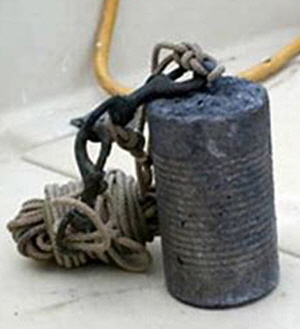
An age-old method of reducing an anchor rode from lifting was to weight it about halfway along its length with what is generally called a kellet, or sentinel. This was a heavy weight that slid down an anchor chain/line until it hit the bottom, thereby helping to keep the whole rode flat on the seabed. But kellet’s do not normally have any digging in capability with the bottom, and they are heavy and dirty and difficult to stow on a small boat and now superseded by more modern anchors.

 Britannia has two cast iron genuine CQR anchors on either side of the bowsprit, the main anchor weighs 65Lbs and the other 35Lbs. The main anchor is attached to 250-feet of 3/8-chain with a further 200-feet of 3/4-inch line for deep anchorages. The "little anchor" has no chain or rope attached to it because it is used in conjunction with the main anchor. I actually wish this anchor was also 65Lbs, but on a cruising boat one learns to use what is available.
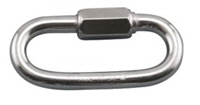
To build the system the first thing to do is to make a strong bridle using a good thickness of nylon line - consistent with the weight of your anchors and the boat. My line is 3/4-inch diameter with stainless thimbles spliced and whipped on each end. One end of the bridle is permanently shackled to the stock of the smaller second anchor, then passes around everything clear of the bow, which in Britannia's case is the bowsprit and bobstay, then up the bow roller of the main anchor and tied on the pulpit, where it can easily be attached to the main anchor chain when required. A bridle using chain would be preferable to join the second anchor to the rode, but I built a rope bridle because it was difficult to lead a chain round Britannia’s bobstay and through the main anchor’s bow roller. It would also clank noisily when not deployed. To attach the bridle to the main chain I use a stainless steel lockable oval carabiner shackle, big enough to pass over a complete chain link - not through the link - then lockable with the bolt.  This bridle needs to only be a little longer than is needed to connect the second anchor to the main rode with the carabiner. Boats without a bowsprit and an easy to reach bow-roller could use a much shorter bridle than Britannia’s and might also use a short length of chain instead of rope.
Having set up this simple arrangement here's how I anchor for maximum security: I first let go the main anchor and allow the boat to fall back with the wind or current, or drive it back with the engine like in a normal moor, until about three times the depth of rode is run out and it feels like the anchor has begun to taken hold. Then I shackle the bridle round the chain with the carabiner, the other end of the bridle still being attached to the shank of the second anchor. Next I shackle a length of strong line to the shank of the second anchor that is longer than the length of extra chain I finally intend to run out. This line makes it easier to snub the second anchor into the bottom and also haul it back on deck when weighing.
The second anchor can now be released to plop into the water where it hangs by the bridle. I then let out more chain, taking the second anchor with it and allowing the boat to fall back further. This extra rode length is usually about two or three times the depth, so I then have the total required length of rode deployed. When the chain is all deployed a hefty burst on the engine drags both anchors backwards with a good chance of forcing them both into the seabed. Practice soon tells you which anchor to slack off and which to haul in to settle them both into the bottom. I now have two anchors dug in at the head of a good length of chain and/or rope, and the second anchor attached to the rode by the bridle and with a length of strong line up to the boat. In Britannia’s case this is 100Lbs of anchors and about 400Lbs of chain. Is it any wonder we never drag?…
All this might sound like a terrible rigmarole to deploy, but it's really quite easy if it is all prepared properly beforehand and with a little practice I can anchor almost as quickly as any boat using a single anchor - but with much more peace of mind if the wind pipes up in the night. This method can easily be adapted to any boat with two anchors, power or sail - and who does not have two anchors on their boat?

 Fig 1 shows how the rode and second anchor lies after deployment facing the wind or current. If the wind shifts say 90 degrees, (always at around 3 am of course), the boat will swing and initially lie to the second anchor. Fig 2.
If the pull on the boat is very strong, like a tidal current or strong wind shift, the first thing to slip will be the second anchor and be pulled round with the chain and bridle, but it will invariably stop as the weight of the chain being pulled increases. In the unlikely event that the anchor continues to slip the whole rode will eventually straighten out in the new direction and the boat will lie to both anchors again. This complete event has never occurred on any boat that I have ever anchored using this method, instead the combined weight of the chain/rope and both anchors have stopped the boat dragging. In the morning I have sometimes found Britannia lying to the second anchor, yet knowing there is also a load of heavy chain out there somewhere with a whopping great anchor still on the end. If you normally anchor with chain and rope you can simply shackle the bridle to the last link before the rope, or wherever you snubbed in the first anchor. If you only use a short length of chain then rope, shackle the bridle to the last link on the chain to achieve almost the same degree of security.
 Weighing anchor, with or without a windlass is only slightly more work than raising a single anchor. The rode is hauled in like normal along with the rope attached to the second anchor until that anchor appears at the stem-head on its bridle. At this point it can be lifted on deck using the rope attached to its stock and secured where it normally sits whereupon the bridle is unshackled from the chain. If the rope is tangled with the chain it can now be unwound knowing that the boat still remains securely anchored by the main anchor. The chain and anchor is then hauled in the normal way and off you go.
For me the main reason for doing all this is because the system has never ever dragged on any boat on which I have deployed it! I wonder how many people can say that about their anchoring successes. In rough conditions it is definitely comforting to know that you are lying to two anchors and also a sturdy line attached to the second anchor as a backup. Who has not worried just a little on a wild night if the chain or line will hold or your single anchor will let go?
It is also much easier and quicker to use this method instead of laying two separate anchors in a ‘V’ configuration. No boat maneuvering is needed as when setting two separate anchors in different positions and any tangling of the rode due to the boat swinging is much easier to untangle when the second anchor comes up on rope, and the boat is still anchored by the first.
As an epilogue I will recount this true story:
I was once anchored in Cala Portinatx, a beautiful rocky cove in northern Ibiza one of the Mediterranean Balearic Islands. A Mistral wind had been forecast out of the Gulf of Lyon and it arrived in the night, but much stronger than predicted. The cove was soon awash with whitecaps and boats dragging their anchors along with all the associated mayhem - but not on my 40-foot ketch. I had two admiralty pattern 55Lb Danforth anchors on 200-feet of 1/2-inch chain set with my method. As the storm hit, my main concern was not dragging but keeping watch in case other boats crashed into us. One small craft did drift close by, the exhausted occupants unable to re-set their tiny anchor or even motor against the howling wind. I heaved them a line and attached it to our aft cleats as they drifted astern then thankfully stopped. Then a second boat scudded by and I passed them a line likewise. All three of us remained like this during a very blustery night, during which a substantial motor cruiser was driven hard up the sandy beach by its frantic occupants - at least one effective way to stop it dragging. Two boats were completely wrecked on rocks and one person lost his life.
When anchoring during the day I would normally use only one anchor because I would see and feel if we were dragging. But at night it is a different matter and I always employ my method—every single time for an overnight stay, no exceptions irrespective of the weather forecast! because old Neptune has been known to frequently change his mind.