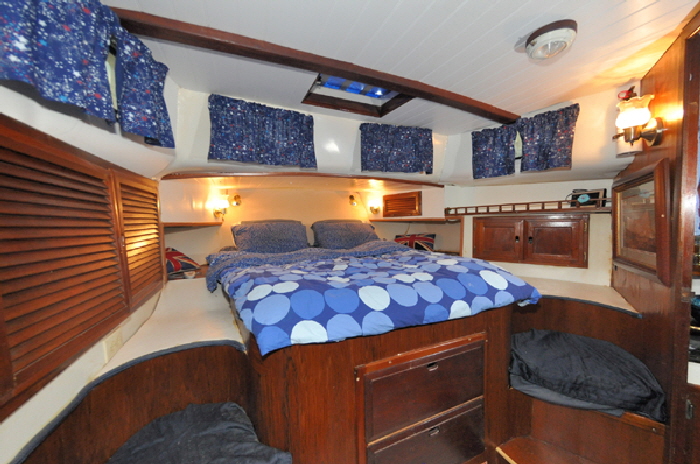
 Britannia has a large aft cabin with an en-suite bathroom, both entered through a walkway down the side of the galley. This cabin is quite roomy, being 10’6” inches at its widest and 9’0” feet deep with 7-feet headroom, but the original layout was very strange. The bed was built athwartship the width of the cabin and severely
  restricted by two a full-width deck storage lazarettes halfway down the bed with only 15-inches of headroom under it. Also, a small washbasin had been built on the port side along with a bulkhead that stretched halfway across the bed. This meant anyone sleeping on that side had to scramble over it all to get in and out of bed. This configuration mystified me, I have never seen a washbasin installed in the cabin, not in the bathroom. In addition there were small cupboards on either side under the lazarette that were not much use since they could only be reached by lying on the bed, and couldn't even be opened when the bed was made up because the doors were set too low.
 Lazarettes are usually just glory-holes on every boat I have seen them on, full of anything and everything. Mine included a propane gas tank lying on its side that I considered highly dangerous because if the tank leaked the gas would seep down into the cabin. Both these hatches leaked and the lockers were always swimming in water.
I didn't like this layout when I bought the boat, but I could see potential for a very nice owner's cabin with an attached bathroom and bathtub. It just needed remodeling.
 The first job was to make it possible for two people to actually sleep side by side without having to climb over each other to get in and out of bed. This meant removing the intrusive lazarettes, but it turned out to be considerably easier said-than-done because they were an integral part of the deck molding. It entailed two full days of hard dusty sawing, hacking through multiple thicknesses of plywood and glass fiber using a powerful reciprocating saw, a couple of sharp chisels and a big hammer. Then there were another couple of days trimming the rough-cuts and permanently sealing the two deck hatches with glass fiber resin which stopped the leaks. The area was further opened up by removing the useless little cupboards on either side and at the foot of the bed.
When everything was finally removed the cabin looked massive, and to enlarge it furher I dismantled the silly little 'un-stainless' wash basin along with its cupboard and large half bulkhead. Then I cut away the bathroom door, complete with its framework and bulkhead, and repositioned it at an angle so a washbasin could be installed inside the bathroom like any normal bathroom.
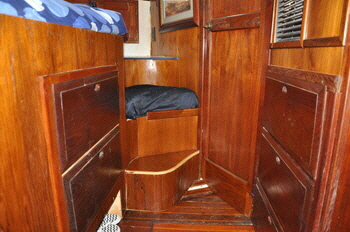 I couldn't do anything about the rudder post and steering quadrant, along with its hydraulic autopilot ram lying directly beneath the bed. Because of this equipment the bed was three feet higher than the cabin sole that made it difficult to climb in and out at the best of times. I solved this access problem by tapering the foot of the new bed frame I built, allowing room for a bucket-seat on each side of the bed. These are nice seats which doubled as steps making it very easy to get in and out of bed on either side.
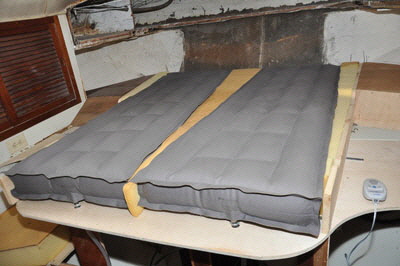 The new bed now measures six feet wide at the head, (king size), four feet wide at the foot and over six feet long. The old bed foam had lost its support and even when supplemented with an extra two inches of new foam it was still horrible to sleep on. Personally I like a soft bed, but my wife likes firmer support so I bought two commercial air mattresses like used in hospitals. These can be inflated and deflated independently by a compressor with twin control buttons to adjust individual firmness, similar to Sleep Number matrasses. The compressor is 120-volts that works when on shore power and also at sea from the 120-volt inverter
 . It uses very little current because we hardly ever adjust the pressure. Unlike foam these matrasses are non-absorptive; lightweight; easy to deflate and remove when necessary. They are two feet wide, six feet long and five inches thick and kept in place against the tapered sides of the bed framework and in the center with strips of soft foam. My wife and I agree this is now one of the most comfortable beds we have ever slept on, anywhere on land or sea.
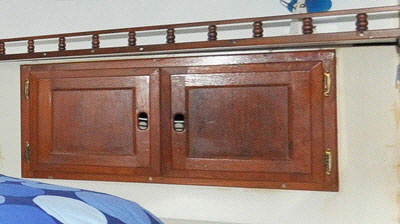
I reused the old cupboard doors to make new lockers which now actually open properly. I edged the shelves with traditional teak pin rails.
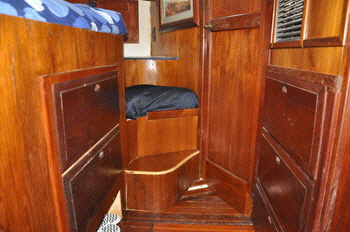 Their was a bank of five large drawers that I would not normally have touched, but I needed a space to install an air conditioner unit for the aft section of the boat. Removing two of these drawers gave me the ideal space, but rather than lose the drawers I incorporated them into the space below the foot of the bed. It's quite marvelous what space can be found on boats with a bit of ingenuity. In this case I actually gained three square feet to install the AC.
With the removal of the lazarettes the rear of the transom was exposed, which I covered with a sheet of plywood covered with vinyl foam, then ran electrics for reading lights and sconce lights working on both 120 and 12-volts.
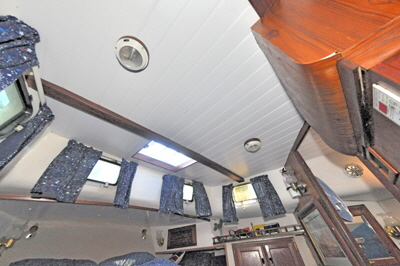 A ceiling was also needed where the lazarettes had been removed. Here I used EverTrue PVC Interior wainscot panels as in the rest of the boat. These are 7½-¯inches wide by 8-feet long tongue and grooved plastic panels. They lock together and are easy to screw to the underside of where the lazarette had been. I then trimmed the exposed edge with teak.
The original foam backed vinyl cabin sides had become torn during the dismantling work, so I made cardboard templates and replaced them with Plas-Tex pliable plastic sheets, glued to the side of the boat with contact adhesive. On the port side I incorporated a locker with a cupboard door to house 50-feet of chain and rope for a stern anchor.
In this rebuild I used a lot of wood left over from other areas, but it was not always possible to match all the teak-faced plywood and the exposed ends. I therefore bought a 4-foot by 8-foot sheet of teak veneer and laminated all the exposed edges and the curved seats. Veneer is easily cut with scissors and glued in place with contact adhesive but you have to be very careful to place it correctly the first time. After one coat of clear satin varnish the result is a very pleasing uniform appearance to the whole room.
 My wife sewed drapes for the four portholes adding a nice touch of homeliness to the cabin. This cabin is what I now call a real “stateroom" with space to move and dress and somewhere to sit if you need a quiet spot.
There was a loss of deck storage after the removal of the lazarettes, including where the propane gas tank was stored. I overcame this loss with two plastic patio seat boxes that I fastened to the deck and cut the base out of one to allow the gas bottle to stand upright. Most importantly the tank is now completely separate from the cabin and any leakage vents into the atmosphere. The capacity of these boxes are only a little less than what the lazarettes had been and they also make nice stern seats.
This was a major modification to the aft cabin, but it transformed the area into a very fine bedroom.
