
 Britannia had neither air-conditioning nor heating when I bought her one cool December day, in Fort Lauderdale Florida. In winter in The South you can often manage without heating or cooling, but come May and throughout the summer the oppressive heat and humidity can become unbearable inside a boat. I therefore knew I only had about three months to get an AC unit installed to at least cool the aft cabin bedroom, bathroom and the saloon.
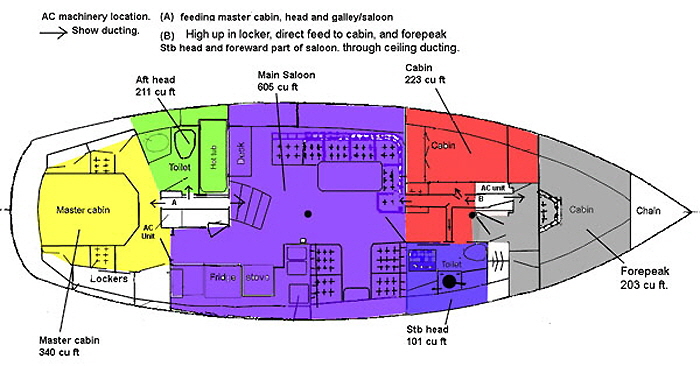
I began researching the many makes and prices of reverse-cycle, (both heating and cooling) marine air-conditioning units. I had never fitted AC in a boat before so I had no experience of what size units, or units, might be needed or how to install them. It seemed to me the first operation should be to determine the cubic capacity of the various areas I wanted to cool to be able to determine what size AC I needed. I took detailed measurements and calculated the cubic capacity of all the boat’s interior and e-mailed the drawing to different manufacturers for their suggestions.
I received recommendations varying from a single large unit in the middle of the boat, to three separate smaller units. Most seemed to agree the overall cooling capability needed to be around 35,000 BTU (British Thermal Units), to be effective in the height of summer. Prices, specifications and sizes varied wildly between manufacturers and shipping charges are also relevant for these heavy items, mostly around 80Lbs for the main unit alone.
I decided it would be better to have two separate units, then if one broke down there would still be cooling from the other. This is a very practical consideration when it is 100 degrees and 90% humidity outside, and where without cooling a boat's interior can rapidly become 115F or higher. I would never be able to repair an AC breakdown in those temperatures.
For people like me who don't know much about boat air conditioning, a basic kit consists of:
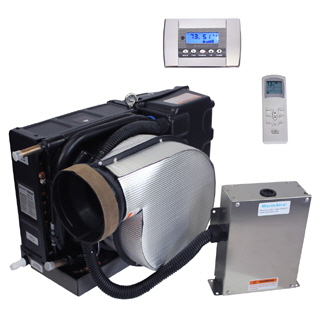
1 The self-contained air-conditioning unit with electrical box and control panel.
2 A 120-volt seawater pump.
3 Other items as needed, including water pipes, filters, ducting, and vents. These vary with different boats.
It is better to have cool air discharge as high as possible, because cold air falls. Ducting is also especially important because if distribution pipes are very long or twisty considerable efficiency can be lost. This was one reason I finally decided I would be better with two units instead of one large one which would have been cheaper. But a single centrally mounted unit would have required very long tubes to blow cold air forward and aft along my 45-foot interior and the pipes would need insulating as they passed through lockers and storage spaces
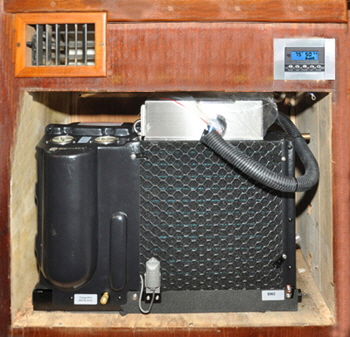
The aft section of the boat consists of the large aft cabin, the en-suite bathroom (head), the saloon and galley. I managed to produce a two-foot square space for an aft AC unit by moving a couple of drawers in the aft cabin. Now all I needed was the equipment.
There are several makers of marine air conditioning units in Florida, so I decided to visit two on a round-trip to Miami from Orlando where I lived. I made appointments with two manufacturers and set off at 6 am down the Florida Turnpike. I arrived promptly at one company in Stuart, only to find the salesman I was to see had gone out, presumably to a more important customer. I was able to look at an AC unit but did not get answers to the many questions I had. They didn’t get my order.
My second appointment was at 1 pm at Marinaire Inc., in northwest Miami, 230 miles south of Orlando. The reception there was very different and I was able to satisfy myself about size and quality of the materials. I came away with a 16,000 BTU air conditioning unit and pump, that saved the high shipping cost of the heavy equipment. Later I bought a second unit for installation in the forward cabins in the boat.
INSTALLATION
I intended to install the first AC unit in the aft cabin, to make sleeping in the cabin and using the aft bathroom more tolerable. I knew the AC unit would fit into the space I had made but I had to modify the direction of the sea-water inlets and outlets. I didn't want to solder elbows to the 5/8-inch diameter pipes so I bought compression elbows which just needed crimping on the pipes. These offer a bit more flexibility when working in a tight space. Other than this the AC unit installation was quite simple.
 I now had to install the seawater pump, which took a bit of scrambling to mount the heavy 120-volt pump, then plumb it with a filter to a spare sea-cock. I then connected the pump to the AC water inlet on the AC and the outlet to a seacock above the waterline. I wired the pump to a spare breaker on my distribution board and into the AC unit control box. Seawater is pumped through the air conditioner and discharges through the seacock. The only other pipework is the condensate overflow runoff from the air-conditioning evaporator, (radiator), which gravity feeds into one of the cockpit drains.
The pump is a very interesting device. It is not the neoprene impeller type that boat owners will be familiar with and there is no connection between the forward part of the pump and the electric motor. On the end of the armature is a large magnetic drum that spins a second magnetic drum inside the sealed head of the pump that is connected to the actual pump vanes, or impeller. The electric motor is therefore separate from the pump vanes that look like propellers and will run dry, unlike neoprene impellers that will strip their vanes if allowed to run dry.
The electrical draw from two units was too high for my single shore power cable so I ran a second cable through a new AC breaker panel. I needed this anyway to handle our electric kettle, toaster, microwave, and dishwasher. I also had to modify the wiring from the 6.5 Kw generator to feed both panels when running two air conditioners on generator power.
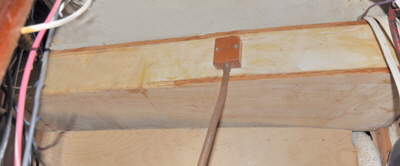 Once the electronics and plumbing were complete the installation became a woodworking project. I built the ducting out of 1/2-inch plywood as an 8” x 4-inch box, through the engine room at a high level just under the cockpit floor, with branches supplying the aft head and rear area of the saloon. This offered a much smoother flow than convoluted tubing and enabled me to direct the air in straight runs exactly where needed. I had to cut holes in the forward and aft engine room bulkheads and re-routed some wires. A further advantage of plywood ducting was it didn't need insulating like the thin-walled flexible pipe normally used, nor did it take up valuable space passing through lockers and storage spaces.
The Marinaire unit has a rotatable outlet vent in any direction. I was therefore able to angle the outlet to suit the ducting and join them together with a flexible plastic sheet held together with duct tape.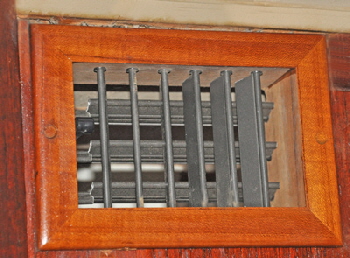
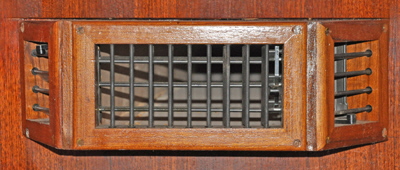 For outlet vents I bought teak adjustable vents which can be closed off completely if required with a little lever in the vent. When varnished they look nicer than cheaper plastic vents. I used an 8-inch by 4-inch vent for the aft cabin outlet. For the saloon outlets I actually combined three vents to deflect air more evenly in different directions into the saloon. This enabled cool air to be deflected to the galle,y which pleased my wife.
 The digital control panel was easy to install since it was pre-wired to plug into the wall-mounted control panel. Marinaire also supplies a 30’ foot extension cord with a thermostat attached. This enables the thermostat to be mounted in the best place within an area to achieve maximum cool air distribution. Other units had the thermostat attached to the control panel itself, that limits the reading. The unit also has built-in pressure gages for high- and low-gage readings, that is useful for owner troubleshooting and there is only need for one low-pressure filler connection if the unit ever needs to be re-filled with freon. The new type R410 is used in these machines.
The electrical draw from both units was too high for a single shore power cable, so I fitted a second cable through a new AC breaker panel. I needed this anyway, to handle our electric kettle, toaster, microwave, and washer/dryer. I also had to modify the wiring from the 6.5kw generator to feed both panels when running the air conditioners on generator power
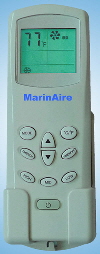
Marinaire supplies a wireless remote control in the kit so the AC can be switched on or o, or the temperature altered remotely, which we have found handy when in bed. I could not find this feature on any other manufacturer's machines. It is also possible to buy a wi-fi control to operate the AC from an iPhone. It would be nice to be able to switch the AC on either in cool or heat mode say an hour before arriving at the boat.Tthe AC would of course have to be left on all the time and the seacock open, along with the shore electric connection which some might feel was not good practice.
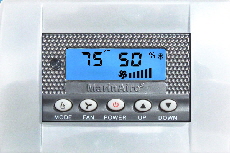 It was marvelous to finally press the “power” button and feel the machine blow a blast of cool air into the cabin, bathroom, and saloon. One thing that struck me was how quiet the unit was compared to others I have heard on boats. This is due to the compressor -the noisy part - being completely encapsulated and insulated.
In summer, Florida temperature can rise to 95/105F with oppressive humidity. Britannia’s AC now keeps the inside of the boat at a nice dry 75F. Cool dry air (or very occasionally heat in winter), spreads evenly throughout the interior and no area is warmer or cooler than any other.
 Later I fitted a second unit in the forward section of the boat, blowing air into the fo'c'sle and port cabin and forward head/shower bathroom. I again built straight-through plywood ducting and a crossover trunking into the bathroom on the port side. Air is also deflected into the saloon to assist the aft unit to cool this largest area. Both units work independently except for the common seawater pump that feeds both even if one is switched off. This provides great flexibility when there are just two of us on the boat. We sometimes switch the forward unit off or close the vents into the two forward cabins, that has the benefit of deflecting more cool air into the other areas.
Even though we tend to now take our air conditioning for granted it is still one of the best investments we have made to Britannia.