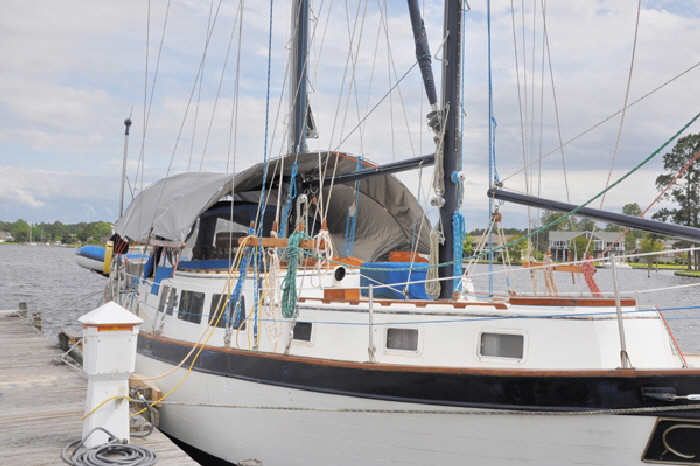

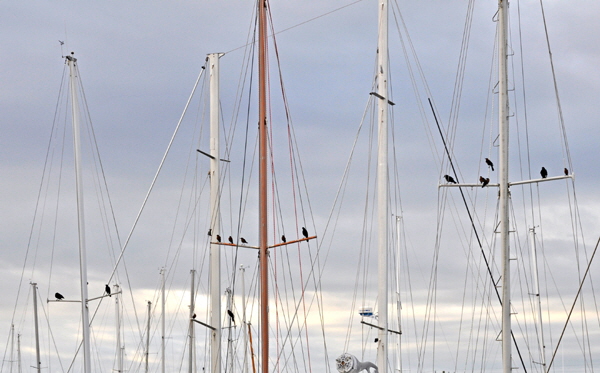
 If a sailboat lies unattended even for a short time, decks and canvas can quickly become grubby from bird droppings and windblown dust. I have counted fifty of the little darlings perched along the triatic stay on Britannia, all having a merry chirp while doing their thing all over the deck.
As a writer for boating magazines I spent a lot of time reviewing intricate and expensive products that are supposed to frighten birds off boats, including acoustic devices, but it's practically impossible to keep birds off every part of a sailboat's rigging when they will sometimes cling to vertical stays. I finally decided that the most effective and also the cheapest method for keeping bird droppings of a sailboat is an awning. I especially wanted to protect the center cockpit Bimini to shield it from the fierce Florida sun, as much as rain and bird droppings, There is also a secondary benefit from a good awning, it keeps the temperature down inside the boat and in Britannia’s case by some 10F degrees when it’s 90F outside.
I shopped around all the local canvas and sail makers and received lots of advice about what material was best, along with a variety of prices. These varied from, “We’ll beat any price,” to “I’m going to need a second mortgage for this one!” The average was $1480, a lot more than my budget would allow so I started to consider how I might make an awning myself.
 The simplest and cheapest way to is to buy a tarpaulin sheet and drape it over a boom, then attach it to lifelines with bungee cords to form a simple tent. The main boom on Britannia passes directly over the cockpit, so making a tent was definitely the easiest. Most tarps’ also have eyelets every 18-inches or so all
  around, so threading bungee cord through them and hooking the other end to the rails was simplicity itself. However, after I erected my tent/awning I discovered it had a few shortcomings: Firstly; by tethering the canvas to the rails it became quite a scramble to edge along the side decks and into the cockpit especially with an armful of groceries. Secondly; the tarp’ resting on the boom also touched the top of the Bimini, causing chafe to both materials in strong winds. A third problem was that my tent looked, well - really cheap, mainly because it was really cheap! After all, what can you expect for under fifty bucks?
Awnings can also be seen stretched between horizontal poles attached to masts or rigging, that generally overcomes the access problem. But they flap about alarmingly in even a slight breeze and rainwater can collect in a flat awning to the point where they can sag and capsize. They also don't offer much by way of temperature reduction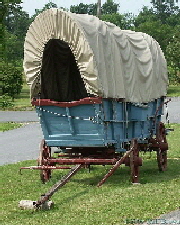 .
.
I wondered how to overcome these shortcomings and make an awning that was both effective and looked more professional. An idea came to mind from seeing the covered wagons in an old Wild-West film and I wondered how to make a curved cover like those wagons. Such an arrangement would also hold the tarp clear of the boom and Bimini, reducing chafe and allowing wind to pass between them. The height would also offer more headroom along the side decks.
 The supports on covered wagons were called "bows," made of hickory wood. But the problem on a boat is, how to be able to stow them when not in use? I found the answer by looking at modern tents that use flexible aluminum rods to support their curved roofs. These tents use demountable rods that slot into each other to form a very strong yet flexible continuous rod held together with bungee cord inside the rods through their whole length. When not in use they fold into a bundle only 28-inches long
  for easy stowage. Britannia’s main boom is 15-feet long so I guessed I would need three bows to support a tarp. I measured the approximate widths I would need by curving a metal tape measure from the toe-rail to just above the boom then doubling it. I then ordered the rods from Tent Pole Technologies, (Tentpoletachnologies.com.) who made different lengths to my exact size. I anchored my new bows on either side of the boat using 3/4-inch plastic PVC tubing strapped to the stanchions with hose clips. The bows then just dropped into the tubing and rested on the toe rail forming three perfect arches.
Britannia's beam at the mast is 13-feet, but a tarp would need to be much wider than this to curve over the bows, so I measured the length down to a point where it offered maximum coverage against rain and bird droppings yet with enough clearance to walk through. The nearest size tarp’ I could find was a 12’ x 16-feet but they are available in many different sizes and colors so it should not be difficult to find one to fit almost any boat. I chose one that is silver on the outside to give maximum heat and sunlight reflection.. CAUTION, do not make the same mistake I made with my first attempt by buying the cheapest lightweight 5mil thickness. These are too thin and flimsy for a boat awning and a strong wind soon blew it to pieces. The 12mil thickness is best and has survived some strong winds and the bows will easily support the extra weight of the heavier material. If 12mil is not available most stores sell 10mil.
 16-feet was too long for my 15-foot boom so I needed to shorten the length by 12-inches. This was easy by simply folding one end and gluing it using contact adhesive and a 4-inch roller. The best way to achieve a strong contact glue joint is to use the double-gluing procedure. I rolled a liberal amount of glue on both sides of the fold allowing it to set overnight. The next day I applied a second coat to each side of the joint and after the normal drying time of about 15-inutes I carefully pressed the fold together working from the center to the outsides of the tarp. Working from the center ensured that there were no creases in the fold, then I placed some strips of timber over the joint and pressed it firmly together by walking on it to make a perfectly flat joint. I bought an eyelet kit and installed a row of eyelets into the fold to be able to attach it to the rear bow. Eyelet kits are available at most hardware stores and all that is needed to fit them is a heavy hammer. But a word of advice - hold the hole-punchng die with vice grips not your fingers because if you miss with the hammer you will regret it for a long time
Back at the boat I installed the bows and tied a 1/ 4-inch line along the center from the mast, around the first bow with a clove hitch then round the center bow and to the end bow and then the rear of the boom. This rope acts as a backbone for the tarp’ and keeps it clear of hte boom, stops it drooping in the center and it also stops the center bow moving about in the wind - because it is not attached to the canvas like the front and rear bows. I then draped the tarp over them all and secured the front and rear to the bows using a few cable ties through the eyelets and around the bows. Next, I wove a rope in-and-out of each eyelet and round the front and rear bow, pulling it tight then tied it down to the nearest fastener on the toe rails. This prevents the tarp from lifting in high winds. Then I ran a line in and out of the side eyelets and fastened the center to the middle bow with a clove hitch. A bungee cord is then attached to the hitch to stop the center of the tarp from lifting.
Suddenly I had my covered wagon.
This inexpensive awning protects Britannia's Bimini from the weather as effectively as any expensive custom-made canvas cover, and the increased height of the bows allows us to comfortably move along the side decks. Temperatures in the cockpit are also significantly lower than without the awning and rain just runs off washing bird droppings with it.
The problem is that any awning on boats - even those made of expensive UV-resistant material - don't tend to last more than a few seasons when exposed to the elements and fierce Florida sunshine day in and day out. Replacing a tarp awning is therefore a lot less expensive than a custom canvas, and mine was ridiculously cheaper than the estimates I received. My awning cost $250, including the tarp, bows, rollers and a pot of glue.
I now think my effort qualifies as quite professional-looking. Even if I do have to ignore the occasional snide remark, "It looks like a replica of a Wild West wagon." because envy is just another form of flattery. Anyway, covered wagons were called “prairie schooners,” so the one on my schooner is spot-on.